. 2014 Jun 3;55(9):5653-60.
doi: 10.1167/iovs.14-14383.

Sirt1, a negative regulator of matrix metalloproteinase-9 in diabetic retinopathy

Affiliations

Sirt1, a negative regulator of matrix metalloproteinase-9 in diabetic retinopathy

Renu A Kowluru et al. Invest Ophthalmol Vis Sci. .

Abstract

Purpose: In the pathogenesis of diabetic retinopathy, matrix metalloproteinase (MMP)-9 damages retinal mitochondria, activating the apoptotic machinery. Transcription of MMP-9 is regulated by nuclear factor kappa B (NF-κB), and the activation of NF-κB is modulated by the acetylation of its p65 subunit. Sirtuin 1 (Sirt1), a deacetylase, plays an important role in the acetylation-deacetylation of p65. The goal of this study is to investigate the role of Sirt1 in the activation of MMP-9 in diabetic retinopathy.

Methods: The effect of hyperglycemia and Sirt1 activator, resveratrol, on acetylation of p65 and its binding at MMP-9 promoter-and mitochondrial damage and apoptosis-was assessed in the retinal endothelial cells. Role of oxidative stress in the regulation of Sirt1 was evaluated in the cells incubated in H2O2. The results were confirmed in the retina from diabetic mice with Sod2 or MMP-9 gene manipulated.

Results: High glucose decreased Sirt1 activity and increased p65 acetylation, and resveratrol prevented increase in p65 acetylation, binding of p65 at MMP-9 promoter and MMP-9 activation, mitochondria damage, and cell apoptosis. While Sirt1 was decreased by H2O2, MMP-9 was significantly increased. Retina from wild-type diabetic mice presented similar decrease in Sirt1, and diabetic mice with Sod2 overexpression or MMP-9 deletion had normal retinal Sirt1. Retinal microvasculature from human donors with established diabetic retinopathy also had decreased Sirt1.

Conclusions: Thus, in diabetes, increase in oxidative stress inhibits Sirt1 and p65 is hyperacetylated, increasing the binding of p65 at MMP-9 promoter. Prevention of Sirt1 inhibition, via modulating acetylation of p65, should protect activation of MMP-9 and inhibit the development of diabetic retinopathy.

Keywords: MMP-9; NF-kB; Sirt1; diabetic retinopathy; posttranslational modification.


Figures

Figure 1
Figure 1
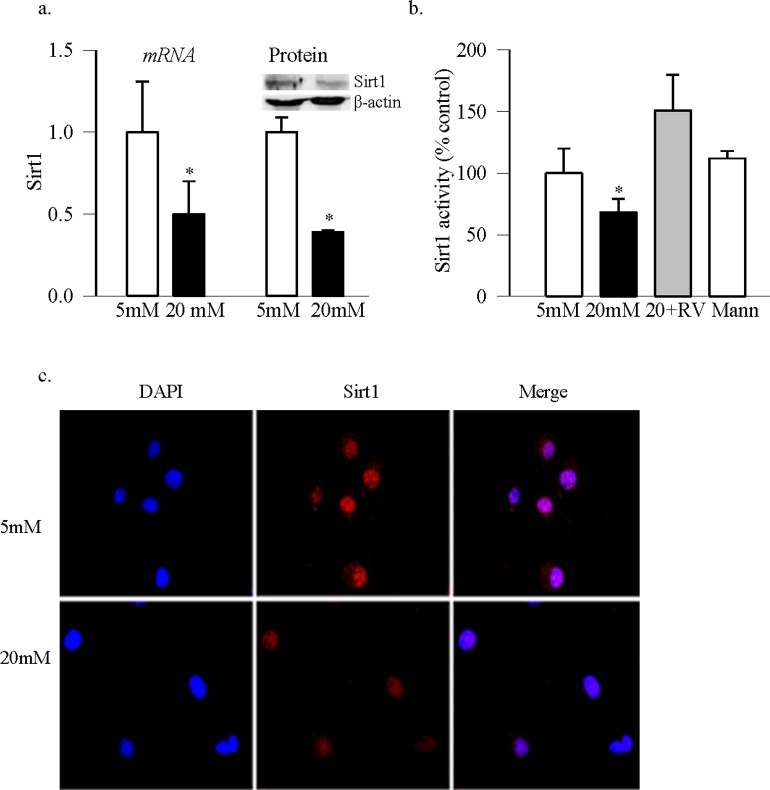
Sirtuin 1 and high glucose exposure of retinal endothelial cells. (a) In retinal endothelial cells incubated in normal (5 mM) or high (20 mM) glucose for 4 days, in the presence or absence of 25 μM resveratrol (RV), gene transcript and protein expression of Sirt1 were determined by qPCR and Western blot technique, respectively. We used β-actin as a housekeeping gene or loading protein. (b) Sirtuin 1 deacetylase activity was measured in the nuclear fraction by using a fluorescence kit from Cayman Chemical. (c) The cells grown on coverslips in normal or high glucose for 4 days were used to immunohistochemically localize Sirt1 in the nucleus. Anti-mouse secondary antibody was conjugated with Texas red, and the mounting reagent contained DAPI blue. The images are representative of three or more different experiments. Data are presented as mean ± SD from three to four preparations in each group with the values obtained from cells incubated in 5 mM glucose adjusted to 1 or 100%. *P < 0.05 compared with the values obtained from the cells incubated in 5 mM glucose. Five mM and 20 mM cells in 5 or 20 mM glucose, respectively; 20 + RV, cells incubated in 20 mM glucose in the presence of resveratrol; Mann, cells in 20 mM mannitol instead of 20 mM glucose.
Figure 2
Figure 2
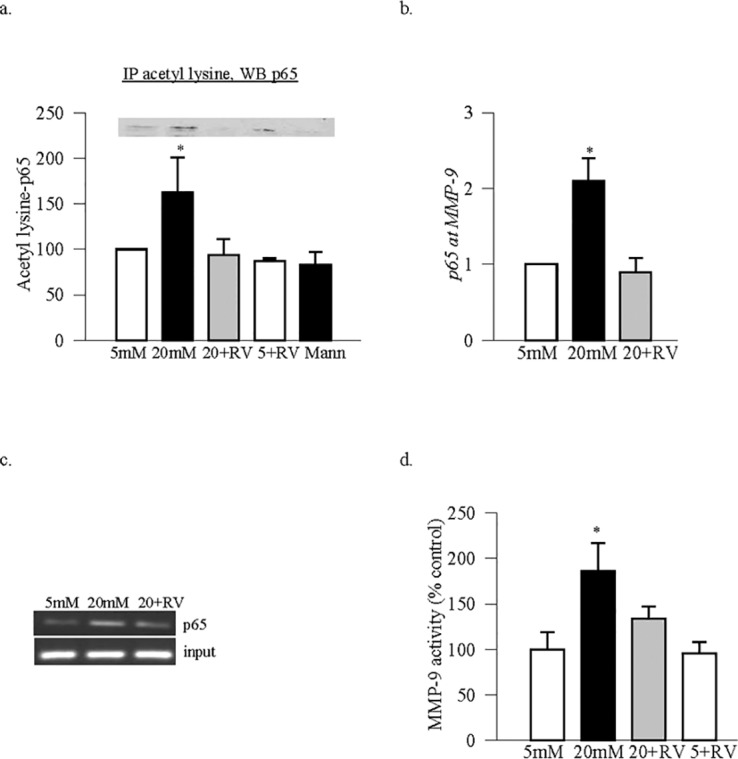
Acetylation of p65 and its binding with MMP-9 promoter: Retinal endothelial cells incubated in the presence or absence of resveratrol were analyzed for (a) acetylation of p65 by coimmunoprecipitation technique. In the acetyl lysine immunoprecipitate, p65 was Western blotted. (b) The binding of p65 at MMP-9 was determined by ChIP technique. The precipitated DNA was amplified for MMP-9 promoter region (−546 to −719) by SYBR green-based qPCR, and (c) the product size was confirmed on a 1.2% agarose gel. (d) Activity of MMP-9 was determined in 30 to 40 μg protein of cell homogenate using a fluorometric assay. *P < 0.05 compared with the values obtained from normal rats. Five + RV and 20 + RV = cells incubated in 5 or 20 mM glucose, respectively in the presence of resveratrol.
Figure 3
Figure 3
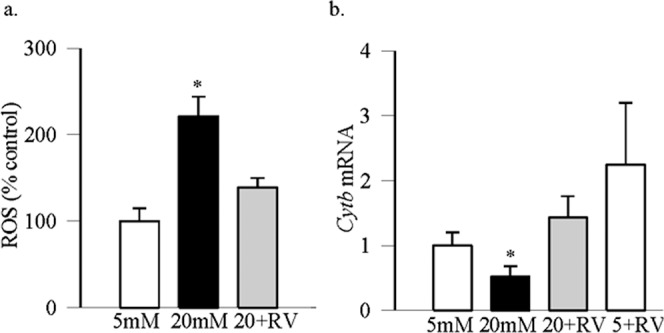
Effect of resveratrol on oxidative stress: (a) Total ROS levels were quantified using 2′,7′-dichlorofluorescein diacetate, and fluorescence was measured at 485-nm excitation wavelength and 530-nm emission wavelength. (b) The transcripts of mtDNA-encoded Cytb were quantified by real time qPCR using β-actin as a housekeeping gene. Values are represented as mean ± SD obtained from three to four cells preparations, and each measurement is made at least in duplicate. *P < 0.05 compared with 5 mM glucose.
Figure 4
Figure 4
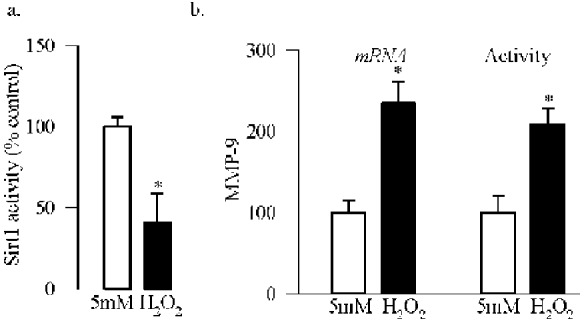
Oxidative stress and inhibition of Sirt1. Cells incubated with 250 μM H2O2 for 1 hour, followed by incubation in normal glucose for 4 additional days were analyzed for (a) deacetylase activity of Sirt1, and (b) MMP-9 mRNA by qPCR and enzyme activity using a fluorogenic substrate, 5-FAM/QXL520 FRET peptide. Each experiment was repeated with three to five different cell preparations. 5 mM, 5 mM glucose; H2O2, cells incubated with H2O2. *P < 0.05 compared with 5 mM glucose.
Figure 5
Figure 5
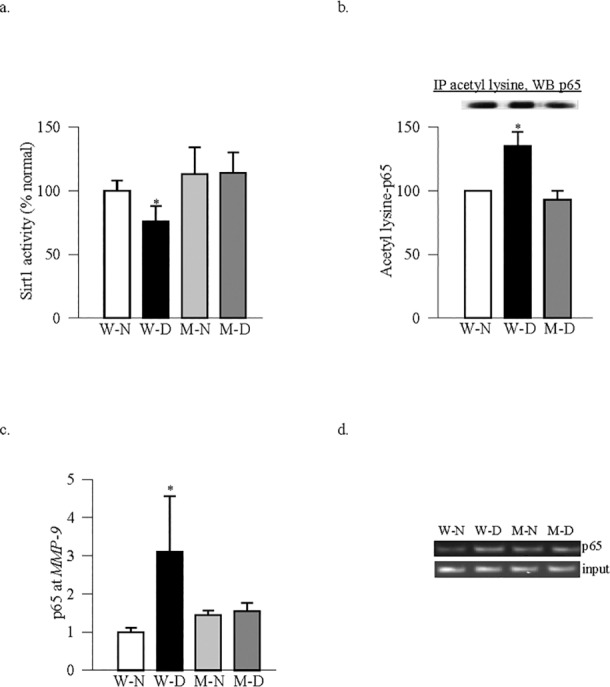
Genetic regulation of MMP-9 and Sirt1. Retina from MMP-9–KO and WT mice, diabetic for 7 months, and their age-matched normal control mice were analyzed for (a) deacetylase activity of Sirt1, (b) acetylation of p65 by coimmunoprecipitation, and (c) p65 binding at MMP-9 promoter by ChIP technique. (d) The product size was confirmed on an agarose gel. Measurements were made in five to seven animals in each group, and the results are represented as mean ± SD. W-N and M-N, wild-type and MMP-KO normal mice; W-D and M-D, wild-type and MMP-KO diabetic mice. *P < 0.05 compared with W-N or M-N.
Figure 6
Figure 6
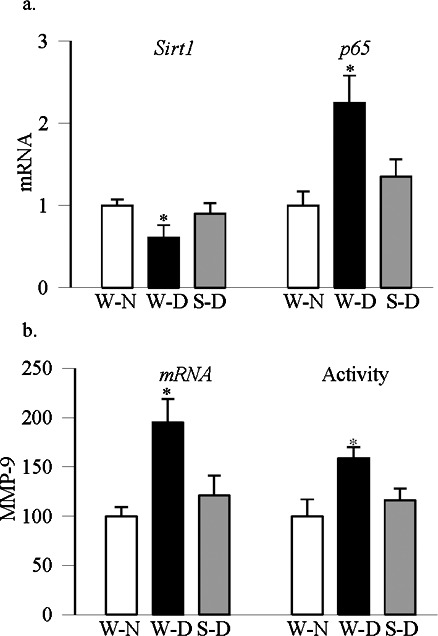
Diabetic mice overexpressing Sod2 are protected from decrease in retinal Sirt1 and increase in MMP-9. Gene transcripts of (a) Sirt1 and p65 were quantified in the retina by SYBR green-based qPCR using a sequence detection system (Applied Biosystems). The data were normalized to β-actin expression. (b) MMP-9 mRNA was quantified by qPCR, and its activity using an assay kit (AnaSpec, Inc.). Results are from six to eight mice in each group and are represented as mean ± SD. W-N, wild-type normal mice; W-D and S-D, wild-type and Sod2-Tg diabetic mice. *P < 0.05 compared with W-N.
Figure 7
Figure 7
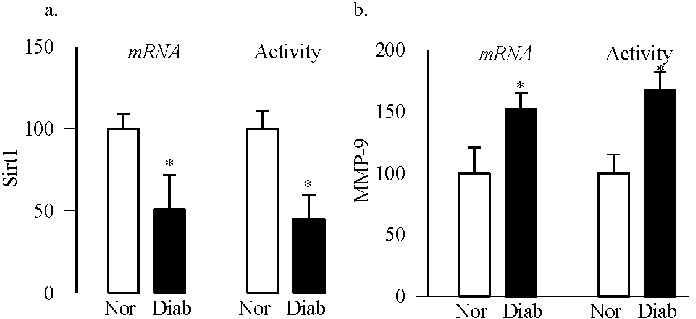
Sirtuin 1 in the retinal microvasculature from human donors with diabetic retinopathy: Microvessels from retina of diabetic subjects with documented retinopathy (Diab) and age-matched nondiabetic subjects (Norm) were analyzed for (a) Sirt1 gene expression and deacetylase activity, and (b) MMP-9 gene expression and its activity (using a specific anti-MMP-9 monoclonal antibody and MMP fluorogenic substrate). Each measurement was performed in duplicate in the retinal microvessels from four to five nondiabetic and diabetic donors. *P < 0.05 compared with nondiabetic donors.

Comment in

References

    1. Engerman RL, Kern TS. Hyperglycemia as a cause of diabetic retinopathy. Metabolism. 1986; 35: 20–23 - PubMed
    1. Diabetes Control and Complications Trial Research Group. The effect of intensive treatment of diabetes on the development of long-term complications in insulin-dependent diabetes mellitus. N Engl J Med. 1993; 329: 977–986 - PubMed
    1. Frank RN. Diabetic retinopathy. N Engl J Med. 2004; 350: 48–58 - PubMed
    1. Kowluru RA, Zhong Q, Santos JM. Matrix metalloproteinases in diabetic retinopathy: Potential role of MMP-9. Expert Opin Investig Drugs. 2012; 21: 797–805 - PMC - PubMed
    1. Petrovic D. Candidate genes for proliferative diabetic retinopathy. Biomed Res Int. 2013; 2013: 540416 - PMC - PubMed

Publication types

MeSH terms