


Risperidone and the 5-HT2A receptor antagonist M100907 improve probabilistic reversal learning in BTBR T + tf/J mice
- PMID: 24894823
- PMCID: PMC4230321
- DOI: 10.1002/aur.1395
Risperidone and the 5-HT2A receptor antagonist M100907 improve probabilistic reversal learning in BTBR T + tf/J mice
Abstract
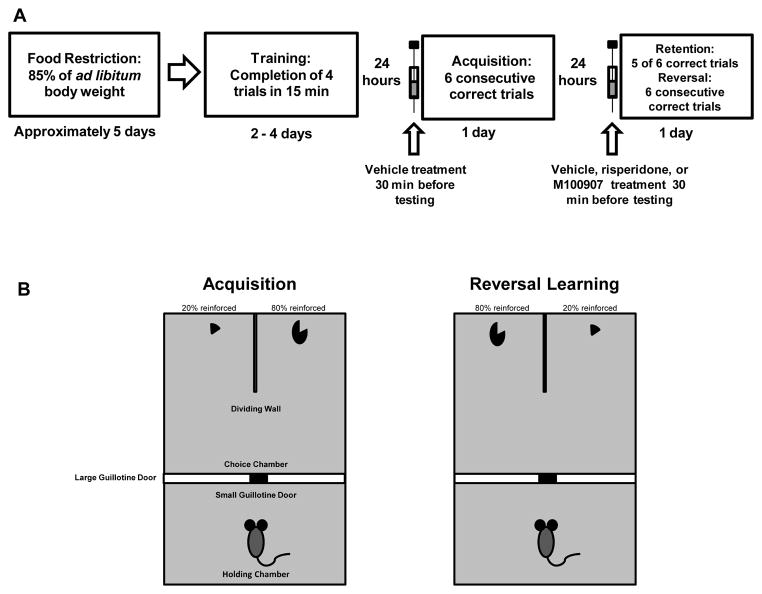
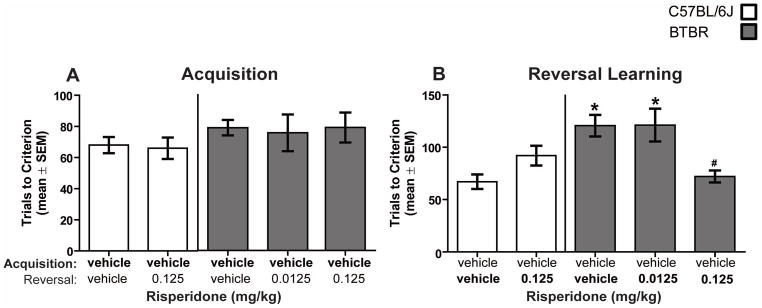
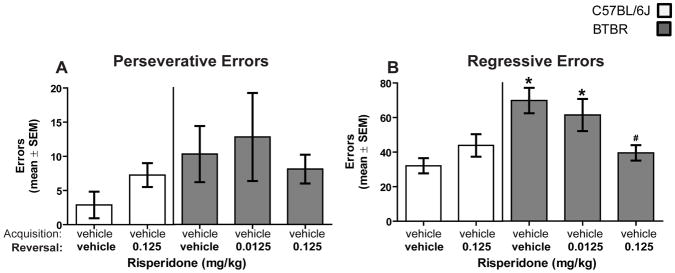
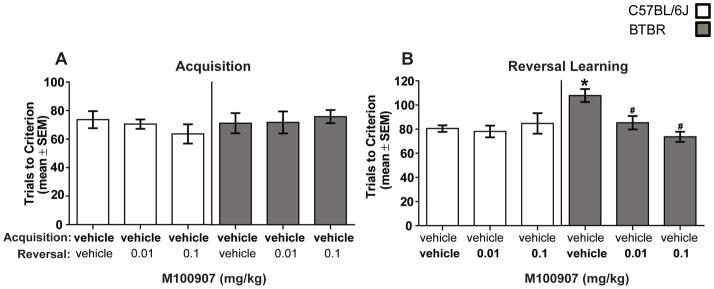
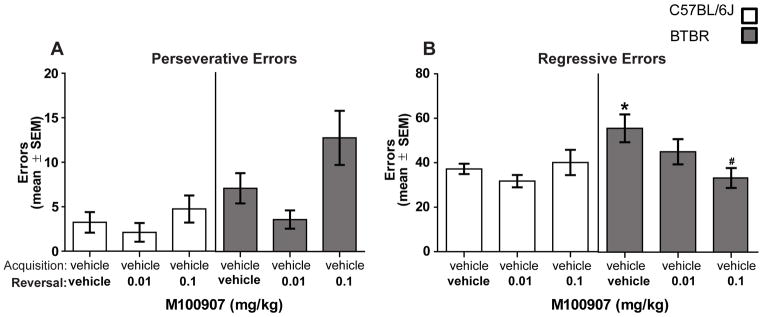
Autism spectrum disorder (ASD) is a neurodevelopmental disorder characterized by impaired social interactions with restricted interests and repetitive behaviors (RRBs). RRBs can severely limit daily living and be particularly stressful to family members. To date, there are limited options for treating this feature in ASD. Risperidone, an atypical antipsychotic, is approved to treat irritability in ASD, but less is known about whether it is effective in treating "higher order" RRBs, for example cognitive inflexibility. Risperidone also has multiple receptor targets in which only a subset may be procognitive and others induce cognitive impairment. 5HT2A receptor blockade represents one promising and more targeted approach, as various preclinical studies have shown that 5HT2A receptor antagonists improve cognition. The present study investigated whether risperidone and/or M100907, a 5HT2A receptor antagonist, improved probabilistic reversal learning performance in the BTBR T + tf/J (BTBR) mouse model of autism. The effects of these treatments were also investigated in C57BL/6J (B6) mice as a comparison strain. Using a spatial reversal learning test with 80/20 probabilistic feedback, similar to one in which ASD individuals exhibit impairments, both risperidone (0.125 mg) and M100907 (0.01 and 0.1 mg) improved reversal learning in BTBR mice. Risperidone (0.125 mg) impaired reversal learning in B6 mice. Improvement in probabilistic reversal learning performance resulted from treatments enhancing the maintenance of the newly correct choice pattern. Because risperidone can lead to unwanted side effects, treatment with a specific 5HT2A receptor antagonist may improve cognitive flexibility in individuals with ASD while also minimizing unwanted side effects.
Keywords: BTBR; autism; cognitive flexibility; reversal learning; risperidone; serotonin.
© 2014 International Society for Autism Research, Wiley Periodicals, Inc.
Figures
References
-
- Aguilar MA, Rodriguez-Arias M, Marí-Sanmillán MI, Miñarro J. Effects of risperidone on conditioned avoidance responding in male mice. Behavioural Pharmacology. 1997;8(8):669–676. - PubMed
-
- Aman MG, De Smedt G, Derivan A, Lyons B, Findling RL. Double-blind, placebo-controlled study of risperidone for the treatment of disruptive behaviors in children with subaverage intelligence. American Journal of Psychiatry. 2002;159(8):1337–1346. - PubMed
-
- Bishop SL, Richler J, Cain AC, Lord C. Predictors of perceived negative impact in mothers of children with autism spectrum disorder. American Journal on Mental Retardation. 2007;112(6):450–461. - PubMed
Publication types
MeSH terms
Substances
Grants and funding
LinkOut - more resources
Full Text Sources
Other Literature Sources
Miscellaneous
