. 2014 Jun 3;5(3):e01193-14.
doi: 10.1128/mBio.01193-14.

Detecting nitrous oxide reductase (NosZ) genes in soil metagenomes: method development and implications for the nitrogen cycle

Affiliations

Detecting nitrous oxide reductase (NosZ) genes in soil metagenomes: method development and implications for the nitrogen cycle

L H Orellana et al. mBio. .

Abstract

Microbial activities in soils, such as (incomplete) denitrification, represent major sources of nitrous oxide (N2O), a potent greenhouse gas. The key enzyme for mitigating N2O emissions is NosZ, which catalyzes N2O reduction to N2. We recently described "atypical" functional NosZ proteins encoded by both denitrifiers and nondenitrifiers, which were missed in previous environmental surveys (R. A. Sanford et al., Proc. Natl. Acad. Sci. U. S. A. 109:19709-19714, 2012, doi:10.1073/pnas.1211238109). Here, we analyzed the abundance and diversity of both nosZ types in whole-genome shotgun metagenomes from sandy and silty loam agricultural soils that typify the U.S. Midwest corn belt. First, different search algorithms and parameters for detecting nosZ metagenomic reads were evaluated based on in silico-generated (mock) metagenomes. Using the derived cutoffs, 71 distinct alleles (95% amino acid identity level) encoding typical or atypical NosZ proteins were detected in both soil types. Remarkably, more than 70% of the total nosZ reads in both soils were classified as atypical, emphasizing that prior surveys underestimated nosZ abundance. Approximately 15% of the total nosZ reads were taxonomically related to Anaeromyxobacter, which was the most abundant genus encoding atypical NosZ-type proteins in both soil types. Further analyses revealed that atypical nosZ genes outnumbered typical nosZ genes in most publicly available soil metagenomes, underscoring their potential role in mediating N2O consumption in soils. Therefore, this study provides a bioinformatics strategy to reliably detect target genes in complex short-read metagenomes and suggests that the analysis of both typical and atypical nosZ sequences is required to understand and predict N2O flux in soils.

Importance: Nitrous oxide (N2O) is a potent greenhouse gas with ozone layer destruction potential. Microbial activities control both the production and the consumption of N2O, i.e., its conversion to innocuous dinitrogen gas (N2). Until recently, consumption of N2O was attributed to bacteria encoding "typical" nitrous oxide reductase (NosZ). However, recent phylogenetic and physiological studies have shown that previously uncharacterized, functional, "atypical" NosZ proteins are encoded in genomes of diverse bacterial groups. The present study revealed that atypical nosZ genes outnumbered their typical counterparts, highlighting their potential role in N2O consumption in soils and possibly other environments. These findings advance our understanding of the diversity of microbes and functional genes involved in the nitrogen cycle and provide the means (e.g., gene sequences) to study N2O fluxes to the atmosphere and associated climate change.


Figures

FIG 1
FIG 1
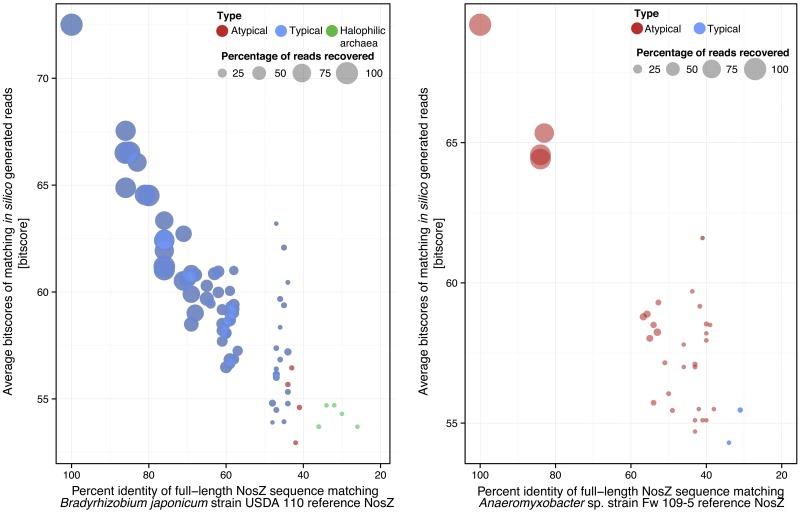
Fraction of nosZ reads recovered from an in silico data set as a function of their relatedness to the reference query sequence. nosZ reads were retrieved from in silico-generated library II using Bradyrhizobium japonicum strain USDA 110 to represent typical NosZ (left) or Anaeromyxobacter sp. strain Fw 109-5 to represent atypical NosZ (right) reference sequences in a BLASTx search. The average bit score value (y axis) for the fraction of nosZ reads recovered (circle size) was plotted against the percentage of identity between each reference sequence and the full-length NosZ sequences from which the retrieved (matching) reads originated (target sequence). The linear relationships observed between the fraction of reads detected and the percentage of identity between the full-length target and references sequences were calculated as follows: y = 0.464x + 40.73 (R2 = 0.90) for typical sequences and y = 0.527x + 42.19 (R2 = 0.89) for atypical sequences, where y is the percentage of identity between the target and full-length reference sequences and x is the fraction of reads retrieved.
FIG 2
FIG 2
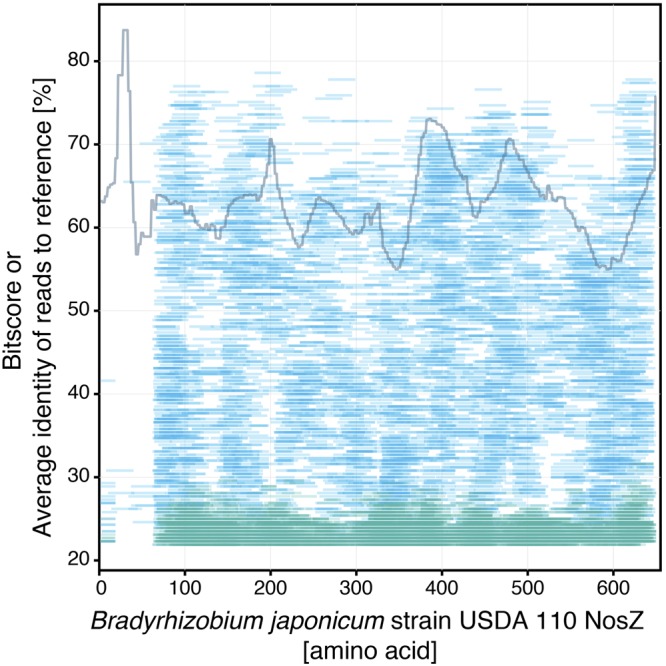
Coverage of matching nosZ reads from library II along the Bradyrhizobium japonicum NosZ reference sequence. Reads from library II matching the Bradyrhizobium japonicum strain USDA 110 NosZ reference are plotted according to their bit score values. Blue and green lines represent reads originating from nosZ genes and other genes, respectively. The solid gray line represents the average percentage of identity of nosZ reads (blue lines) matching the NosZ reference in a 3-amino-acid window.
FIG 3
FIG 3
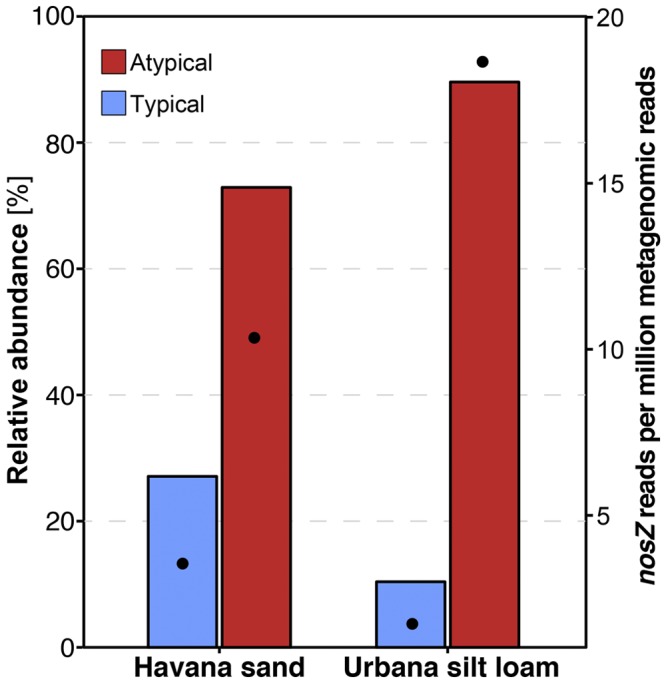
Relative abundances for typical and atypical nosZ genes in Havana sand and Urbana silt loam soil metagenomes. All metagenomic nosZ reads from soil were classified as typical or atypical according to their best match against a reference database of NosZ sequences, and the calculated relative abundances of the two gene types are shown (primary y axis, bars). The absolute abundance, i.e., number of identified nosZ reads per million of all reads in each metagenome is also shown (secondary y axis, dots).
FIG 4
FIG 4
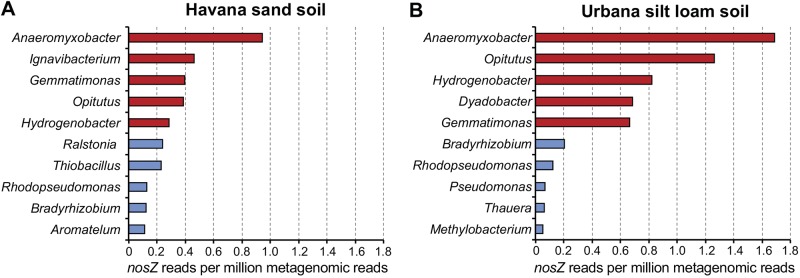
Phylogenetic affiliations for the five most abundant genera harboring typical and atypical nosZ genes in Havana sand and Urbana silt loam soil metagenomes. Metagenomic reads were assigned to a genus based on their best match against a reference database of NosZ sequences, and the normalized number of reads (based on the size of the data sets) assigned to each genus is shown for Havana sand (A) and Urbana silt loam (B) soils. Red and blue bars represent atypical and typical genes, respectively.
FIG 5
FIG 5
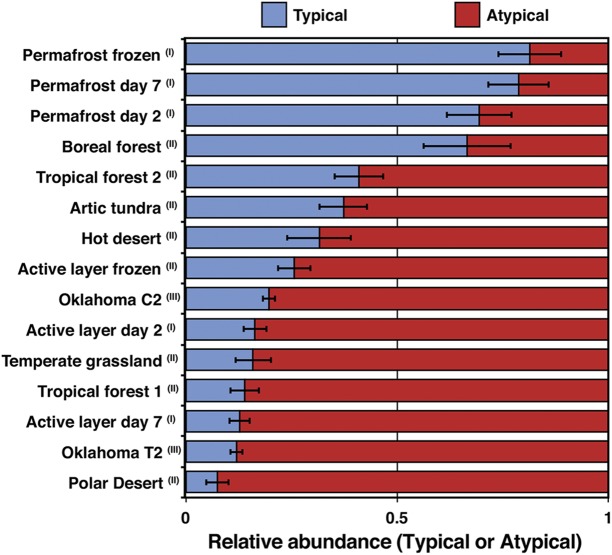
Relative abundances of typical and atypical nosZ sequences in various soil ecosystems. nosZ reads were retrieved from available Illumina short-read metagenomes by following the same approach used with the Illinois soils reported in this study. The bars represent the probability of finding typical (blue) or atypical (red) sequences as a proxy for their relative abundances, and the error bars represent the variance of the sample mean for each soil metagenome. Data sets were obtained from Mackelprang et al. (25) (library I), Fierer et al. (26) (library II), and Luo et al. (40) (library III).

References

    1. Canfield DE, Glazer AN, Falkowski PG. 2010. The evolution and future of Earth’s nitrogen cycle. Science 330:192–196. 10.1126/science.1186120 - DOI - PubMed
    1. Montzka SA, Dlugokencky EJ, Butler JH. 2011. Non-CO2 greenhouse gases and climate change. Nature 476:43–50. 10.1038/nature10322 - DOI - PubMed
    1. Forster P, Ramaswamy V, Artaxo P, Berntsen T, Betts R, Fahey DW, Haywood J, Lean J, Lowe DC, Myhre G, Nganga J, Prinn R, Raga G, Schultz M, Van Dorland R. 2007. Changes in atmospheric constituents and in radiative forcing, p 129–234 In Solomon S, Qin D, Manning M, Chen Z, Marquis M, Averyt KB, Tignor M, Miller HL. (ed), Climate change 2007: the physical science basis. Contribution of Working Group I to the Fourth Assessment Report of the Intergovernmental Panel on Climate Change. Cambridge University Press, Cambridge, United Kingdom
    1. Ravishankara AR, Daniel JS, Portmann RW. 2009. Nitrous Oxide (N2O): the dominant ozone-depleting substance emitted in the 21st century. Science 326:123–125. 10.1126/science.1176985 - DOI - PubMed
    1. Portmann RW, Daniel JS, Ravishankara AR. 2012. Stratospheric ozone depletion due to nitrous oxide: influences of other gases. Philos. Trans. R. Soc. Lond. B Biol. Sci. 367:1256–1264. 10.1098/rstb.2011.0377 - DOI - PMC - PubMed

Publication types

LinkOut - more resources