. 2014:2014:865065.
doi: 10.1155/2014/865065. Epub 2014 May 6.

Identification and Expression Profiling of the BTB Domain-Containing Protein Gene Family in the Silkworm, Bombyx mori

Affiliations

Identification and Expression Profiling of the BTB Domain-Containing Protein Gene Family in the Silkworm, Bombyx mori

Daojun Cheng et al. Int J Genomics. 2014.

Abstract

The BTB domain is a conserved protein-protein interaction motif. In this study, we identified 56 BTB domain-containing protein genes in the silkworm, in addition to 46 in the honey bee, 55 in the red flour beetle, and 53 in the monarch butterfly. Silkworm BTB protein genes were classified into nine subfamilies according to their domain architecture, and most of them could be mapped on the different chromosomes. Phylogenetic analysis suggests that silkworm BTB protein genes may have undergone a duplication event in three subfamilies: BTB-BACK-Kelch, BTB-BACK-PHR, and BTB-FLYWCH. Comparative analysis demonstrated that the orthologs of each of 13 BTB protein genes present a rigorous orthologous relationship in the silkworm and other surveyed insects, indicating conserved functions of these genes during insect evolution. Furthermore, several silkworm BTB protein genes exhibited sex-specific expression in larval tissues or at different stages during metamorphosis. These findings not only contribute to a better understanding of the evolution of insect BTB protein gene families but also provide a basis for further investigation of the functions of BTB protein genes in the silkworm.


Figures
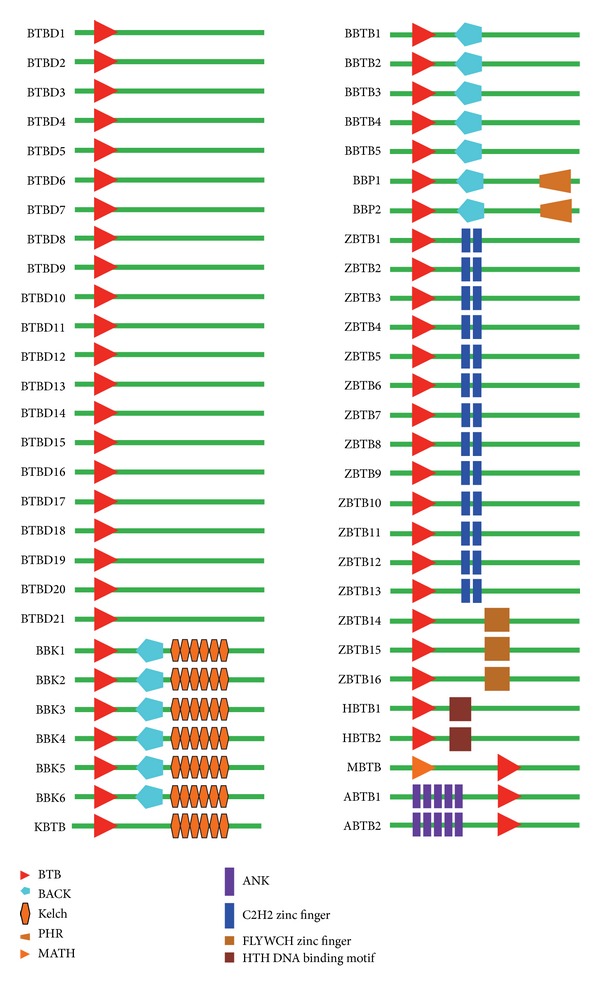
Figure 1
Figure 1
Architecture of functional domains in silkworm BTB protein genes. The conserved BTB domain and other types of functional domains are marked with different signs and colors as indicated below the schematic architecture. Domain names refer to the resource from the SMART database.
Figure 2
Figure 2
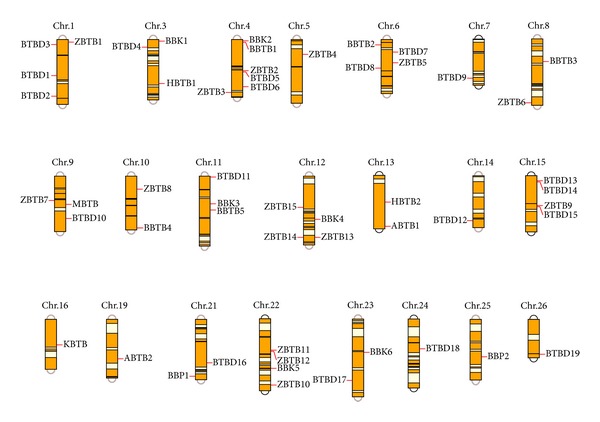
Chromosomal distribution of silkworm BTB protein genes. In total, 53 of the identified silkworm BTB protein genes (i.e., all except BTBD20, BTBD21, and ZBTB13) were localized to specific chromosomes based on the whole-genome sequence and single-nucleotide polymorphism (SNP) marker linkage map for the silkworm. The chromosome number of each gene was indicated above.
Figure 3
Figure 3
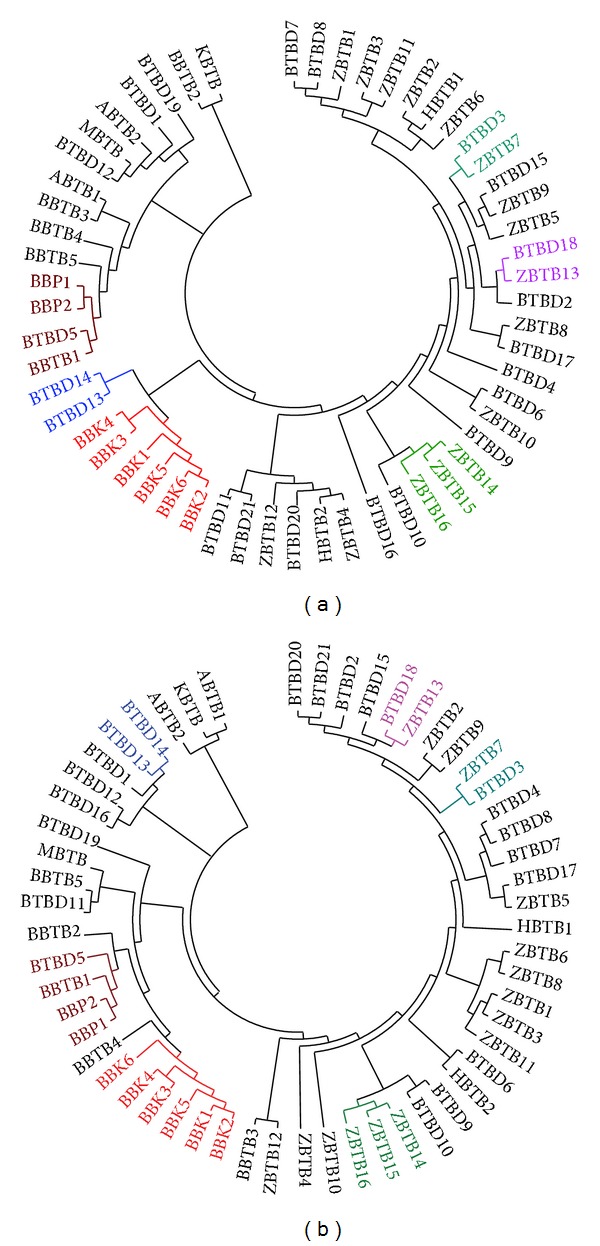
Phylogenetic tree of silkworm BTB protein genes. A neighbor-joining phylogenetic tree of the identified silkworm BTB protein genes was constructed using the ClustalX program and visualized using the MEGA4 software. (a) BTB domain sequence-based phylogenetic tree. (b) Complete amino acid sequence-based phylogenetic tree. Similar grouping clades between these two phylogenetic trees are indicated by the same colors.
Figure 4
Figure 4
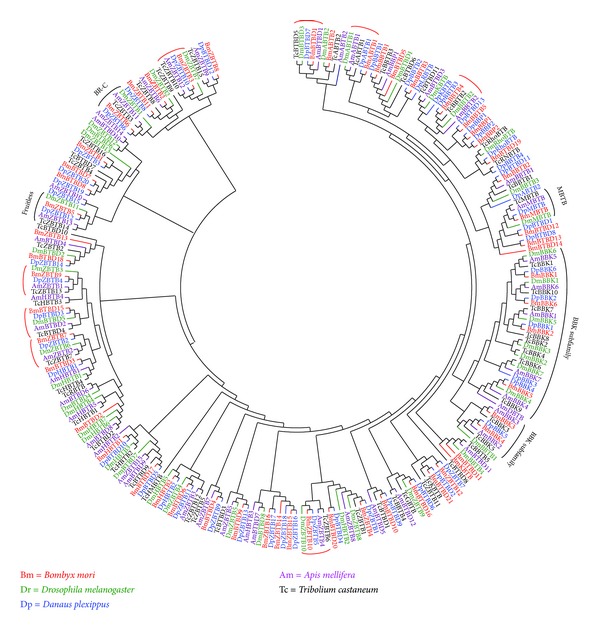
Phylogenetic relationships of the BTB protein genes of the silkworm with those of other surveyed insects. Based on the amino acid sequences of the BTB domains, a neighbor-joining phylogenetic tree of all insect BTB protein genes was constructed using the ClustalX program and visualized using the MEGA4 software. The grouping clade for the orthologs of a silkworm BTB protein gene that showed a 1 : 1 : 1 : 1 : 1 orthologous relationship among all five surveyed insect species is indicated by a red cambered line. The names of all BTB protein genes from a single insect species are indicated in the same color.
Figure 5
Figure 5
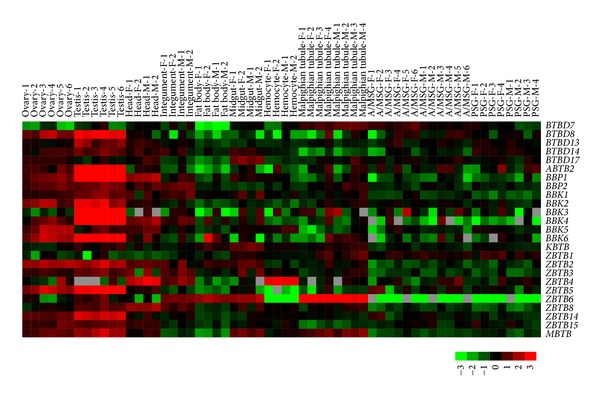
Microarray-based expression profiling of BTB protein genes in multiple tissues of silkworm larvae. Microarray data representing genome-wide gene expression in multiple tissues of silkworm larvae on day 3 of the fifth instar were downloaded from the SilkDB database. Each tissue sample was analyzed using at least two biological repeats, which are indicated with different Arabic numerals. F: female; M: male; A/MSG: anterior/median silk gland; PSG: posterior silk gland.
Figure 6
Figure 6
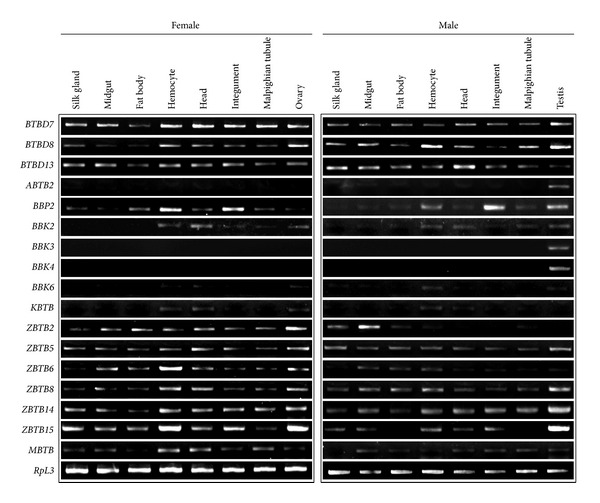
RT-PCR examination of expression profiles of the BTB protein genes in silkworm larval tissues. The expression profiles of the BTB protein genes in multiple tissues of silkworm larvae on day 3 of the fifth instar (L5D3) were further examined in RT-PCR experiments. The silkworm RpL3 gene was used as a control.
Figure 7
Figure 7
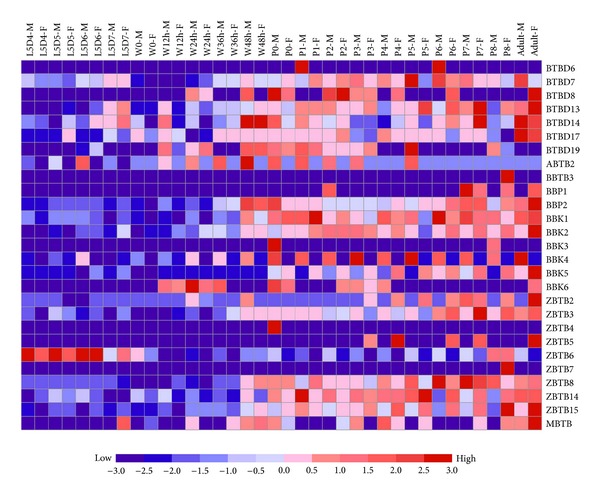
Microarray-based expression profiling of the BTB protein genes during silkworm metamorphosis. Time-course microarray data representing gene expression during silkwormmetamorphosis was used to profile the developmental expression patterns of silkworm BTB protein genes. Changes in the expression of the BTB protein genes were visualized using the GeneCluster 2.0 program. Plus and minus denote up- and downregulation, respectively. F: female; M: male; L: larval; W: wandering; P: pupal; D: day; h: hour. The Arabic numeral in phase P1 represents one day after pupation.

References

    1. Zollman S, Godt D, Privé GG, Couderc J, Laski FA. The BTB domain, found primarily in zinc finger proteins, defines an evolutionarily conserved family that includes several developmentally regulated genes in Drosophila . Proceedings of the National Academy of Sciences of the United States of America. 1994;91(22):10717–10721. - PMC - PubMed
    1. Bardwell VJ, Treisman R. The POZ domain: a conserved protein-protein interaction motif. Genes and Development. 1994;8(14):1664–1677. - PubMed
    1. Collins T, Stone JR, Williams AJ. All in the family: the BTB/POZ, KRAB, and SCAN domains. Molecular and Cellular Biology. 2001;21(11):3609–3615. - PMC - PubMed
    1. Numoto M, Niwa O, Kaplan J, et al. Transcriptional repressor ZF5 identifies a new conserved domain in zinc finger proteins. Nucleic Acids Research. 1993;21(16):3767–3775. - PMC - PubMed
    1. Perez-Torrado R, Yamada D, Defossez PA. Born to bind: the BTB protein-protein interaction domain. BioEssays. 2006;28(12):1194–1202. - PubMed

LinkOut - more resources