Review
. 2014:43:381-408.
doi: 10.1146/annurev-biophys-051013-022653.

Fidelity of cotranslational protein targeting by the signal recognition particle

Affiliations
Review

Fidelity of cotranslational protein targeting by the signal recognition particle

Xin Zhang et al. Annu Rev Biophys. 2014.

Abstract

Accurate folding, assembly, localization, and maturation of newly synthesized proteins are essential to all cells and require high fidelity in the protein biogenesis machineries that mediate these processes. Here, we review our current understanding of how high fidelity is achieved in one of these processes, the cotranslational targeting of nascent membrane and secretory proteins by the signal recognition particle (SRP). Recent biochemical, biophysical, and structural studies have elucidated how the correct substrates drive a series of elaborate conformational rearrangements in the SRP and SRP receptor GTPases; these rearrangements provide effective fidelity checkpoints to reject incorrect substrates and enhance the fidelity of this essential cellular pathway. The mechanisms used by SRP to ensure fidelity share important conceptual analogies with those used by cellular machineries involved in DNA replication, transcription, and translation, and these mechanisms likely represent general principles for other complex cellular pathways.

Keywords: GTPases; RNA; protein biogenesis; protein translocation; ribosome; signal sequence.


Figures
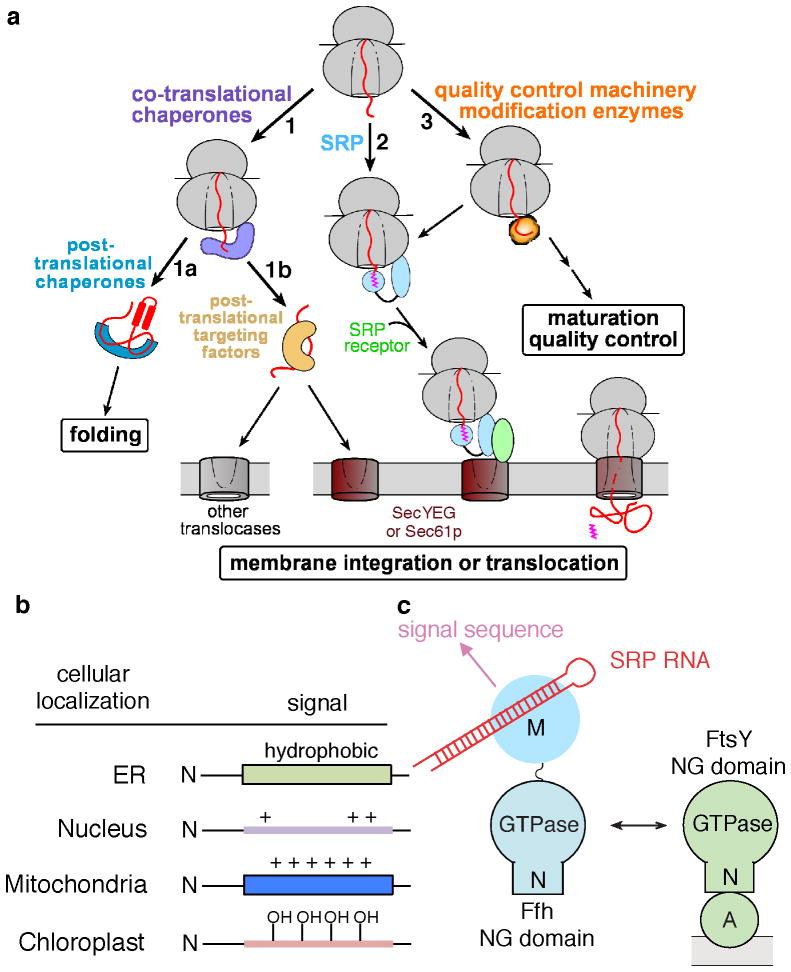
Figure 1
Figure 1
Multiplicity of fates awaiting a newly synthesized protein. (a) A variety of protein biogenesis factors can interact with a nascent protein during and immediately after its synthesis by the ribosome, including co- and post-translational chaperones, co- and post-translational protein targeting machineries, and ribosome-associated modification enzymes and quality control complexes. (b) General features of signal sequences that direct proteins to distinct subcellular organelles. (c) Domain structures of the SRP, which is composed of the SRP54 (Ffh) protein and the SRP RNA (left), and of the bacterial SRP receptor FtsY (right).
Figure 2
Figure 2
Cargo binding by the SRP is insufficient to ensure a high fidelity of co-translational protein targeting. (a) Incorporation of a fluorescent non-natural amino acid to produce site-specifically labeled RNC. (b) FRET assay to monitor the SRP-RNC interaction. Fluorescence emission spectra are shown for Cm-labeled RNC1A9L (black), BODIPY-Fl labeled SRP (blue), and their complex (red). (c) Design of signal sequence variants for investigation of the fidelity of SRP-dependent protein targeting. Bold highlights the hydrophobic core, and blue highlights the N-terminal signal sequence extension of EspP. (d) Summary of the binding affinities of SRP for RNCs bearing the different signal sequences. Adapted from Figure 1E in reference (160). The green line denotes the cellular SRP concentration of ~400 nM.
Figure 3
Figure 3
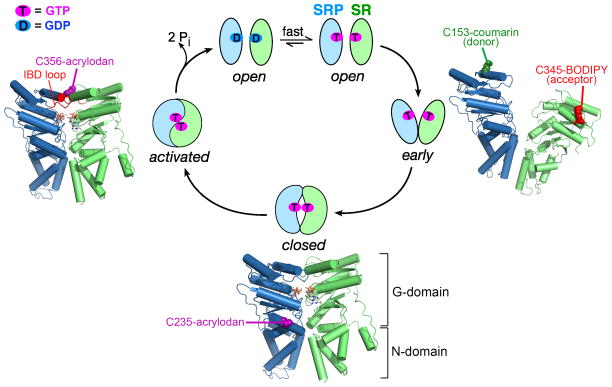
A series of conformational rearrangements in the SRP•FtsY dimer drive their GTPase cycle. The SRP and SR NG-domains are in green and blue, respectively. (Right) molecular model of the early intermediate [Protein Data Bank (PDB) 2XKV]. (Bottom and left) co-crystal structure of the Ffh-FtsY NG domain complex in the closed/activated conformation (PDB: 1RJ9). The positions of fluorescence probes that detect each conformational state are depicted in the structures.
Figure 4
Figure 4
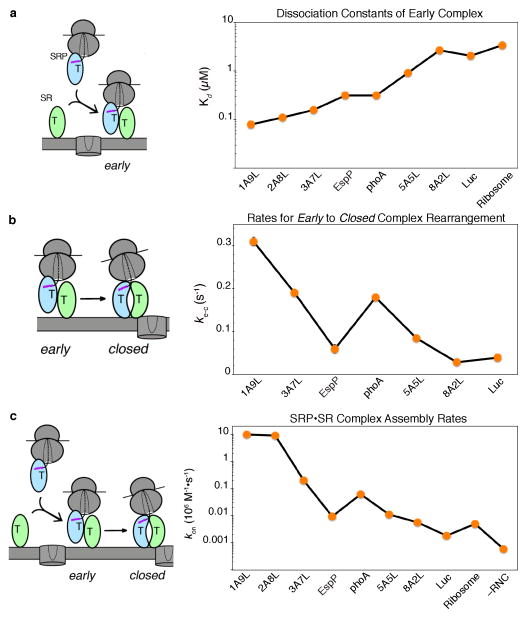
Correct cargos stabilize the early intermediate and mediate faster rearrangement to the closed complex, and thus enabling faster assembly of a stable SRP-FtsY complex. (a) Summary of the equilibrium dissociation constants (Kd) of the early intermediate formed with different cargos (adapted from Fig. 2C in ref. (160)). (b) Summary of the rate constants for the conformational rearrangement from the early to closed complex mediated by the different cargos (adapted from Fig. 2G in ref. (160)). (c) Rate constants for assembly of the stable, GTP-dependent closed complex mediated by the different cargos (adapted from Fig. 3C in ref. (160)).
Figure 5
Figure 5
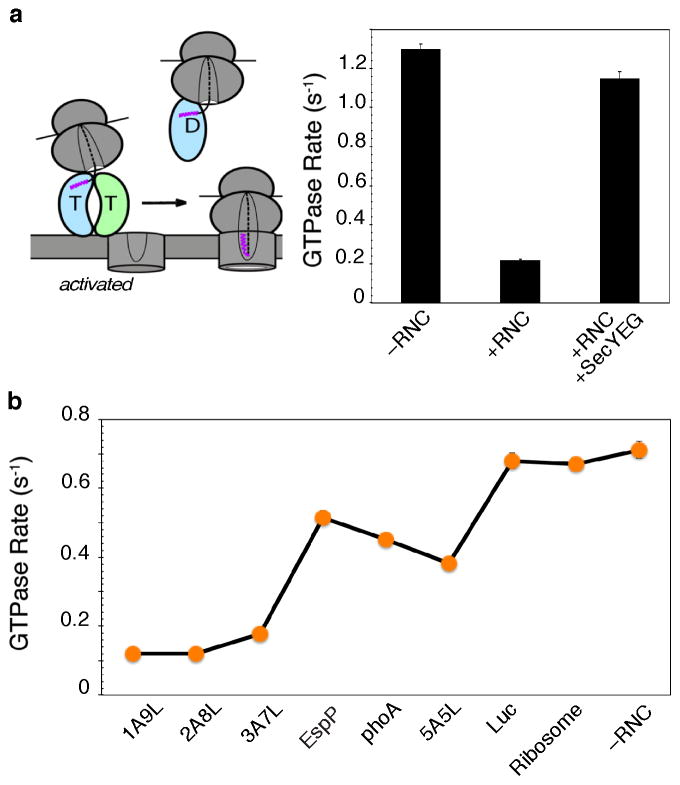
Correct cargos delay GTP hydrolysis. (a) The correct cargo delays GTP hydrolysis from the RNC-SRP-FtsY complex, which is restored by the SecYEG translocon. (b) Summary of GTPase rate constants from the RNC•SRP•FtsY complex mediated by the different cargos.
Figure 6
Figure 6
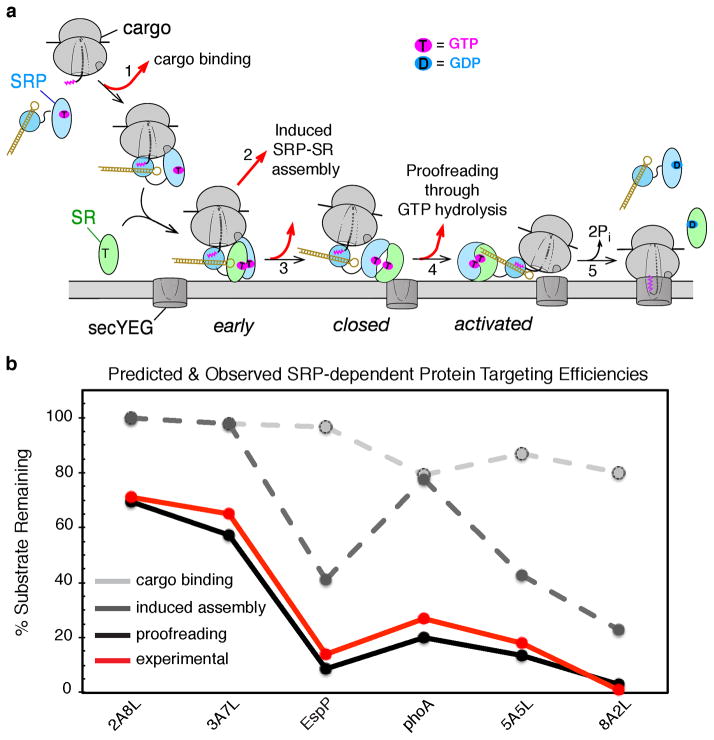
A sequential series of checkpoints reject incorrect cargos from the SRP pathway. (a) Model for how conformational rearrangements in the SRP/SR GTPases provide the driving force and ensure the fidelity of protein targeting. Step 1, a cargo with a signal sequence (magenta) enters the pathway upon binding SRP. Step 2, the cargo-bound SRP forms a stabilized early intermediate with FtsY. Step 3, association of FtsY with membrane drives the rearrangements from the early intermediate to the closed complex. Step 4, the SecYEG translocon promotes conformational rearrangements that drive GTPase activation and cargo handover. Step 5, the cargo is unloaded from the SRP onto SecYEG, and GTP hydrolysis drives the disassembly and recycling of SRP and FtsY. At each step, the cargo can be either retained in (black arrows) or rejected (red arrows) from the pathway. Color codings are the same as in Figure 3. (b) Predicted fraction of cargos retained in the SRP pathway after cargo binding (light grey), induced SRP-SR assembly (dark grey), and kinetic proofreading through GTP hydrolysis (black). The experimentally determined protein targeting efficiencies are shown in red.
Figure 7
Figure 7
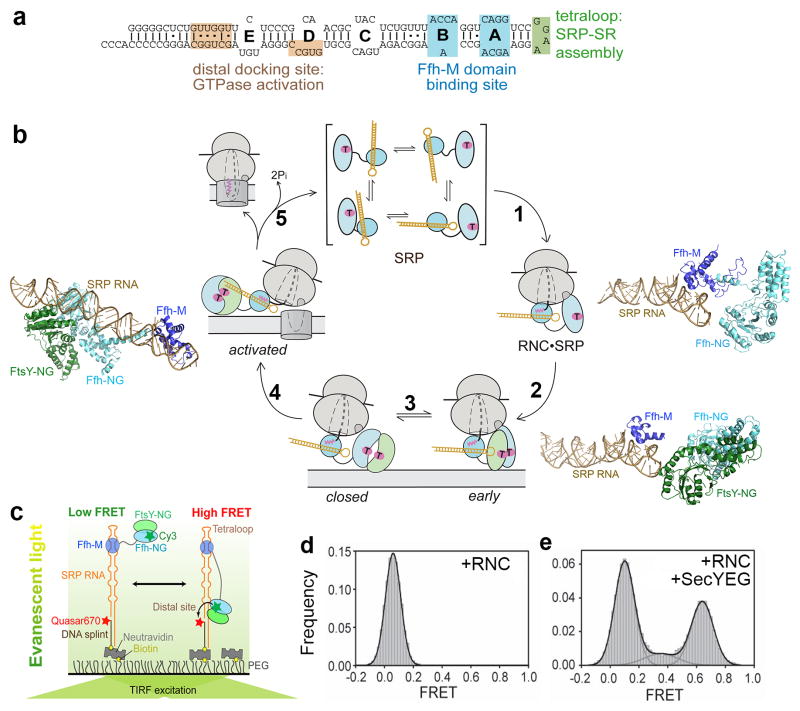
SRP RNA-mediated global rearrangement of SRP couples cargo loading and unloading events to the GTPase cycle during protein targeting. (a) Secondary structure of the Escherichia coli 4.5S SRP RNA. The binding sites for the Ffh-M domain (blue) and for FtsY during the GTPase assembly (green) and activation (tan) steps are denoted. (b) Global rearrangement of SRP mediated by the SRP RNA during the protein targeting cycle. Top, free SRP exist in a variety of ‘latent’ conformations not conducive to the recruitment of FtsY. Right, binding of RNC induces a more active conformation of SRP (step 1), in which the SRP RNA tetraloop is properly positioned to interact with the G-domain of SR and hence form a stabilized early targeting complex (step 2). Molecular models derived from cyro-EM reconstructions are shown for the RNC•SRP (right panel) and RNC•SRP•SR early complex (lower right panel); the ribosome was not shown for clarity. Bottom, the GTPases detach from the SRP RNA tetraloop upon formation of the closed complex (step 3). Left, the GTPase complex relocalizes to the distal end of the SRP RNA (step 4), a conformation (left panel; PDB 2XXA) conducive to GTPase activation and cargo unloading (Step 5). All structures are aligned with respect to the SRP RNA. Color codings are the same as in Figure 3. The steps are numbered to be consistent with Figure 6a. (c) The smFRET setup to monitor the dynamic movements of the SRP-FtsY GTPase complex on the SRP RNA. FtsY Cys345 is labeled with Cy3, and the 5′end of the DNA splint is labeled with Quasar 670. (de) RNC and SecYEG regulate GTPase movement on the SRP RNA, as shown by the smFRET histograms of the SRP-FtsY complex bound to RNCFtsQ in the absence (d) and presence (e) of the SecYEG translocon. Adapted from reference (128).

References

    1. Akopian D, Dalai K, Shen K, Duong F, Shan S. SecYEG activates GTPases to drive the completion of cotranslational protein targeting. J Biol Chem. 2013 in press. - PMC - PubMed
    1. Akopian D, Shen K, Zhang X, Shan S. Signal recognition particle: an essential protein-targeting machine. Ann Rev Biochem. 2013;82:693–721. - PMC - PubMed
    1. Alamo M, Hogan DJ, Pechmann S, Albanese V, Brown PO, Frydman J. Defining the specificity of cotranslationally acting chaperones by systematic analysis of mRNAs associated with ribosome-nascent chain complexes. Plos Biology. 2011;9:e1001100. - PMC - PubMed
    1. Albanese V, Yam AY-W, Baughman J, Parnot C, Frydman J. Systems analyses reveal two chaperone networks with distinct functions in eukaryotic cells. Cell. 2006;124:75–88. - PubMed
    1. Ataide SF, Schmitz N, Shenk K, Ke A, Shan S, Doudna A, Ban N. The crystal structure of the Signal Recognition Particle in complex with its receptor. Science. 2011;381:881–86. - PMC - PubMed

Substances

LinkOut - more resources