


Background level of risk determines how prey categorize predators and non-predators
- PMID: 24898371
- PMCID: PMC4071537
- DOI: 10.1098/rspb.2014.0355
Background level of risk determines how prey categorize predators and non-predators
Abstract
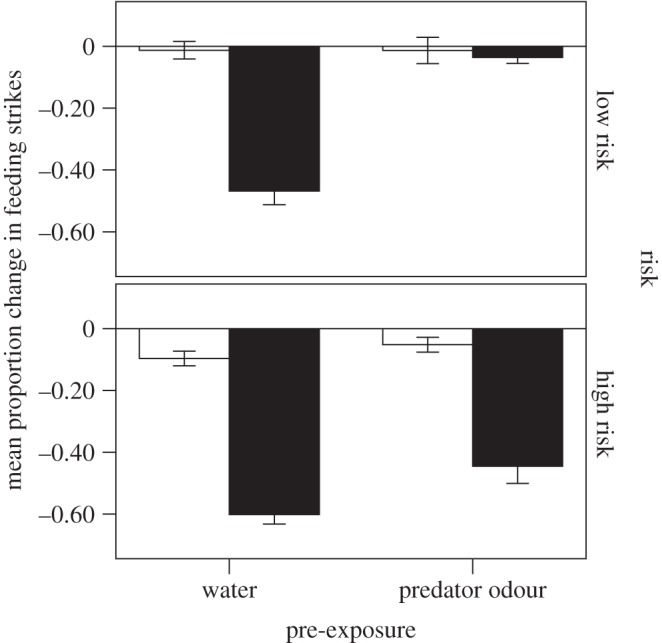
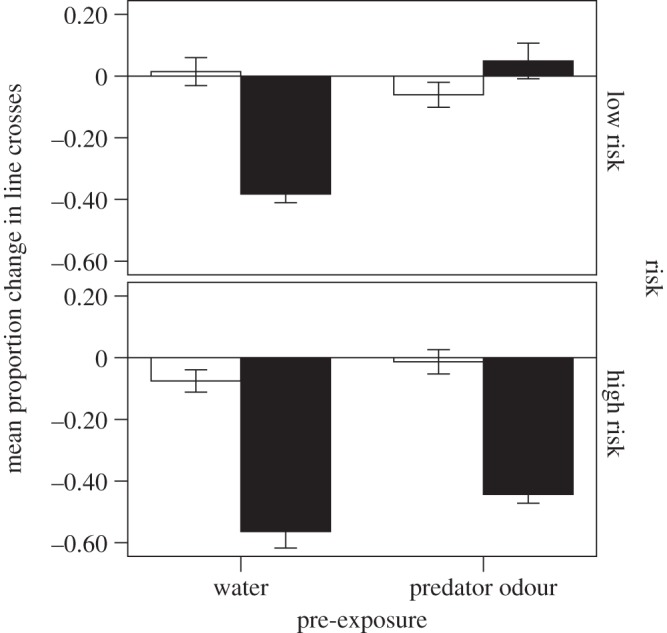
Much of the plasticity that prey exhibit in response to predators is linked to the prey's immediate background level of risk. However, we know almost nothing of how background risk influences how prey learn to categorize predators and non-predators. Learning non-predators probably represents one of the most underappreciated aspects of anti-predator decision-making. Here, we provide larval damselfish (Pomacentrus chrysurus) with a high or low background risk and then try to teach them to recognize a cue as non-threatening through the process of latent inhibition. Prey from the low-risk background that were pre-exposed to the novel odour cues in the absence of negative reinforcement for 3 days, and then provided the opportunity to learn to recognize the odour as threatening, failed to subsequently respond to the odour as a threat. Fish from the high-risk background showed a much different response. These fish did not learn the odour as non-threatening, probably because the cost of falsely learning an odour as non-threatening is higher when the background level of risk is higher. Our work highlights that background level of risk appears to drive plasticity in cognition of prey animals learning to discriminate threats in their environment.
Keywords: coral reefs; damselfish; learning; non-predator recognition; predator recognition; risk assessment.
© 2014 The Author(s) Published by the Royal Society. All rights reserved.
Figures
References
-
- Blumstein DT. 2010. Flush early and avoid the rush: a general rule of antipredator behavior? Behav. Ecol. 21, 440–442. (10.1093/beheco/arq030) - DOI
-
- Lima SL. 1998. Stress and decision making under the risk of predation: recent developments from behavioral, reproductive, and ecological perspectives. Adv. Study behav. 27, 215–290.
Publication types
MeSH terms
LinkOut - more resources
Full Text Sources
Other Literature Sources
