


doi: 10.1186/1297-9716-45-62.
Induction of protective immune response against both PPRV and FMDV by a novel recombinant PPRV expressing FMDV VP1
Affiliations
- PMID: 24898430
- PMCID: PMC4059095
- DOI: 10.1186/1297-9716-45-62
Item in Clipboard
Induction of protective immune response against both PPRV and FMDV by a novel recombinant PPRV expressing FMDV VP1
Vet Res.
.
Abstract
Peste des petits ruminants (PPR) and foot-and-mouth disease (FMD) are both highly contagious diseases of small domestic and wild ruminants caused by the PPR virus (PPRV) and the FMD virus (FMDV). In this study, a recombinant PPRV expressing the FMDV VP1 gene (rPPRV/VP1) was generated and FMDV VP1 expression did not impair replication of the recombinant virus in vitro and immunogenicity in inducing neutralizing antibody against PPR in goats. Vaccination with one dose of rPPRV/VP1 induced FMDV neutralizing antibody in goats and protected them from challenge with virulent FMDV. Our results suggest that the recombinant PPRV expressing the FMDV VP1 protein is a potential dual live vectored vaccine against PPRV and FMDV.
Figures
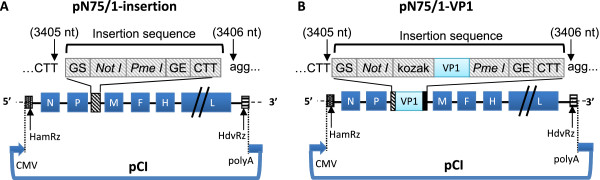
Plasmid construction for recombinant PPRV rescue. (A) pN75/1-insertion was constructed previously [22] through insertion of a morbillivirus gene start (GS) sequence, Not I and Pme I sites, gene end (GE) sequence, and CTT intergenic trinucleotides between the P and M genes of genomic PPRV cDNA. (B) The VP1 ORF with a Kozak sequence at the 5' end of the ORF was inserted into plasmid pN75/1-insertion to generate plasmid pN75/1-VP1.
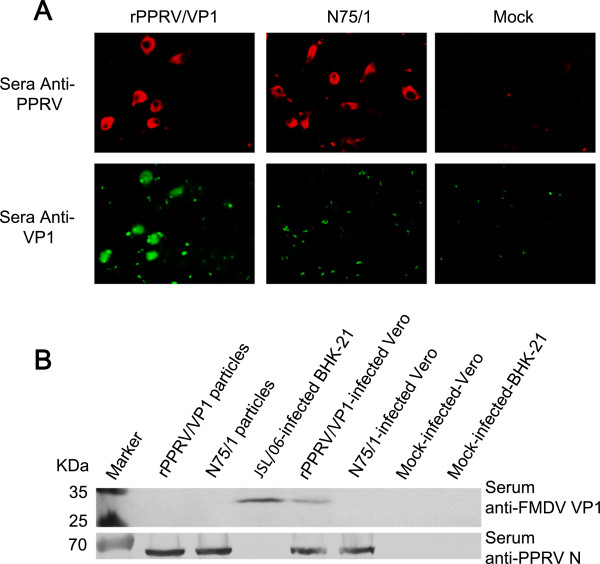
VP1 protein replication and expression of rPPRV/VP1 in Vero cells. (A) Cells infected with rPPRV/VP1, N75/1, or mock-infected were fixed and labeled with anti-N75/1 mouse serum for the presence of PPRV protein (red) or anti-FMDV VP1 (Asia-I type) rabbit serum for the presence of the VP1 protein (green). (B) The N75/1 and rPPRV/VP1 particles were respectively purified by sucrose gradient centrifugation with 60%, 40% and 20% density (140 000 g). Lysates of N75/1- or rPPRV/VP1-infected Vero cells, lysates of FMDV JSL/06-infected Vero cells, N75/1 particles and rPPRV/VP1 particles were respectively probed by SDS-PAGE and western blotting using anti-FMDV VP1 (Asia-I type) rabbit serum and anti-PPRV-N rabbit serum respectively. Mock-infected Vero and BHK-21 cells were used as controls.
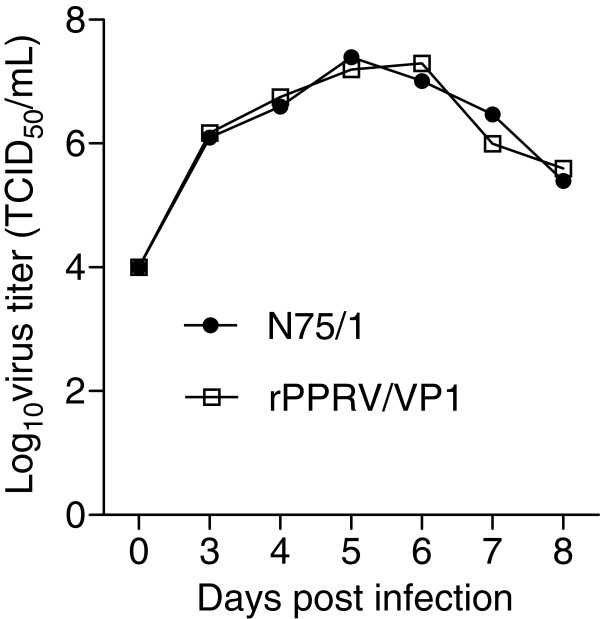
Growth of rescued viruses in Vero cells. The viral titers in rPPRV/VP1- or N75/1-infected Vero cells were measured at different days post infection.
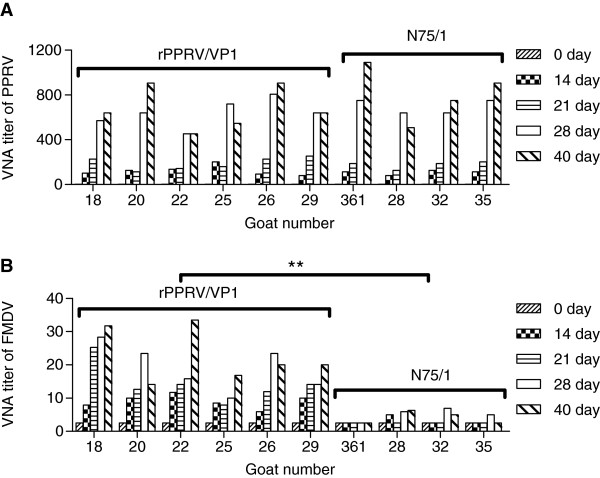
Viral NA responses elicited by rPPRV/VP1 and N75/1 in goats. Six goats (nos. 18, 20, 22, 25, 26, and 29) were inoculated by intramuscular injection with rPPRV/VP1 and four goats (nos. 361, 28, 32 and 35) were inoculated by intramuscular injection with N75/1. The sera were collected at 14, 21, 28, and 40 days post-inoculation and were tittered for PPRV NA (A) and FMDV NA (B). The data were analyzed by the two-way ANOVA method using the GraphPad Prism statistical software (**, p < 0.01).
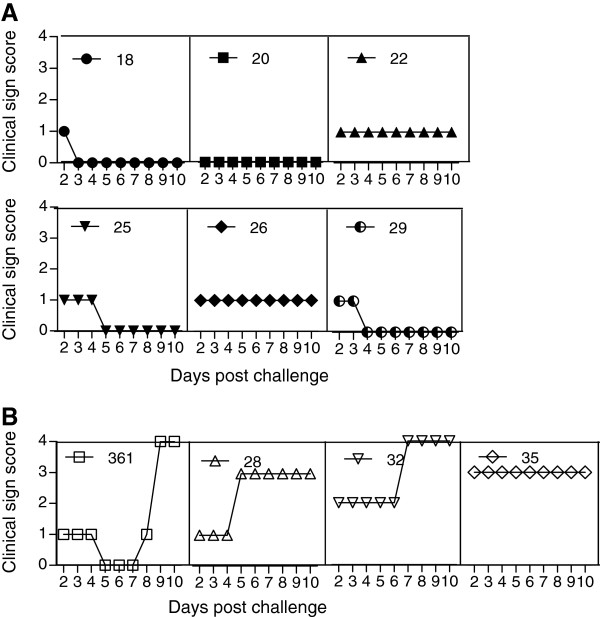
Clinical scoring post-challenge with virulent FMDV. Clinical signs of FMD rPPRV/VP1-inoculated goat (nos. 18, 20, 22, 25, 26, and 29) (A) and N75/1 –inoculated goat (nos. 361, 28, 32, and 35) (B) were observed from 2 to 10 days post challenge with FMDV JSL/06, and the clinical signs were scored as described in the Material and methods. Statistical differences were evaluated between two groups by the t-test method using GraphPad Prism statistical software, and the result showed the p < 0.01.
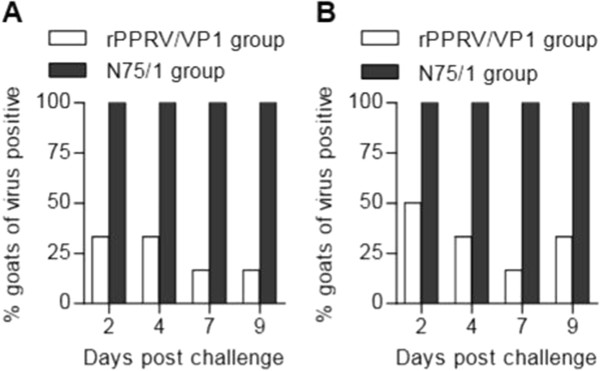
Virusisolation post challenge. Heparinized blood (A) and oropharyngeal swabs (B) for FMDV isolation were respectively collected from six individual rPPRV/VP1-inoculated goats and four individual N75/1-inoculated goats at 2, 4, 7, and 9 days post challenge with FMDV JSL/06. Viruses were isolated by inoculation of BHK-21 cell culture as described in the Material and methods.
References
Publication types
MeSH terms
Substances
LinkOut - more resources
Full Text Sources
Other Literature Sources
