


Phase angle for prognostication of survival in patients with advanced cancer: preliminary findings
- PMID: 24899148
- PMCID: PMC4079743
- DOI: 10.1002/cncr.28624
Phase angle for prognostication of survival in patients with advanced cancer: preliminary findings
Abstract
Background: Accurate survival prediction is essential for decision-making in cancer therapies and care planning. Objective physiologic measures may improve the accuracy of prognostication. In this prospective study, the authors determined the association of phase angle, handgrip strength, and maximal inspiratory pressure with overall survival in patients with advanced cancer.
Methods: Hospitalized patients with advanced cancer who were seen by palliative care specialists for consultation were enrolled. Information regarding phase angle, handgrip strength, maximal inspiratory pressure, and known prognostic factors including the Palliative Prognostic Score, Palliative Prognostic Index, serum albumin, and body composition was collected. Univariate and multivariate survival analysis were performed, and the correlation between phase angle and other prognostic variables was examined.
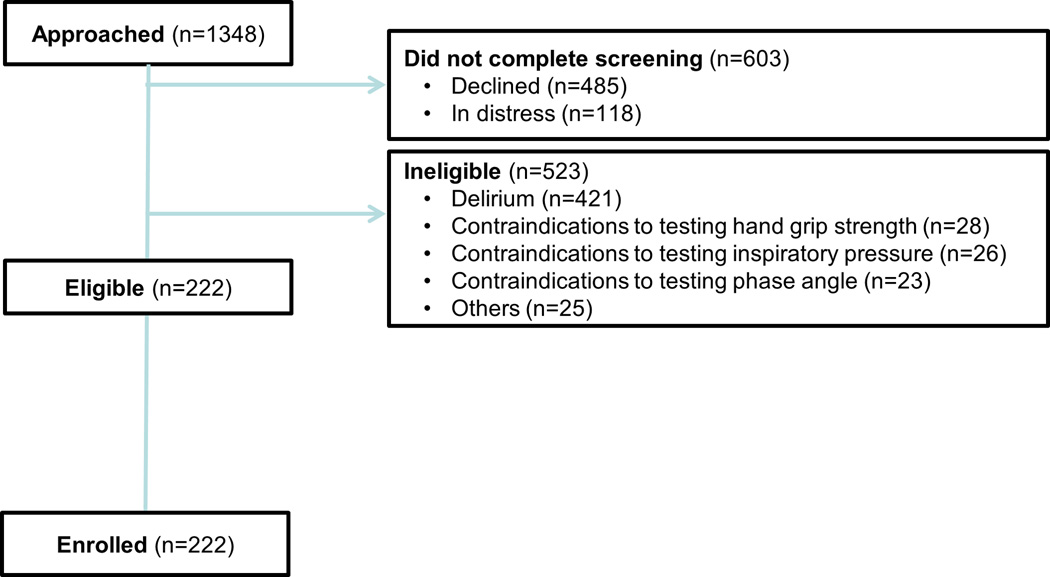
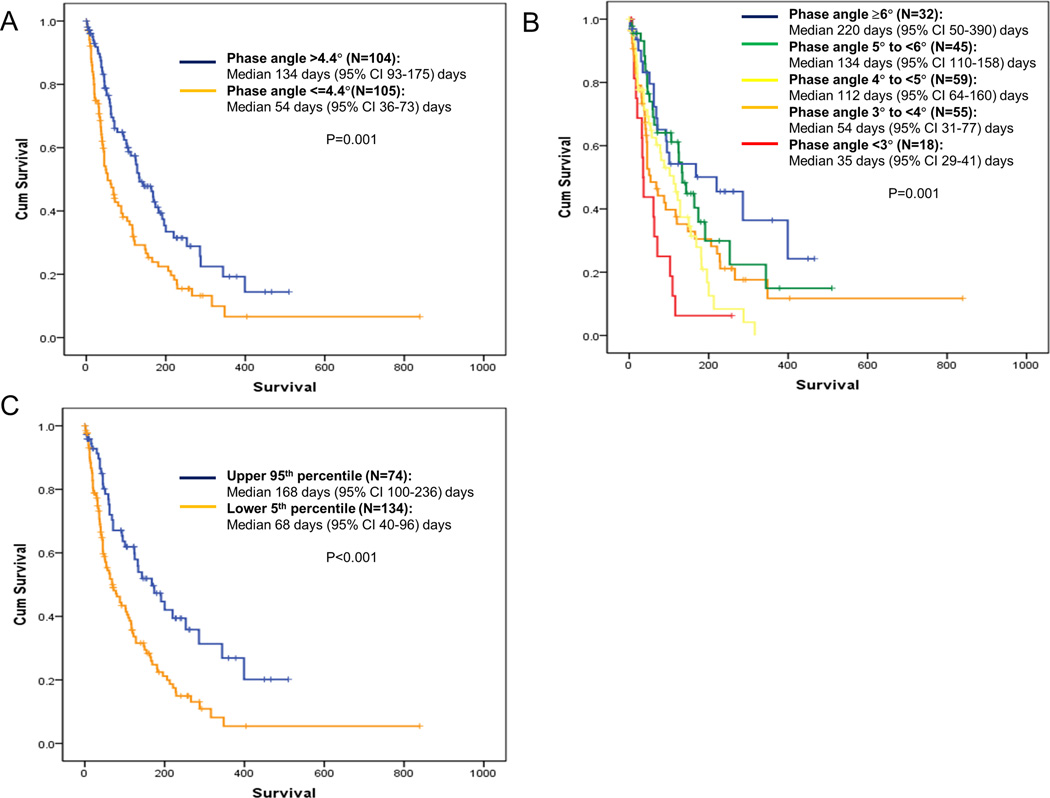
Results: A total of 222 patients were enrolled. The average age of the patients was 55 years (range, 22 years-79 years); 59% of the patients were female, with a mean Karnofsky performance status of 55 and a median overall survival of 106 days (95% confidence interval [95% CI], 71 days-128 days). The median survival for patients with phase angle 2 to 2.9°, 3 to 3.9°, 4 to 4.9°, 5 to 5.9° and ≥ 6° was 35 days, 54 days, 112 days, 134 days, and 220 days, respectively (P = .001). On multivariate analysis, phase angle (hazards ratio [HR], 0.86-per degree increase; 95% CI, 0.74-0.99 increase [P = .04]), Palliative Prognostic Score (HR, 1.07; 95% CI, 1.02-1.13 [P = .008]), serum albumin (HR, 0.67; 95% CI, 0.50-0.91 [P = .009]), and fat-free mass (HR, 0.98; 95% CI, 0.96-0.99 [P = .02]) were found to be significantly associated with survival. Phase angle was found to be only weakly (γ < 0.4) associated with other prognostic variables.
Conclusions: Phase angle was found to be a novel predictor of poor survival, independent of established prognostic factors, in the advanced cancer setting. This objective and noninvasive tool may be useful for bedside prognostication.
Keywords: electric impedance; neoplasms; palliative care; physiology; prognosis.
© 2014 American Cancer Society.
Figures
References
-
- Lamont EB, Christakis NA. Complexities in prognostication in advanced cancer: "to help them live their lives the way they want to". JAMA. 2003;290(1):98–104. - PubMed
-
- Earle CC, Park ER, Lai B, Weeks JC, Ayanian JZ, Block S. Identifying potential indicators of the quality of end-of-life cancer care from administrative data. J Clin Oncol. 2003;21(6):1133–1138. - PubMed
-
- Glare PA, Sinclair CT. Palliative Medicine review: prognostication. J Palliat Med. 2008;11(1):84–103. - PubMed
-
- Barbosa-Silva MC, Barros AJ. Bioelectrical impedance analysis in clinical practice: a new perspective on its use beyond body composition equations. Curr Opin Clin Nutr Metab Care. 2005;8(3):311–317. - PubMed
Publication types
MeSH terms
Substances
Grants and funding
LinkOut - more resources
Full Text Sources
Other Literature Sources
Medical
