


The relationship between the number of repetitions performed at given intensities is different in endurance and strength trained athletes
- PMID: 24899782
- PMCID: PMC4042664
- DOI: 10.5604/20831862.1099047
The relationship between the number of repetitions performed at given intensities is different in endurance and strength trained athletes
Abstract
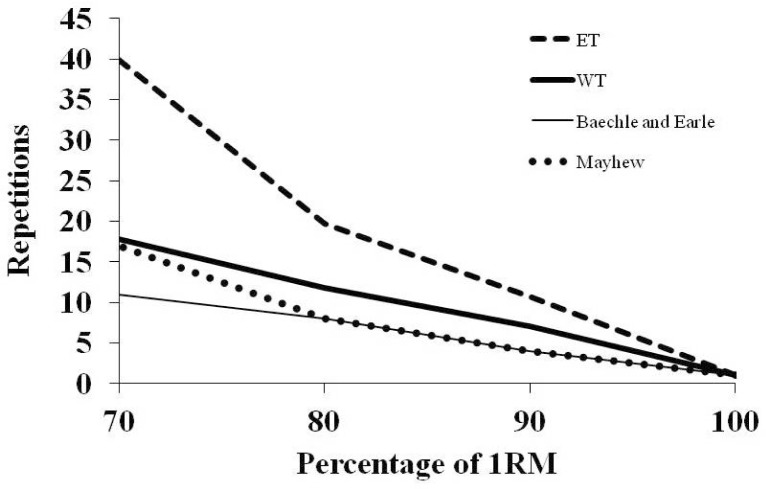
Prescribing training intensity and volume is a key problem when designing resistance training programmes. One approach is to base training prescription on the number of repetitions performed at a given percentage of repetition maximum due to the correlation found between these two measures. However, previous research has raised questions as to the accuracy of this method, as the repetitions completed at different percentages of 1RM can differ based upon the characteristics of the athlete. The objective of this study was therefore to evaluate the effect of an athlete's training background on the relationship between the load lifted (as a percentage of one repetition maximum) and the number of repetitions achieved. Eight weightlifters and eight endurance runners each completed a one repetition maximum test on the leg press and completed repetitions to fatigue at 90, 80 and 70% of their one repetition maximum. The endurance runners completed significantly more repetitions than the weightlifters at 70% (39.9 ± 17.6 versus 17.9 ± 2.8; p < 0.05) and 80% (19.8 ± 6.4 versus 11.8 ± 2.7; p < 0.05) of their one repetition maximum but not at 90% (10.8 ± 3.9 versus 7.0 ± 2.1; p > 0.05) of one repetition maximum. These differences could be explained by the contrasting training adaptations demanded by each sport. This study suggests that traditional guidelines may underestimate the potential number of repetitions that can be completed at a given percentage of 1RM, particularly for endurance trained athletes.
Keywords: adaptation, physiological; exercise; exercise prescription; one repetition maximum; physical endurance; weight lifting.
Figures
References
-
- Baechle T.R, Earle R.W. Weight training: A text written for the college student. Omaha, NE: Creighton University Press; 1989.
-
- Baechle T.R, Earle R.W, Wathen D. Resistance training. Essentials Strength Train. Cond. 2nd ed. Champaign, IL: Human Kinetics; 2000. pp. 395–426.
-
- Brzycki M. Strength testing-predicting a one-rep max from reps-to-fatigue. J. Phys. Educ. Recreat. Dance. 1993;64:88–88.
-
- Chapman P.P, Whitehead J.R, Binkert R.H. The 225-1b reps-to-fatigue test as a submaximal estimate of 1-RM bench press performance in college football players. J. Strength Cond. Res. 1998;12:258–61.
LinkOut - more resources
Full Text Sources
Other Literature Sources