


Stress hyperglycemia, insulin treatment, and innate immune cells
- PMID: 24899891
- PMCID: PMC4034653
- DOI: 10.1155/2014/486403
Stress hyperglycemia, insulin treatment, and innate immune cells
Abstract
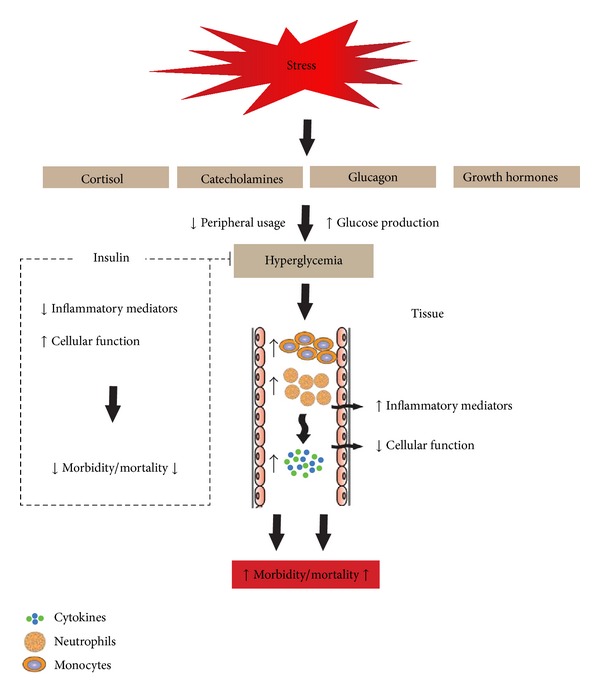
Hyperglycemia (HG) and insulin resistance are the hallmarks of a profoundly altered metabolism in critical illness resulting from the release of cortisol, catecholamines, and cytokines, as well as glucagon and growth hormone. Recent studies have proposed a fundamental role of the immune system towards the development of insulin resistance in traumatic patients. A comprehensive review of published literatures on the effects of hyperglycemia and insulin on innate immunity in critical illness was conducted. This review explored the interaction between the innate immune system and trauma-induced hypermetabolism, while providing greater insight into unraveling the relationship between innate immune cells and hyperglycemia. Critical illness substantially disturbs glucose metabolism resulting in a state of hyperglycemia. Alterations in glucose and insulin regulation affect the immune function of cellular components comprising the innate immunity system. Innate immune system dysfunction via hyperglycemia is associated with a higher morbidity and mortality in critical illness. Along with others, we hypothesize that reduction in morbidity and mortality observed in patients receiving insulin treatment is partially due to its effect on the attenuation of the immune response. However, there still remains substantial controversy regarding moderate versus intensive insulin treatment. Future studies need to determine the integrated effects of HG and insulin on the regulation of innate immunity in order to provide more effective insulin treatment regimen for these patients.
Figures
References
-
- van den Berghe G, Wouters P, Weekers F, et al. Intensive insulin therapy in critically ill patients. The New England Journal of Medicine. 2001;345(19):1359–1367. - PubMed
-
- Marik PE, Raghavan M. Stress-hyperglycemia, insulin and immunomodulation in sepsis. Intensive Care Medicine. 2004;30(5):748–756. - PubMed
-
- Kerby JD, Griffin RL, MacLennan P, Rue LW., III Stress-induced hyperglycemia, not diabetic hyperglycemia, is associated with higher mortality in trauma. Annals of Surgery. 2012;256(3):446–452. - PubMed
Publication types
Grants and funding
LinkOut - more resources
Full Text Sources
Other Literature Sources
