


Cyclopropyl Carboxamides: A New Oral Antimalarial Series Derived from the Tres Cantos Anti-Malarial Set (TCAMS)
- PMID: 24900273
- PMCID: PMC4017974
- DOI: 10.1021/ml2001517
Cyclopropyl Carboxamides: A New Oral Antimalarial Series Derived from the Tres Cantos Anti-Malarial Set (TCAMS)
Abstract
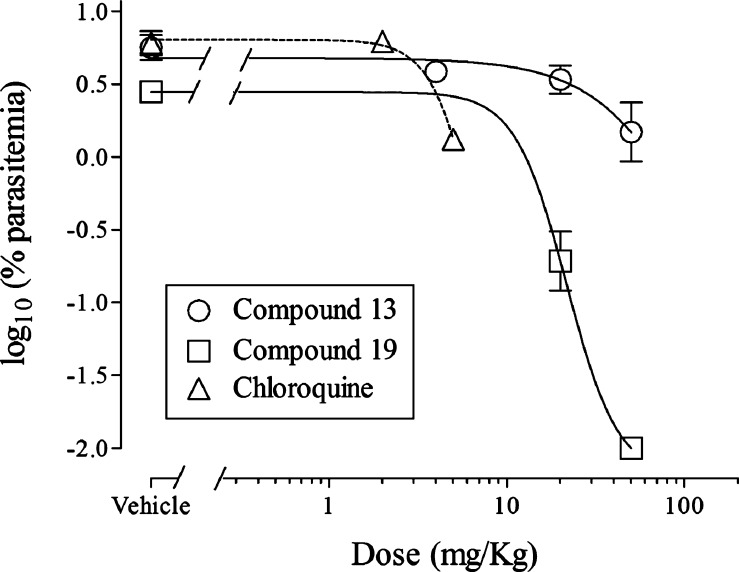
Rapid triaging of three series of related hits selected from the Tres Cantos Anti-Malarial Set (TCAMS) are described. A triazolopyrimidine series was deprioritized due to delayed inhibition of parasite growth. A lactic acid series has derivatives with IC50 < 500 nM in a standard Plasmodium falciparum in vitro whole cell assay (Pf assay) but shows half-lives of < 30 min in both human and murine microsomes. Compound 19, from a series of cyclopropyl carboxamides, is a highly potent in vitro inhibitor of P. falciparum (IC50 = 3 nM) and has an oral bioavailability of 55% in CD-1 mice and an ED90 of 20 mg/kg after oral dosing in a nonmyelo-depleted P. falciparum murine model.
Keywords: Medicines for Malaria Venture; Plasmodium falciparum; TCAMS; Tres Cantos Anti-Malarial Set; carboxamide; cyclopropyl; in vivo activity; malaria; murine; oral bioavailability; triazole.
Figures
References
-
- World Health Organization. World malaria report 2009; http://www.who.int/malaria/publications/atoz/9789241563901/en/index.html.
-
- Wells T. N. C.; Alonso P. L.; Gutteridge W. E. New medicines to improve control and contribute to the eradication of malaria. Nature Rev. Drug Discovery 2009, 8, 879–891. - PubMed
-
- Wu T.; Nagle A. S.; Chatterjee A. K. Road towards new antimalarials—Overview of the strategies and their chemical progress. Curr. Med. Chem. 2011, 18, 853–871. - PubMed
-
- Zhang Y.-K; Plattner J. J.; Freund Y. R.; Easom E. R.; Zhou Y.; Gut J.; Rosenthal P. J.; Waterson D.; Gamo F.-J.; Angulo-Barturen I.; Ge M.; Li Z.; Li L.; Jian Y.; Cui H.; Wang H.; Yang J. Synthesis and structure-activity relationships of novel benzoxaboroles as a new class of antimalarial agents. Bioorg. Med. Chem. Lett. 2011, 21, 644–651; see also http://www.mmv.org/newsroom/press-releases/anacor-pharmaceuticals-and-mm.... - PubMed
-
- Lucumi E.; Darling C.; Jo H.; Napper A. D.; Chandramohanadas R.; Fisher N.; Shone A. E.; Jing H.; Ward S. A.; Biagini G. A.; DeGrado W. F.; Dimond S. L.; Greenbaum D. C. Discovery of potent small molecule inhibitors of muti-drug resistant Plasmodium falciparum using a novel miniaturized high-throughput luciferase-based assay. Antimicrob. Agents Chemother. 2010, 276, 128–134. - PMC - PubMed
LinkOut - more resources
Full Text Sources
