


Discovery of Dabrafenib: A Selective Inhibitor of Raf Kinases with Antitumor Activity against B-Raf-Driven Tumors
- PMID: 24900673
- PMCID: PMC4027516
- DOI: 10.1021/ml4000063
Discovery of Dabrafenib: A Selective Inhibitor of Raf Kinases with Antitumor Activity against B-Raf-Driven Tumors
Abstract
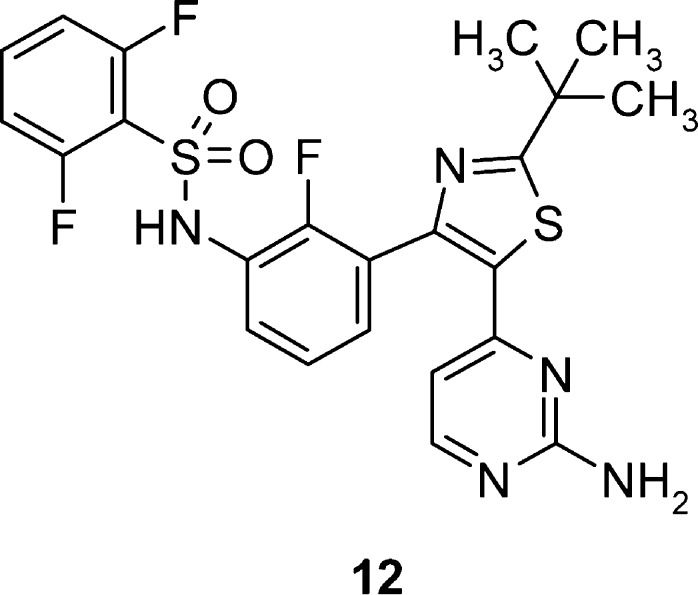
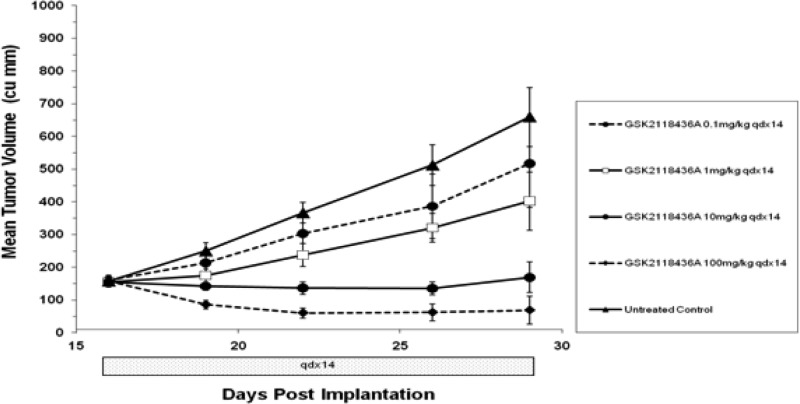
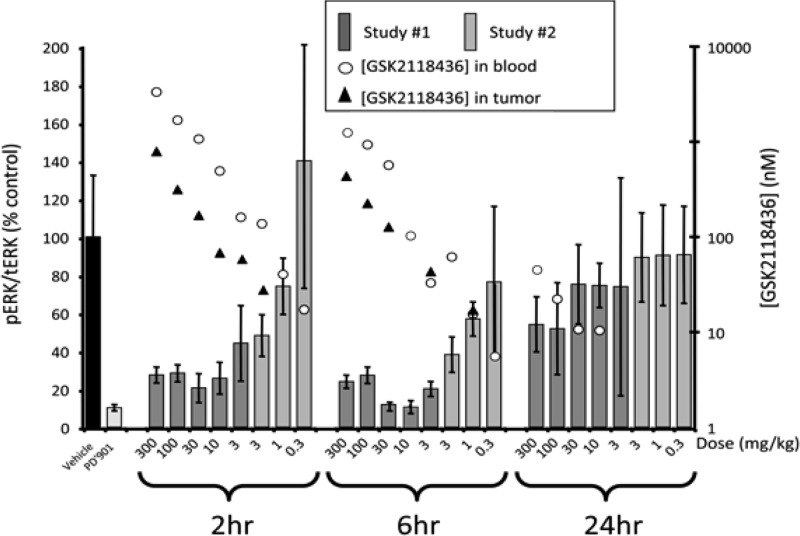
Hyperactive signaling of the MAP kinase pathway resulting from the constitutively active B-Raf(V600E) mutated enzyme has been observed in a number of human tumors, including melanomas. Herein we report the discovery and biological evaluation of GSK2118436, a selective inhibitor of Raf kinases with potent in vitro activity in oncogenic B-Raf-driven melanoma and colorectal carcinoma cells and robust in vivo antitumor and pharmacodynamic activity in mouse models of B-Raf(V600E) human melanoma. GSK2118436 was identified as a development candidate, and early clinical results have shown significant activity in patients with B-Raf mutant melanoma.
Keywords: B-Raf; GSK2118436; MAP kinase; dabrafenib; melanoma.
Figures

References
-
- Davies H.; Bignell G.; Cox C.; Stevens P.; Edkins S.; Clegg S.; Teague J.; Woffendin H.; Garnett M.; Bottomley W.; Davis N.; Dicks E.; Ewing R.; Floyd Y.; Gray K.; Hall S.; Hawes R.; Hughes J.; Kosmidou V.; Menzies A.; Mould C.; Parker A.; Stevens C.; Watt S.; Hooper S.; Wilson R.; Jayatilake H.; Gusterson B.; Cooper C.; Shipley J.; Hargrave D.; Pritchard-Jones K.; Maitland N.; Chenevix-Trench G.; Riggins G.; Bigner D.; Palmieri G.; Cossu A.; Flanagan A.; Nicholson A.; Ho J.; Leung S.; Yuen S.; Weber B.; Seigler H.; Darrow T.; Paterson H.; Marais R.; Marshall C.; Wooster R.; Stratton M.; Futreal P. Mutations of the BRAF gene in human cancer. Nature 2002, 417, 949–954. - PubMed
-
- Singer G.; Oldt R.; Cohen Y.; Wang B.; Sidransky D.; Kurman R.; Shih Ie. M. Mutations in BRAF and KRAS characterize the development of low-grade ovarian serous carcinoma. J. Natl. Cancer Inst. 2003, 95, 484–486. - PubMed
-
- Cohen Y.; Xing M.; Mambo E.; Guo Z.; Wu G.; Trink B.; Beller U.; Westra W. H.; Ladenson P. W.; Sidransky D. BRAF mutation in papillary thyroid carcinoma. J. Natl. Cancer Inst. 2003, 95, 625–627. - PubMed
-
- Yuen S.; Davies H.; Chan T.; Ho J.; Bignell G.; Cox C.; Stephens P.; Edkins S.; Tsui W.; Chan A.; Futreal P.; Stratton M.; Wooster R.; Leung S. Similarity of the phenotypic patterns associated with BRAF and KRAS mutations in colorectal neoplasia. Cancer Res. 2002, 62, 6451–6455. - PubMed
-
- Wan P.; Garnett M.; Roe S.; Lee S.; Niculescu-Duvaz D.; Good V.; Jones C. M.; Marshall C. J.; Springer C. J.; Barford D.; Marais R. Mechanism of Action of the RAF-ERK Signaling Pathway by Oncogenic Mutations of B-RAF. Cell 2004, 116, 855–867. - PubMed
Grants and funding
LinkOut - more resources
Full Text Sources
Other Literature Sources
Chemical Information
Research Materials
Miscellaneous
