. 2014 Aug 15;9(8):1788-98.
doi: 10.1021/cb500086e. Epub 2014 Jun 17.

Phytochemicals perturb membranes and promiscuously alter protein function

Affiliations

Phytochemicals perturb membranes and promiscuously alter protein function

Helgi I Ingólfsson et al. ACS Chem Biol. .

Abstract

A wide variety of phytochemicals are consumed for their perceived health benefits. Many of these phytochemicals have been found to alter numerous cell functions, but the mechanisms underlying their biological activity tend to be poorly understood. Phenolic phytochemicals are particularly promiscuous modifiers of membrane protein function, suggesting that some of their actions may be due to a common, membrane bilayer-mediated mechanism. To test whether bilayer perturbation may underlie this diversity of actions, we examined five bioactive phenols reported to have medicinal value: capsaicin from chili peppers, curcumin from turmeric, EGCG from green tea, genistein from soybeans, and resveratrol from grapes. We find that each of these widely consumed phytochemicals alters lipid bilayer properties and the function of diverse membrane proteins. Molecular dynamics simulations show that these phytochemicals modify bilayer properties by localizing to the bilayer/solution interface. Bilayer-modifying propensity was verified using a gramicidin-based assay, and indiscriminate modulation of membrane protein function was demonstrated using four proteins: membrane-anchored metalloproteases, mechanosensitive ion channels, and voltage-dependent potassium and sodium channels. Each protein exhibited similar responses to multiple phytochemicals, consistent with a common, bilayer-mediated mechanism. Our results suggest that many effects of amphiphilic phytochemicals are due to cell membrane perturbations, rather than specific protein binding.


Figures
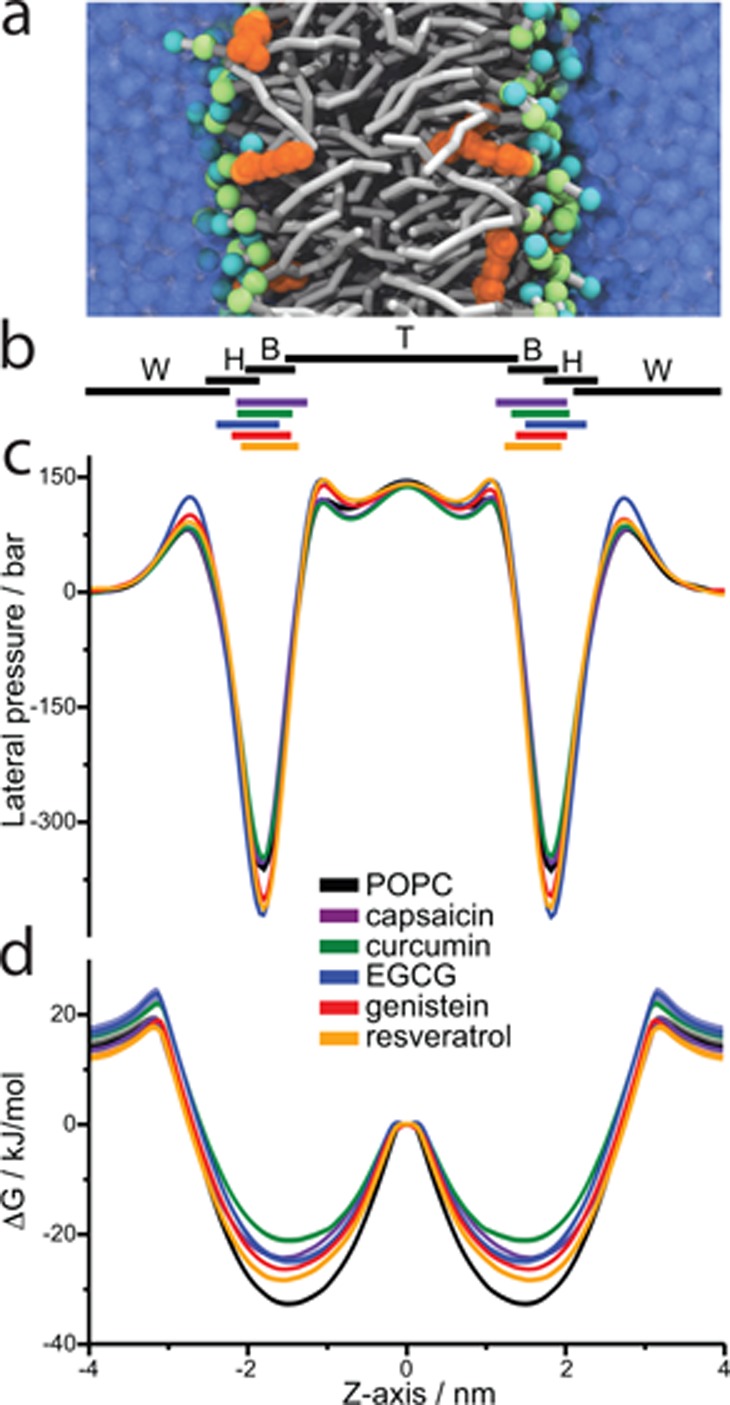
Figure 1
Figure 1
Phytochemicals partition into phospholipid bilayers and alter their properties. The phytochemicals’ effects on 1-palmitoyl-2-oleoyl-sn-glycero-3-phosphocholine (POPC) CG bilayers were explored using Martini simulations at 1:10 phytochemical/lipid molar ratio. (a) Simulation snapshot showing resveratrol (orange) in a CG POPC bilayer (tails and backbone in gray and the head groups in cyan and green). (b) Lateral density, indicated as density width at half-maximum height of the distributions for water (W), POPC lipid head groups (H), backbone (B), tails (T), and for the phytochemicals (see also Supporting Information Figure S1e). (c) Lateral pressure profile. (d) Symmetrized potential of mean force (PMF) for translocating a probe of radius 0.9 nm through the bilayer. The bilayer normal is set to the Z-axis with zero at the center of the bilayer.
Figure 2
Figure 2
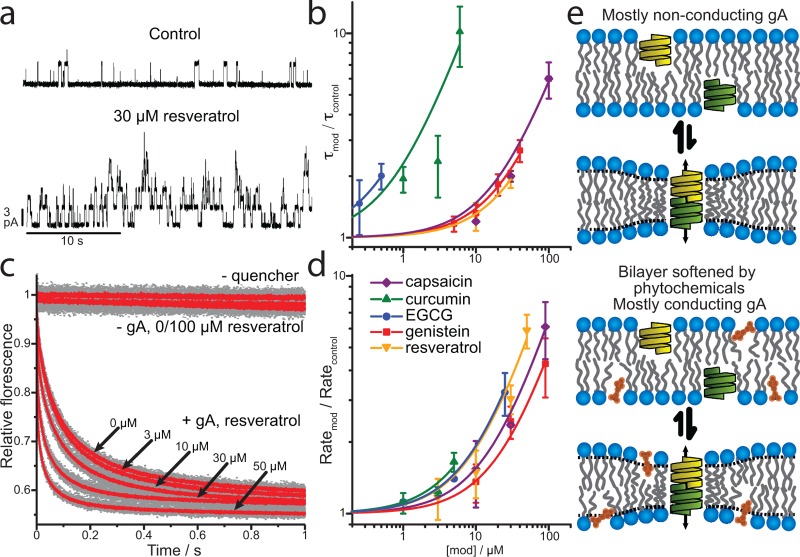
Phytochemicals perturb phospholipid bilayers as sensed by gramicidin channels. (a, b) Phytochemical effect on gA channel lifetime measured using single-channel electrophysiology in planar DOPC/n-decane bilayers. (a) Representative current traces. (b) Changes to gA lifetime with the addition of phytochemicals. The solid lines are f([mod]) = 1 + [mod]/D fits to the results. The phytochemicals double the gA lifetime at (concentrations in μM) 20.7 ± 1.3 capsaicin, 0.8 ± 0.1 curcumin, 0.5 ± 0.01 EGCG, 25.6 ± 1.5 genistein, and 32.3 ± 0.7 resveratrol. (c, d) Phytochemical effect on gA channel activity measured with a gA permeable quencher rate of influx into fluorescent vesicles doped with gA. (d) Changes to gA activity with the addition of phytochemicals. The solid lines are f([mod]) = 1 + [mod]/D fits to the results. The phytochemicals double gA induced quencher influx rates at (concentrations in μM) 18.0 ± 0.6 capsaicin, 8.6 ± 1.0 curcumin, 11.2 ± 0.2 EGCG, 26.7 ± 1.4 genistein, and 11.3 ± 0.9 resveratrol. (e) Schematic depicting increased gA channel activity following the addition of phytochemicals that partition into the bilayer/solution interface.
Figure 3
Figure 3
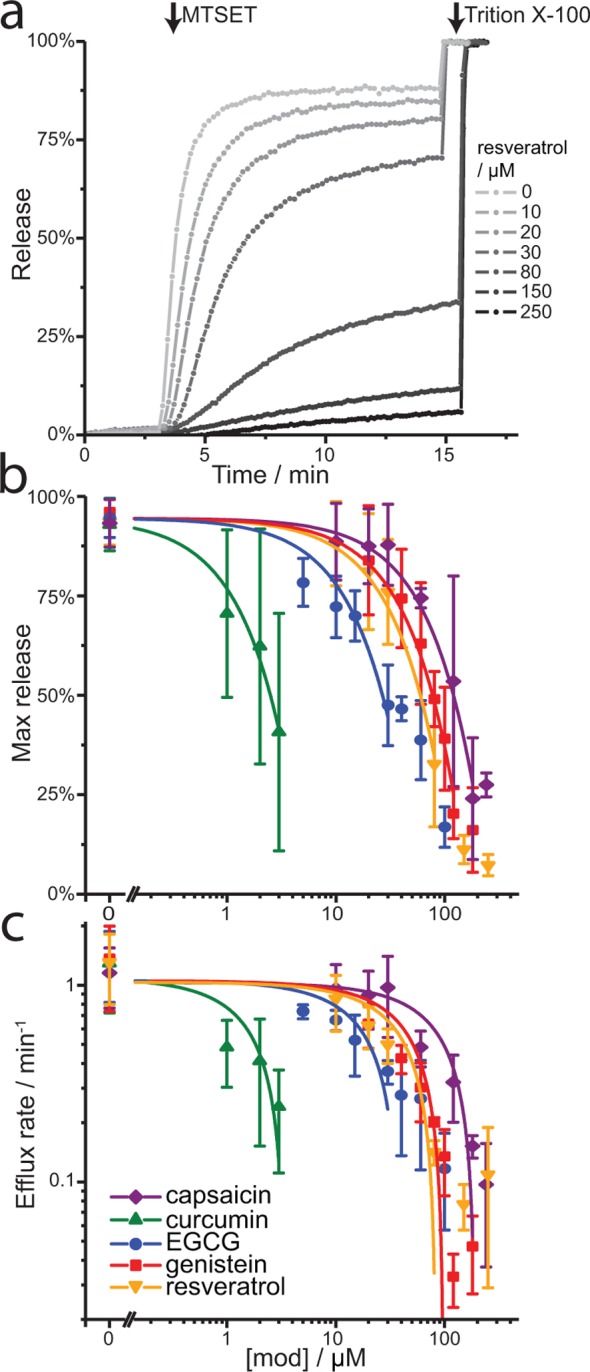
Phytochemicals inhibit mechanosensitive channels. MscL channels were reconstituted into calcein-loaded vesicles. Channel activation was initiated by exposure to MTSET and the release of calcein through open MscL channels is monitored as an increase in fluorescence. (a) Representative calcein release curves. (b, c) Changes in MscL activity after addition of phytochemicals, avg ± standard deviation (SD), n = 3. The solid lines are f([mod]) = f(control) – [mod]/D fits to the results (excluding saturating concentration). (b) The phytochemicals produce a 50% reduction in the max release at (concentrations in μM) 127 ± 5 capsaicin, 2.7 ± 0.2 curcumin, 28 ± 2 EGCG, 82 ± 2 genistein, and 63 ± 2 resveratrol μM concentration and half the efflux rate (c) at 92 ± 12 capsaicin, 1.6 ± 0.4 curcumin, 18 ± 5 EGCG, 46 ± 9 genistein, and 40 ± 9 resveratrol.
Figure 4
Figure 4
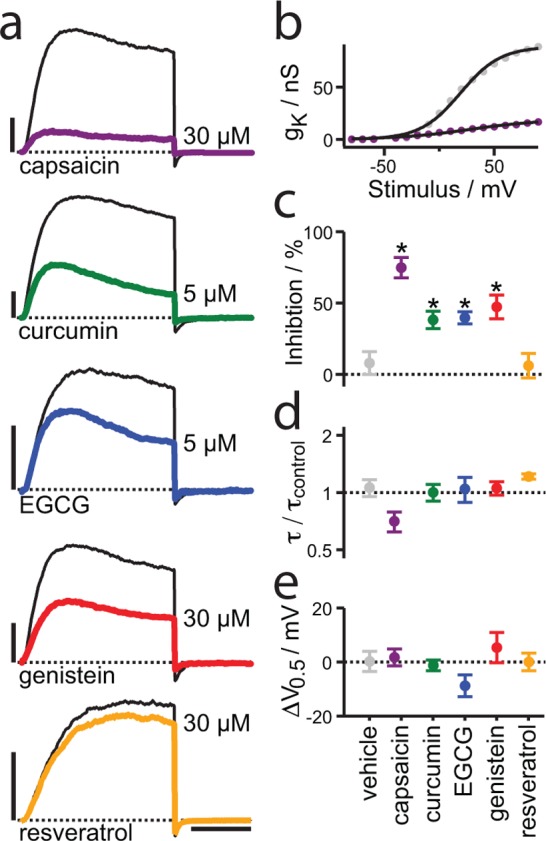
Phytochemicals inhibit voltage-dependent potassium channels. (a) Representative KV2.1 current traces from 100 ms steps to +20 mV, returning to the holding potential of −100 mV. Black lines, control. Colored lines, during application of indicated phytochemical. Abscissa bar, 40 ms; ordinate, 1 nA. (b) Conductance–voltage relation. Gray circles, KV2.1 control; purple circles, 30 μM capsaicin. Lines are fitted Boltzmann relations. (c–e) Phytochemical effects on KV2.1 currents. Same concentrations as panel a. Circles indicate mean, bars standard error. Asterisks indicate significant difference from DMSO vehicle treatments, P < 0.05 two-tailed, Mann–Whitney U-test, n = 4–6. (c) Inhibition of peak KV2.1 current at +20 mV. (d) Ratio of KV2.1 activation time constant at +20 mV in phytochemical versus control. (e) Shift of conductance–voltage relation midpoint by phytochemicals.
Figure 5
Figure 5
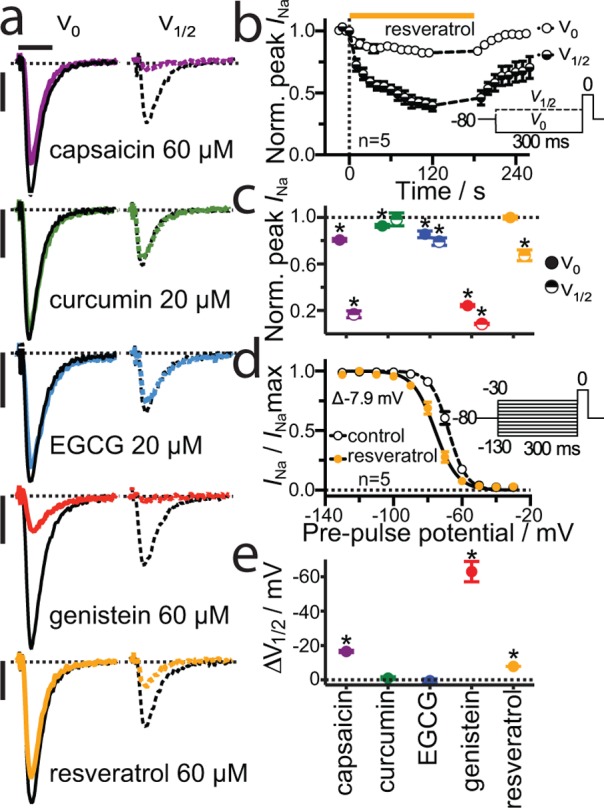
Phytochemicals inhibit sodium channels. (a) Representative NaV current traces from an experiment with an alternating two-pulse protocol. A test pulse to 0 mV, to elicit peak Na+ current (INa) was preceded by a 300 ms prepulse to holding potentials of either V0 (−130 mV) or V1/2 (see insert in panel (b) V1/2 = −69 ± 3 mV). Black lines, control. Colored lines, results obtained during application of the listed concentration of the indicated phytochemical. Abscissa bar, 1 ms; ordinate, 1 nA. (b) Inhibition of peak INa during wash-in and wash-out of resveratrol. (c) Inhibition of peak INa after 120 s treatment with the different compounds. (d, e) Shift in steady-state inactivation tested using a double-pulse protocol in which a test pulse to 0 mV was preceded by a 300 ms conditioning prepulse to potentials ranging from −130 mV to −30 mV. (d) Shift in the voltage-dependence of steady-state inactivation. The results from each experiment were fitted with a standard Boltzmann equation to calculate the individual V1/2 values. (e) Shift in V1/2 caused by the phytochemicals. For all panels, phytochemicals were tested at the concentrations shown in panel a (avg ± sem). Asterisks denote significant difference from control, p < 0.05 two-tailed, Student’s t-test, n = 4–6.
Figure 6
Figure 6
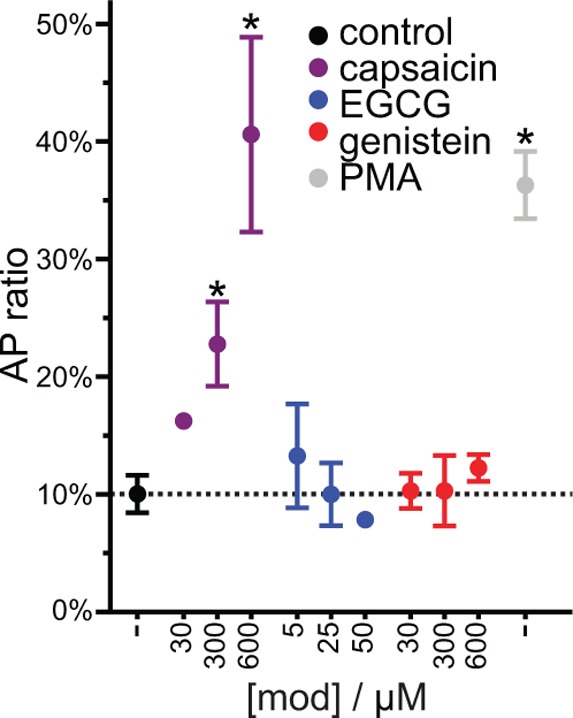
Phytochemicals’ effect on ADAM17-mediated shedding of TGFα. ADAM17-mediated shedding of alkaline phosphatase (AP)-tagged TGFα was measured and shown as an AP-ratio. TGFα shedding was sensitive to capsaicin but not to EGCG or genistein at concentrations between 5 and 600 μM, as indicated. Phorbol-12-myristate-13-acetate (PMA), 25 ng/mL, was used as a positive control for activation of ADAM17. Asterisks indicate significant difference from control, p < 0.05 two-tailed, Student’s t-test, avg ± sem, n = 1–5.

References

    1. Joe B.; Vijaykumar M.; Lokesh B. R. (2004) Biological properties of curcumin—cellular and molecular mechanisms of action. Crit. Rev. Food Sci. Nutr. 44, 97–111. - PubMed
    1. Shishodia S.; Sethi G.; Aggarwal B. B. (2005) Curcumin: Getting back to the roots. Ann. N.Y. Acad. Sci. 1056, 206–217. - PubMed
    1. Shimizu M.; Weinstein I. B. (2005) Modulation of signal transduction by tea catechins and related phytochemicals. Mutat. Res. 591, 147–160. - PubMed
    1. Khan N.; Afaq F.; Saleem M.; Ahmad N.; Mukhtar H. (2006) Targeting multiple signaling pathways by green tea polyphenol (−)-epigallocatechin-3-gallate. Cancer Res. 66, 2500–2505. - PubMed
    1. Nagle D. G.; Ferreira D.; Zhou Y.-D. (2006) Epigallocatechin-3-gallate (EGCG): chemical and biomedical perspectives. Phytochemistry 67, 1849–1855. - PMC - PubMed

Publication types

MeSH terms