


Efficacy of baby-CIMT: study protocol for a randomised controlled trial on infants below age 12 months, with clinical signs of unilateral CP
- PMID: 24903062
- PMCID: PMC4062504
- DOI: 10.1186/1471-2431-14-141
Efficacy of baby-CIMT: study protocol for a randomised controlled trial on infants below age 12 months, with clinical signs of unilateral CP
Abstract
Background: Infants with unilateral brain lesions are at high risk of developing unilateral cerebral palsy (CP). Given the great plasticity of the young brain, possible interventions for infants at risk of unilateral CP deserve exploration. Constraint-induced movement therapy (CIMT) is known to be effective for older children with unilateral CP but is not systematically used for infants. The development of CIMT for infants (baby-CIMT) is described here, as is the methodology of an RCT comparing the effects on manual ability development of baby-CIMT versus baby-massage. The main hypothesis is that infants receiving baby-CIMT will develop manual ability in the involved hand faster than will infants receiving baby-massage in the first year of life.
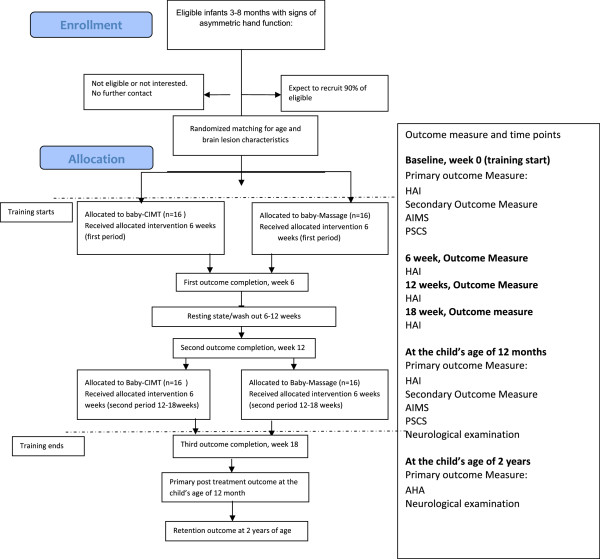
Method and design: The study will be a randomised, controlled, prospective parallel-group trial. Invited infants will be to be randomised to either the baby-CIMT or the baby-massage group if they: 1) are at risk of developing unilateral CP due to a known neonatal event affecting the brain or 2) have been referred to Astrid Lindgren Children's Hospital due to asymmetric hand function. The inclusion criteria are age 3-8 months and established asymmetric hand use. Infants in both groups will receive two 6-weeks training periods separated by a 6-week pause, for 12 weeks in total of treatment. The primary outcome measure will be the new Hand Assessment for Infants (HAI) for evaluating manual ability. In addition, the Parenting Sense of Competence scale and Alberta Infant Motor Scale will be used. Clinical neuroimaging will be utilized to characterise the brain lesion type. To compare outcomes between treatment groups generalised linear models will be used.
Discussion: The model of early intensive intervention for hand function, baby-CIMT evaluated by the Hand Assessment for Infants (HAI) will have the potential to significantly increase our understanding of how early intervention of upper limb function in infants at risk of developing unilateral CP can be performed and measured.
Trial registration: SFO-V4072/2012, 05/22/2013.
Figures
References
Publication types
MeSH terms
LinkOut - more resources
Full Text Sources
Other Literature Sources
Medical
Miscellaneous
