


Concise review: breast cancer stem cells: regulatory networks, stem cell niches, and disease relevance
- PMID: 24904174
- PMCID: PMC4116249
- DOI: 10.5966/sctm.2014-0020
Concise review: breast cancer stem cells: regulatory networks, stem cell niches, and disease relevance
Abstract
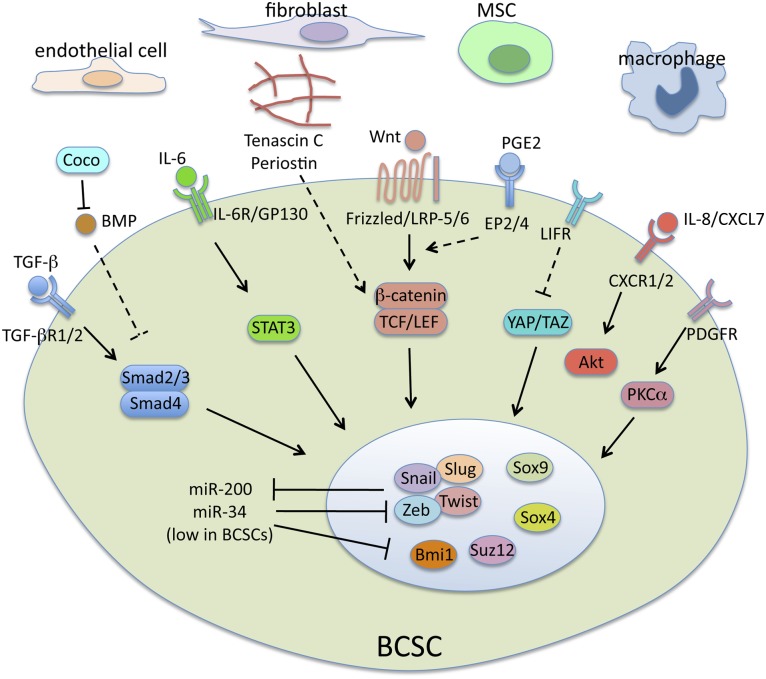
Accumulating evidence has shown that cancer stem cells (CSCs), the cancer cells that have long-term proliferative potential and the ability to regenerate tumors with phenotypically heterogeneous cell types, are important mediators of tumor metastasis and cancer relapse. In breast cancer, these cells often possess attributes of cells that have undergone an epithelial-mesenchymal transition (EMT). Signaling networks mediated by microRNAs and EMT-inducing transcription factors connect the EMT program with the core stem cell regulatory machineries. These signaling networks are also regulated by extrinsic niche signals that induce and maintain CSCs, contributing to metastatic colonization and promoting the reactivation of dormant tumor cells. Targeting these CSC pathways is likely to improve the efficacy of conventional chemo- and radiotherapies.
Keywords: Breast cancer stem cells; Epithelial-mesenchymal transition; Metastasis; Tumor dormancy.
©AlphaMed Press.
Figures
References
-
- Hanahan D, Weinberg RA. Hallmarks of cancer: The next generation. Cell. 2011;144:646–674. - PubMed
-
- Dick JE. Stem cell concepts renew cancer research. Blood. 2008;112:4793–4807. - PubMed
-
- Lobo NA, Shimono Y, Qian D, et al. The biology of cancer stem cells. Annu Rev Cell Dev Biol. 2007;23:675–699. - PubMed
-
- Shackleton M, Quintana E, Fearon ER, et al. Heterogeneity in cancer: Cancer stem cells versus clonal evolution. Cell. 2009;138:822–829. - PubMed
Publication types
MeSH terms
LinkOut - more resources
Full Text Sources
Other Literature Sources
Medical
