. 2014 May 22:8:342.
doi: 10.3389/fnhum.2014.00342. eCollection 2014.

Precise timing when hitting falling balls

Affiliations

Precise timing when hitting falling balls

Eli Brenner et al. Front Hum Neurosci. .

Abstract

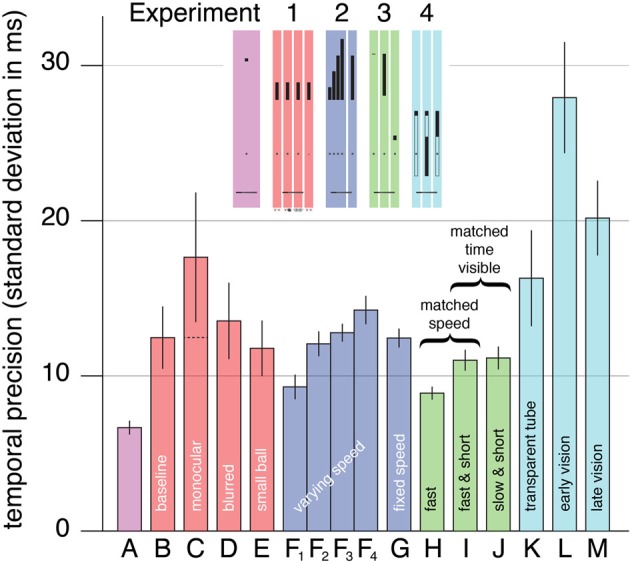
People are extremely good at hitting falling balls with a baseball bat. Despite the ball's constant acceleration, they have been reported to time hits with a standard deviation of only about 7 ms. To examine how people achieve such precision, we compared performance when there were no added restrictions, with performance when looking with one eye, when vision was blurred, and when various parts of the ball's trajectory were hidden from view. We also examined how the size of the ball and varying the height from which it was dropped influenced temporal precision. Temporal precision did not become worse when vision was blurred, when the ball was smaller, or when balls falling from different heights were randomly interleaved. The disadvantage of closing one eye did not exceed expectations from removing one of two independent estimates. Precision was higher for slower balls, but only if the ball being slower meant that one saw it longer before the hit. It was particularly important to see the ball while swinging the bat. Together, these findings suggest that people time their hits so precisely by using the changing elevation throughout the swing to adjust the bat's movement to that of the ball.

Keywords: baseball; gravity; hitting; interception; motor control; precision; timing; vision.


Figures
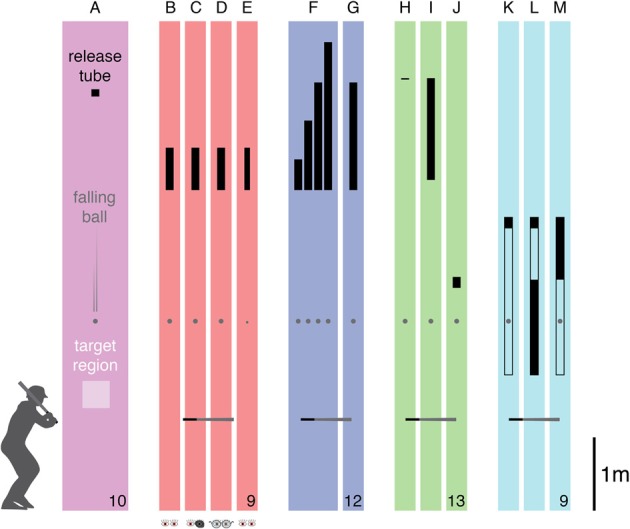
Figure 1
Figure 1
Overview of task and conditions. Subjects had to try to hit a falling ball toward a target region. The ball was released through a tube (indicated in black). (A) The configuration of the corresponding condition in Brenner et al. (2012). (B–E) The four conditions of Experiment 1: baseline, monocular, blurred, and small ball. (F,G) The two conditions of Experiment 2: varying speed and fixed speed. (H–J) The three conditions of Experiment 3: fast, fast & short, and slow & short. (K–M) The three conditions of Experiment 4: transparent tube, early vision, and late vision. The drawings are approximately to scale, showing the lengths and heights of the release tubes as well as the approximate height of the horizontal “bat” at the anticipated moment of impact. The gray disk represents the ball at an arbitrary moment. The number of participants that were included in the analysis is indicated at the bottom right for each experiment.
Figure 2
Figure 2
Mean timing precision. Each experiment is represented by a different color. The letters indicate the conditions (for a quick graphical reference see the miniature version of Figure 1 that is included as an inset). The leftmost bar (A) shows the corresponding data from Brenner et al. (2012). There are four bars labeled F because there are four release heights in this condition. The dashed line in the bar for the monocular condition of Experiment 1 (bar C) indicates the precision that would be expected by combining two such monocular judgments (that are independent and equally precise). Error bars are standard errors across subjects.

References

    1. Baruch O., Yeshurun Y., Shore D. I. (2013). Space and time: an impact of spatial separation, apparent motion, and perceptual grouping on TOJ performance. Perception 42, 551–561 10.1068/p7401 - DOI - PubMed
    1. Bennett S. J., van der Kamp J., Savelsbergh G. J. P., Davids K. (2000). Discriminating the role of binocular information in the timing of a one-handed catch. The effects of telestereoscopic viewing and ball size. Exp. Brain Res. 135, 341–347 10.1007/s002210000520 - DOI - PubMed
    1. Blake R., Sloane M., Fox R. (1981). Further developments in binocular summation. Percept. Psychophys. 30, 266–276 10.3758/BF03214282 - DOI - PubMed
    1. Bootsma R. J., van Wieringen P. C. W. (1990). Timing an attacking forehand drive in table tennis. J. Exp. Psychol. Hum. Percept. Perform. 16, 21–29 10.1037/0096-1523.16.1.21 - DOI
    1. Brenner E., Smeets J. B. J. (1997). Fast responses of the human hand to changes in target position. J. Mot. Behav. 29, 297–310 10.1080/00222899709600017 - DOI - PubMed

LinkOut - more resources