. 2014 May 28:8:350.
doi: 10.3389/fnhum.2014.00350. eCollection 2014.

Cortical alpha oscillations as a tool for auditory selective inhibition

Affiliations

Cortical alpha oscillations as a tool for auditory selective inhibition

Antje Strauß et al. Front Hum Neurosci. .

Abstract

Listening to speech is often demanding because of signal degradations and the presence of distracting sounds (i.e., "noise"). The question how the brain achieves the task of extracting only relevant information from the mixture of sounds reaching the ear (i.e., "cocktail party problem") is still open. In analogy to recent findings in vision, we propose cortical alpha (~10 Hz) oscillations measurable using M/EEG as a pivotal mechanism to selectively inhibit the processing of noise to improve auditory selective attention to task-relevant signals. We review initial evidence of enhanced alpha activity in selective listening tasks, suggesting a significant role of alpha-modulated noise suppression in speech. We discuss the importance of dissociating between noise interference in the auditory periphery (i.e., energetic masking) and noise interference with more central cognitive aspects of speech processing (i.e., informational masking). Finally, we point out the adverse effects of age-related hearing loss and/or cognitive decline on auditory selective inhibition. With this perspective article, we set the stage for future studies on the inhibitory role of alpha oscillations for speech processing in challenging listening situations.

Keywords: aging; alpha; effortful listening; hearing loss; inhibition; masking; neural oscillations; speech.


Figures
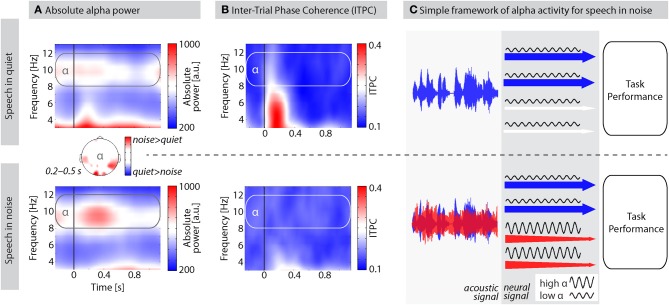
Figure 1
Figure 1
The proposed role of alpha activity for speech processing in noise. (A) Average absolute alpha power of 11 participants performing a lexical decision task on words in quiet (top) and in white noise (bottom). SNRs were titrated individually using a two-down-one-up staircase adaptive tracking procedure. Average SNR was −10.22 dB ±1.95 (SD) such that participants performed about 71% correct. Speech onset is indicated by the black vertical line at 0 s; average word length = 750 ms; EEG recorded from 61 scalp electrodes; time-frequency analysis using Morlet wavelets. Plots show measures of absolute power averaged over all scalp electrodes. Topography depicts the alpha power difference for speech in noise–quiet. Data were SCD (source current density)-transformed before power estimation to improve spatial resolution. (B) Inter-trial phase coherence (ITPC) as a measure of phase-locking of oscillations over trials. ITPC is bound between 0 and 1; higher ITPC values indicate stronger phase alignment across trials. (C) A simple framework of alpha oscillations for speech processing in noise. Acoustic signals overlap energetically as they enter the ear. At the brain level, features of speech and noise are processed as far as possible in distinct processing channels (depicted here with arrows; for details see text). High alpha power inhibits channels processing noise features to allow for an optimal task performance with minimized noise interference.

References

    1. Ahveninen J., Huang S., Belliveau J. W., Chang W.-T., Hämäläinen M. (2013). Dynamic oscillatory processes governing cued orienting and allocation of auditory attention. J. Cogn. Neurosci. 25, 1926–1943 10.1162/jocn_a_00452 - DOI - PMC - PubMed
    1. Arbogast T. L., Mason C. R., Kidd G., Jr. (2005). The effect of spatial separation on informational masking of speech in normal-hearing and hearing-impaired listeners. J. Acoust. Soc. Am. 117, 2169–2180 10.1121/1.1861598 - DOI - PubMed
    1. Banerjee S., Snyder A. C., Molholm S., Foxe J. J. (2011). Oscillatory alpha-band mechanisms and the deployment of spatial attention to anticipated auditory and visual target locations: supramodal or sensory-specific control mechanisms? J. Neurosci. 31, 9923–9932 10.1523/JNEUROSCI.4660-10.2011 - DOI - PMC - PubMed
    1. Berger H. (1931). Über das Elektrenkephalogramm des Menschen. Arch. Psychiatr. Nervenkr. 94, 16–60 10.1007/BF01835097 - DOI
    1. Bizley J. K., Cohen Y. E. (2013). The what, where and how of auditory-object perception. Nat. Rev. Neurosci. 14, 693–707 10.1038/nrn3565 - DOI - PMC - PubMed

LinkOut - more resources
