Review
. 2014 May 28:5:197.
doi: 10.3389/fphys.2014.00197. eCollection 2014.

MFS multidrug transporters in pathogenic fungi: do they have real clinical impact?

Affiliations
Review

MFS multidrug transporters in pathogenic fungi: do they have real clinical impact?

Catarina Costa et al. Front Physiol. .

Abstract

Infections caused by opportunistic fungal pathogens have reached concerning numbers due to the increase of the immunocrompromised human population and to the development of antifungal resistance. This resistance is often attributed to the action of multidrug efflux pumps, belonging to the ATP-binding cassette (ABC) superfamily and the major facilitator superfamily (MFS). Although many studies have focused on the role of ABC multidrug efflux transporters, little is still known on the part played by the Drug:H(+) Antiporter (DHA) family of the MFS in this context. This review summarizes current knowledge on the role in antifungal drug resistance, mode of action and phylogenetic relations of DHA transporters, from the model yeast S. cerevisiae to pathogenic yeasts and filamentous fungi. Through the compilation of the predicted DHA transporters in the medically relevant Candida albicans, C. glabrata, C. parapsilosis, C. lusitaniae, C. tropicalis, C. guilliermondii, Cryptococcus neoformans, and Aspergillus fumigatus species, the fact that only 5% of the DHA transporters from these organisms have been characterized so far is evidenced. The role of these transporters in antifungal drug resistance and in pathogen-host interaction is described and their clinical relevance discussed. Given the knowledge gathered for these few DHA transporters, the need to carry out a systematic characterization of the DHA multidrug efflux pumps in fungal pathogens, with emphasis on their clinical relevance, is highlighted.

Keywords: Candida species; antifungal drug resistance; drug:H+ antiporters; multidrug resistance efflux pumps; pathogenic fungi.


Figures
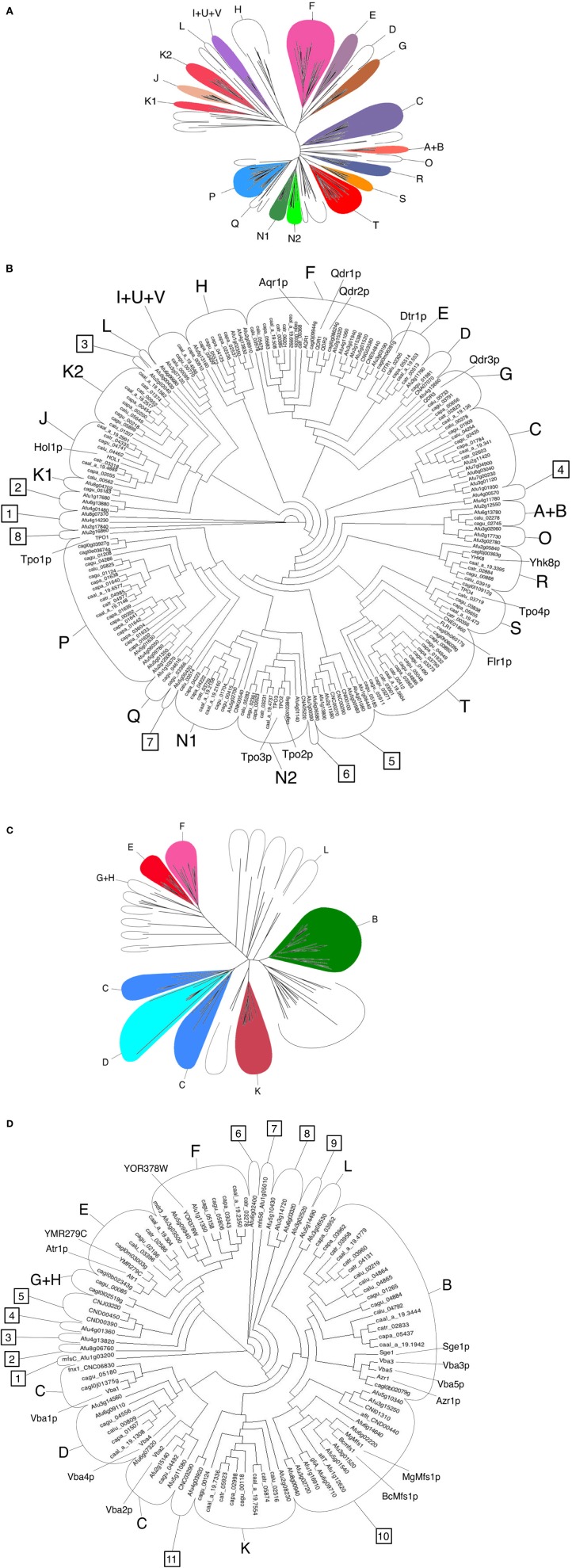
Figure 1
Figure 1
Phylogenetic analysis of DHA1 and DHA2 transporters gathered from the S. cerevisiae S288C reference strain and from eight clinically important fungal species - C. albicans, C. tropicalis, C. parapsilosis, C. guilliermondii, C. lusitaniae, C. glabrata, A. fumigatus and C. neoformans - using the PROTDIST/NEIGHBOR packages of PHYLIP suite, as detailed in (Dias and Sá-Correia, 2013, in press). (A) Radial phylogram showing the amino acid sequence similarity distances between these 197 full-size DHA1 transporters. (B) Circular cladogram showing the corresponding tree topology. The DHA1 proteins are distributed into 20 known phylogenetic clusters, labeled using letters and based on previous cluster annotation (Dias and Sá-Correia, in press), and 8 new phylogenetic clusters (clusters 1–4 and 6–7) comprising only members of the filamentous fungi. (C) Radial phylogram showing the amino acid sequence similarity distances between these 95 full-size DHA2 transporters. (D) Circular cladogram showing the corresponding tree topology. The DHA2 proteins are distributed into 8 known phylogenetic clusters, labeled using letters and based on a previous cluster annotation (Dias and Sá-Correia, 2013), and 11 new phylogenetic clusters (clusters 1–11) comprising only members of the filamentous fungi. The DHA1 and the DHA2 proteins encoded in the genome of S. cerevisiae S288c strain and biochemically characterized MgMfs1 and BcMfs1 DHA2 fungal proteins were used as functional reference and the corresponding names are indicated in the phylogenetic trees. The ARN and GEX proteins (Dias and Sá-Correia, 2013), were not included in this analysis.

References

    1. Albertsen M., Bellahn I., Kramer R., Waffenschmidt S. (2003). Localization and function of the yeast multidrug transporter Tpo1p. J. Biol. Chem. 278, 12820–12825 10.1074/jbc.M210715200 - DOI - PubMed
    1. Barchiesi F., Calabrese D., Sanglard D., Falconi Di Francesco L., Caselli F., Giannini D., et al. (2000). Experimental induction of fluconazole resistance in Candida tropicalis ATCC 750. Antimicrob. Agents Chemother. 44, 1578–1584 10.1128/AAC.44.6.1578-1584.2000 - DOI - PMC - PubMed
    1. Barker K. S., Pearson M. M., Rogers P. D. (2003). Identification of genes differentially expressed in association with reduced azole susceptibility in Saccharomyces cerevisiae. J. Antimicrob. Chemother. 51, 1131–1140 10.1093/jac/dkg217 - DOI - PubMed
    1. Bowyer P., Mosquera J., Anderson M., Birch M., Bromley M., Denning D. W. (2012). Identification of novel genes conferring altered azole susceptibility in Aspergillus fumigatus. FEMS Microbiol. Lett. 332, 10–19 10.1111/j.1574-6968.2012.02575.x - DOI - PMC - PubMed
    1. Brôco N., Tenreiro S., Viegas C. A., Sá-Correia I. (1999). FLR1 gene (ORF YBR008c) is required for benomyl and methotrexate resistance in Saccharomyces cerevisiae and its benomyl-induced expression is dependent on Pdr3 transcriptional regulator. Yeast 15, 1595–1608 10.1002/(SICI)1097-0061(199911)15:15<1595::AID-YEA484>3.0.CO;2-6 - DOI - PubMed

LinkOut - more resources
