Review
. 2014 May 21:5:473.
doi: 10.3389/fpsyg.2014.00473. eCollection 2014.

Tool use disorders after left brain damage

Affiliations
Review

Tool use disorders after left brain damage

Josselin Baumard et al. Front Psychol. .

Abstract

In this paper we review studies that investigated tool use disorders in left-brain damaged (LBD) patients over the last 30 years. Four tasks are classically used in the field of apraxia: Pantomime of tool use, single tool use, real tool use and mechanical problem solving. Our aim was to address two issues, namely, (1) the role of mechanical knowledge in real tool use and (2) the cognitive mechanisms underlying pantomime of tool use, a task widely employed by clinicians and researchers. To do so, we extracted data from 36 papers and computed the difference between healthy subjects and LBD patients. On the whole, pantomime of tool use is the most difficult task and real tool use is the easiest one. Moreover, associations seem to appear between pantomime of tool use, real tool use and mechanical problem solving. These results suggest that the loss of mechanical knowledge is critical in LBD patients, even if all of those tasks (and particularly pantomime of tool use) might put differential demands on semantic memory and working memory.

Keywords: apraxia; mechanical problem solving; pantomime; stroke; tool use.


Figures
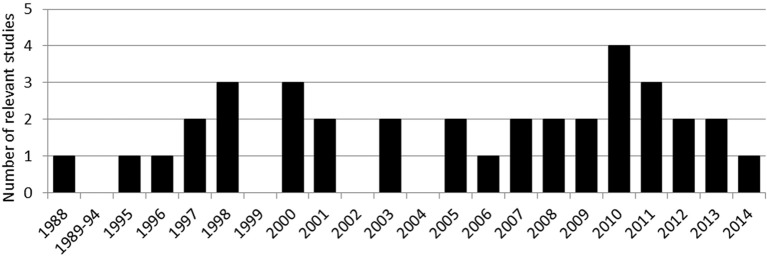
Figure 1
Figure 1
Repartition of the 36 studies included in the present review over time.
Figure 2
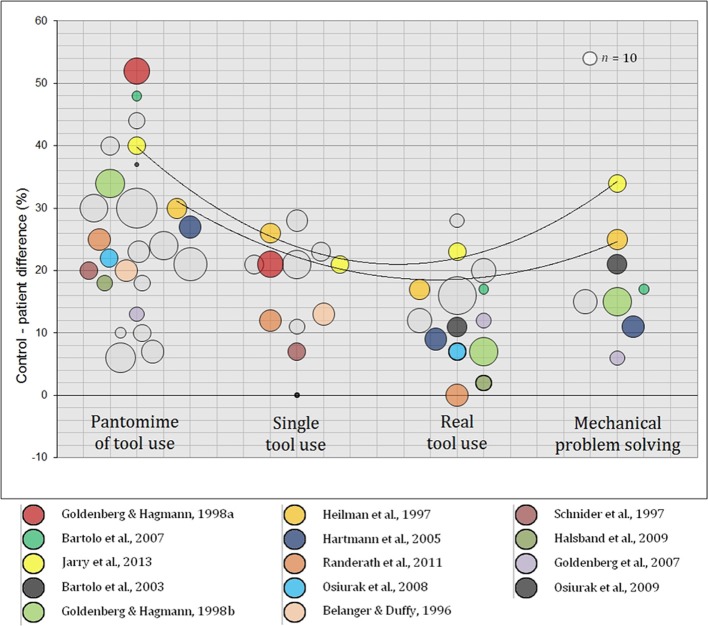
Figure 2
Differences (in percentage) between control subjects and LBD patients: pantomime of tool use, single tool use, real tool use and mechanical problem solving. Colored circles correspond to studies that investigated more than one task. Circles in bold are non-significant differences. Curves were drawn for studies that investigated the four tasks.
Figure 3
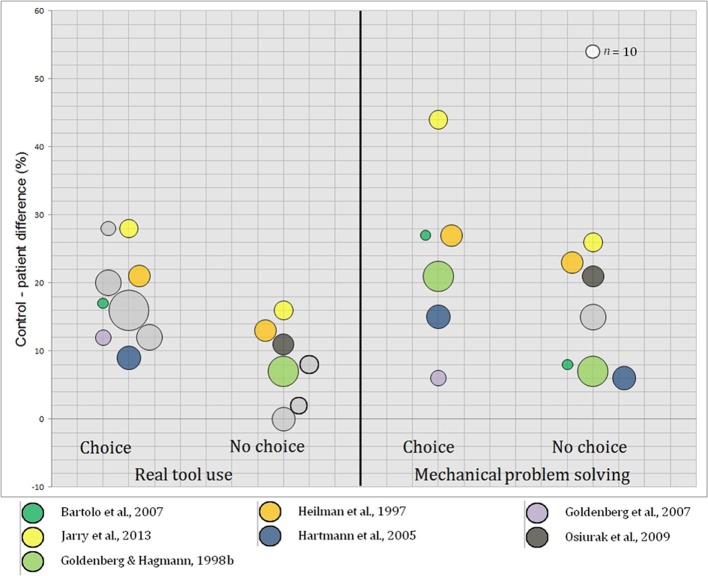
Figure 3
Differences (in percentages) between control subjects and LBD patients in real tool use (Choice and No-Choice) and mechanical problem solving (Choice and No-Choice). Colored circles correspond to studies that investigated more than one condition. Circles in bold are non-significant differences.
Figure 4
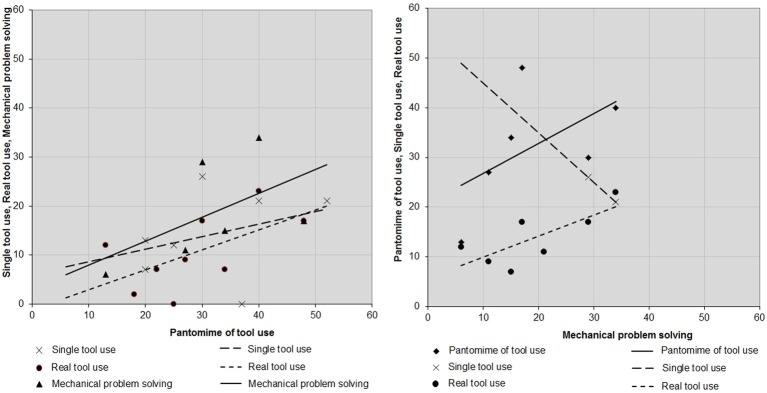
Figure 4
Associations between pantomime of tool use and single tool use, real tool use, and mechanical problem solving (left panel) and between mechanical problem solving and pantomime of tool use, single tool use and real tool use (right panel). Each point corresponds to control-patient differences. Slopes illustrate the degree of association.

References

    1. *. Barbieri C., De Renzi E. (1988). The executive and ideational components of apraxia. Cortex 24, 535–543 10.1016/S0010-9452(88)80047-9 - DOI - PubMed
    1. *. Bartolo A., Cubelli R., Della Sala S., Drei S. (2003). Pantomimes are special gestures which rely on working memory. Brain Cogn. 53, 483–494 10.1016/S0278-2626(03)00209-4 - DOI - PubMed
    1. *. Bartolo A., Daumüller M., Della Sala S., Goldenberg G. (2007). Relationship between object-related gestures and the fractionated object knowledge system. Behav. Neurol. 18, 143–147 10.1155/2007/241670 - DOI - PMC - PubMed
    1. *. Belanger S. A., Duffy R. J. (1996). The assessment of limb apraxia: an investigation of task effects and their cause. Brain Cogn. 32, 384–404 10.1006/brcg.1996.0072 - DOI - PubMed
    1. *. Bickerton W., Riddoch M. J., Samson D., Bahrami Balani A., Mistry B., Humphreys G. W. (2012). Systematic assessment of apraxia and functional predictions from the Birmingham Cognitive Screen. J. Neurol. Neurosur. Psychiatry 83, 513–521 10.1136/jnnp-2011-300968 - DOI - PubMed

LinkOut - more resources