


Never too late? An advantage on tests of auditory attention extends to late bilinguals
- PMID: 24904498
- PMCID: PMC4033267
- DOI: 10.3389/fpsyg.2014.00485
Never too late? An advantage on tests of auditory attention extends to late bilinguals
Abstract
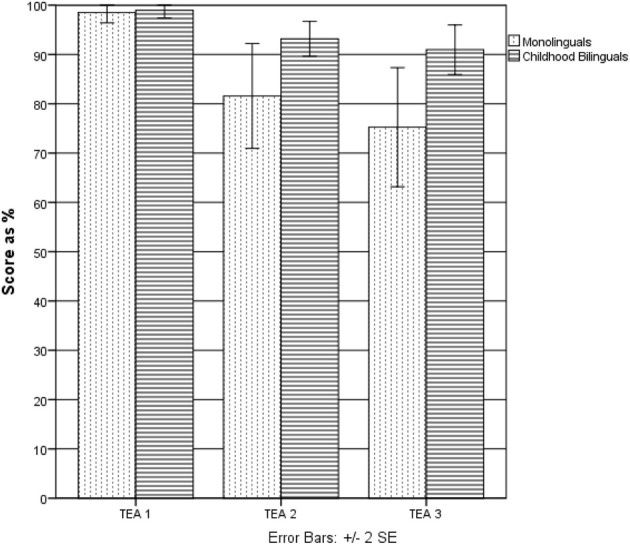
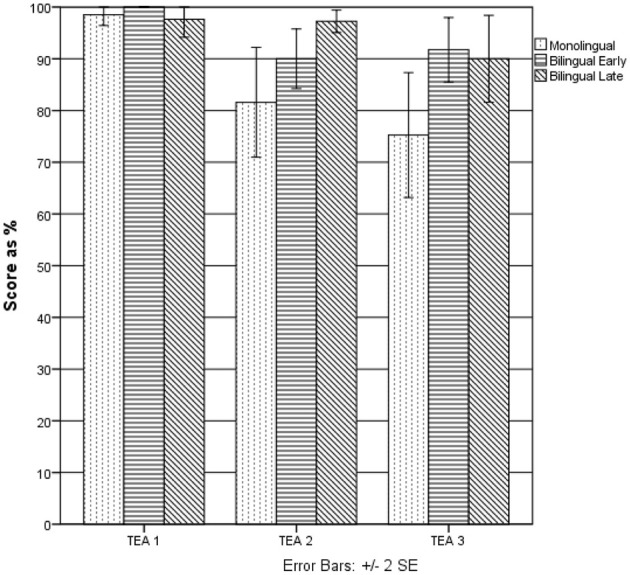
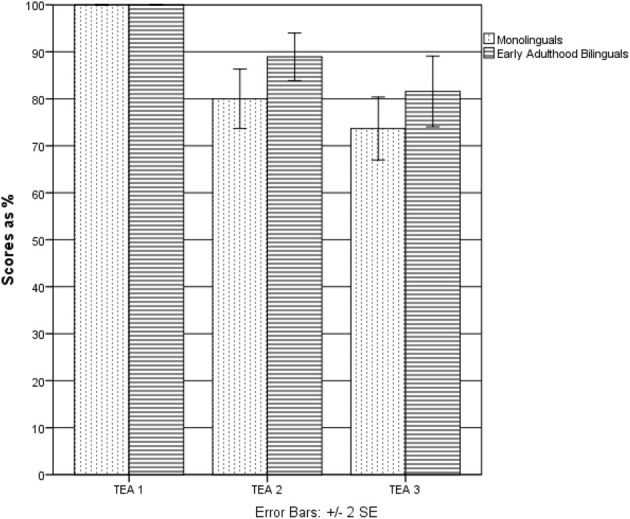
Recent studies, using predominantly visual tasks, indicate that early bilinguals tend to outperform monolinguals on attention tests. It remains less clear whether such advantages extend to those bilinguals who have acquired their second language later in life. We examined this question in 38 monolingual and 60 bilingual university students. The bilingual group was further subdivided into early childhood (ECB), late childhood (LCB), and early adulthood bilinguals (EAB). The assessment consisted of five subtests from the clinically validated Test of Everyday Attention (TEA). Overall, bilinguals outperformed monolinguals on auditory attention tests, but not on visual search tasks. The latter observation suggests that the differences between bilinguals and monolinguals are specific and not due to a generally higher cognitive performance in bilinguals. Within the bilingual group, ECB showed a larger advantage on attention switching, LCB/EAB on selective attention. We conclude that the effects of bilingualism extend into the auditory domain and are not confined to childhood bilinguals, although their scope might be slightly different in early and late bilinguals.
Keywords: age of acquisition; attention; auditory attention; bilingualism; cognition.
Figures
References
-
- Bak T. H., Alladi S. (2014). Can being bilingual affect the onset of dementia? Future Neurol. 9, 101–103 10.2217/fnl.14.8 - DOI
-
- Bak T. H., Mioshi E. (2007). A cognitive bedside assessment beyond the MMSE: the Addenbrooke's cognitive examination. Pract. Neurol. 7, 245–249 - PubMed
-
- Bialystok E. (1999). Cognitive complexity and attentional control in the bilingual mind. Child Dev. 70, 636–644 10.1111/1467-8624.00046 - DOI
-
- Bialystok E. (2007). Cognitive effects of bilingualism: how linguistic experience leads to cognitive change. Int. J. Biling. Educ. Biling. 10, 210–223 10.2167/beb441.0 - DOI
LinkOut - more resources
Full Text Sources
Other Literature Sources
