Review
. 2014 May 21:5:234.
doi: 10.3389/fimmu.2014.00234. eCollection 2014.

Immune responses to inhalant Mammalian allergens

Affiliations
Review

Immune responses to inhalant Mammalian allergens

François Hentges et al. Front Immunol. .

Abstract

In Europe and the USA, at least one person in four is exposed every day to inhalant allergens of mammalian origin, a considerable number is regularly exposed for professional reasons and almost everyone is occasionally exposed to inhalant allergens from pets or domestic animals. The production of IgE to these inhalant allergens, often complicated by asthma and rhinitis, defines the atopic status. However, the immune response to these allergens largely imprints the cellular immune compartment and also drives non-IgE humoral immune responses in the allergic and non-allergic population. During the recent years, it has become clear that IgE antibodies recognize mammalian allergens that belong to three protein or glycoprotein families: the secretoglobins, the lipocalins, and the serum albumins. In this article, we review the humoral and cellular immune responses to the major members of these families and try to define common characteristics and also distinctive features.

Keywords: IgE response; albumin; allergen; cellular response; cross-reactivity; lipocalin; secretoglobin.


Figures
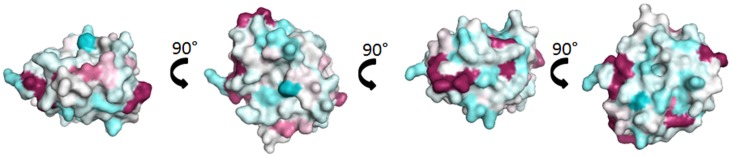
Figure 1
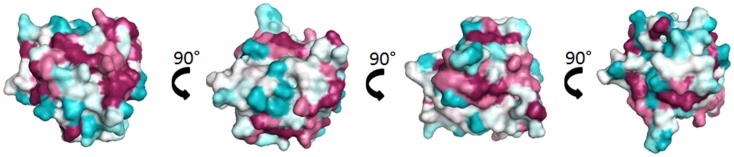
Figure 1
Comparison of Fel d 1 and Ory c 3 composing the secretoglobin group. Surface representation of Fel d 1 (2EJN) (7) colored by sequence conservation with Ory c 3 (Q9GK63; Q9GK67) (9). Sequence conservation was determined through Consurf (10), the highly variable sequence conservation was identified as deep blue, the average was in white, and the conserved sequences are denoted in deep red.
Figure 2
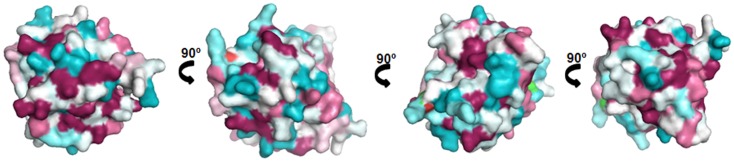
Figure 2
Comparison of the cross-reactive lipocalin group from horse (Equ c 1), cat (Fel d 4), and dog (Can f 6). Surface representation of Equ c 1 (1EW3) (69) colored by sequence conservation with Fel d 4 (Q5VFH6) (70), Can f 6 (H2B3G5) (35).
Figure 3
Figure 3
Comparison of the cross-reactive lipocalin group from rat (Rat n 1), mouse (Mus m 1), and rabbit (Ory c 4). Surface representation of Rat n 1 (1MUP) (71) colored by sequence conservation with Ory c 4 (U6C8D6) (72) and Mus m 1 (P02762) (73).

References

    1. Salo PM, Sever ML, Zeldin DC. Indoor allergens in school and day care environments. J Allergy Clin Immunol (2009) 124(2):185–9210.1016/j.jaci.2009.05.012 - DOI - PMC - PubMed
    1. Heinzerling LM, Burbach GJ, Edenharter G, Bachert C, Bindslev-Jensen C, Bonini S, et al. GA(2)LEN skin test study I: GA(2)LEN harmonization of skin prick testing: novel sensitization patterns for inhalant allergens in Europe. Allergy (2009) 64(10):1498–50610.1111/j.1398-9995.2009.02093.x - DOI - PubMed
    1. Hammad H, Chieppa M, Perros F, Willart MA, Germain RN, Lambrecht BN. House dust mite allergen induces asthma via toll-like receptor 4 triggering of airway structural cells. Nat Med (2009) 15(4):410–610.1038/nm.1946 - DOI - PMC - PubMed
    1. Lambrecht BN, Hammad H. The airway epithelium in asthma. Nat Med (2012) 18(5):684–9210.1038/nm.2737 - DOI - PubMed
    1. Herre J, Gronlund H, Brooks H, Hopkins L, Waggoner L, Murton B, et al. Allergens as immunomodulatory proteins: the cat dander protein Fel d 1 enhances TLR activation by lipid ligands. J Immunol (2013) 191(4):1529–3510.4049/jimmunol.1300284 - DOI - PMC - PubMed

LinkOut - more resources