


The transcriptional regulatory network in the drought response and its crosstalk in abiotic stress responses including drought, cold, and heat
- PMID: 24904597
- PMCID: PMC4032904
- DOI: 10.3389/fpls.2014.00170
The transcriptional regulatory network in the drought response and its crosstalk in abiotic stress responses including drought, cold, and heat
Abstract
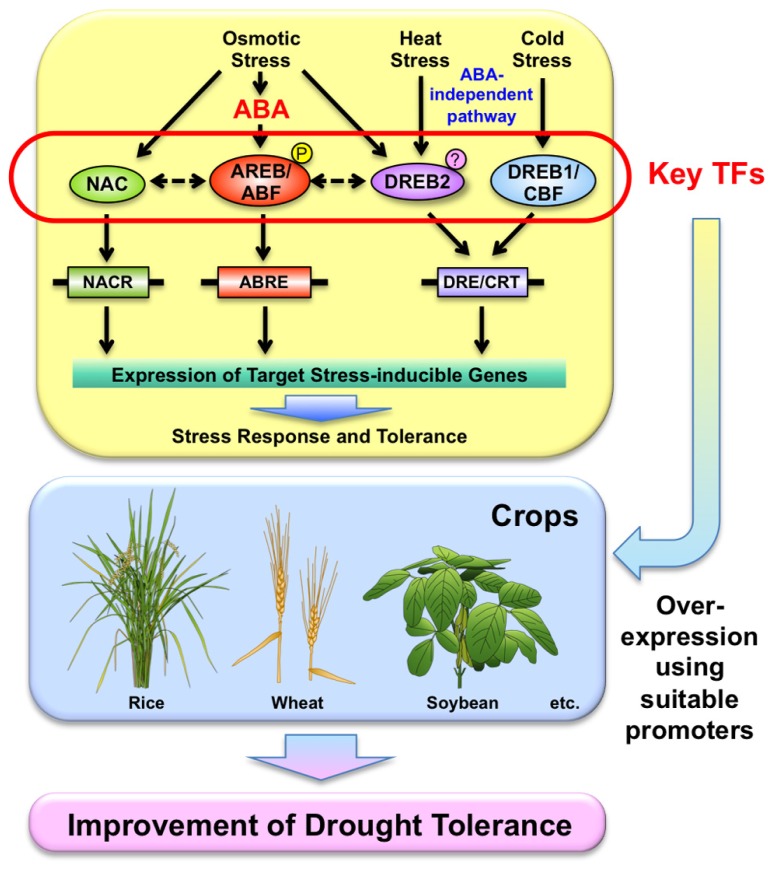
Drought negatively impacts plant growth and the productivity of crops around the world. Understanding the molecular mechanisms in the drought response is important for improvement of drought tolerance using molecular techniques. In plants, abscisic acid (ABA) is accumulated under osmotic stress conditions caused by drought, and has a key role in stress responses and tolerance. Comprehensive molecular analyses have shown that ABA regulates the expression of many genes under osmotic stress conditions, and the ABA-responsive element (ABRE) is the major cis-element for ABA-responsive gene expression. Transcription factors (TFs) are master regulators of gene expression. ABRE-binding protein and ABRE-binding factor TFs control gene expression in an ABA-dependent manner. SNF1-related protein kinases 2, group A 2C-type protein phosphatases, and ABA receptors were shown to control the ABA signaling pathway. ABA-independent signaling pathways such as dehydration-responsive element-binding protein TFs and NAC TFs are also involved in stress responses including drought, heat, and cold. Recent studies have suggested that there are interactions between the major ABA signaling pathway and other signaling factors in stress responses. The important roles of these TFs in crosstalk among abiotic stress responses will be discussed. Control of ABA or stress signaling factor expression can improve tolerance to environmental stresses. Recent studies using crops have shown that stress-specific overexpression of TFs improves drought tolerance and grain yield compared with controls in the field.
Keywords: ABA; abiotic stress; drought; signal transduction; transcription factor.
Figures
References
-
- Alonso-Blanco C., Gomez-Mena C., Llorente F., Koornneef M., Salinas J., Martinez-Zapater J. M. (2005). Genetic and molecular analyses of natural variation indicate CBF2 as a candidate gene for underlying a freezing tolerance quantitative trait locus in Arabidopsis. Plant Physiol. 139 1304–1312 10.1104/pp.105.068510 - DOI - PMC - PubMed
-
- Barbosa E. G. G., Leite J. P., Marin S. R. R., Marinho J. P., Fátima Corrêa Carvalho J., Fuganti-Pagliarini R., et al. (2013). Overexpression of the ABA-dependent AREB1 transcription factor from Arabidopsis thaliana improves soybean tolerance to water deficit. Plant Mol. Biol. Rep. 31 719–730 10.1007/s11105-012-0541-4 - DOI
-
- Bhatnagar-Mathur P., Devi M. J., Reddy D. S., Lavanya M., Vadez V., Serraj R., et al. (2007). Stress-inducible expression of At DREB1A in transgenic peanut (Arachis hypogaea L.) increases transpiration efficiency under water-limiting conditions. Plant Cell Rep. 26 2071–2082. 10.1007/s00299-007-0406-8 - DOI - PubMed
Publication types
LinkOut - more resources
Full Text Sources
Other Literature Sources
