Review
. 2014 May 19:5:207.
doi: 10.3389/fpls.2014.00207. eCollection 2014.

Enhancing crop resilience to combined abiotic and biotic stress through the dissection of physiological and molecular crosstalk

Affiliations
Review

Enhancing crop resilience to combined abiotic and biotic stress through the dissection of physiological and molecular crosstalk

Christos Kissoudis et al. Front Plant Sci. .

Abstract

Plants growing in their natural habitats are often challenged simultaneously by multiple stress factors, both abiotic and biotic. Research has so far been limited to responses to individual stresses, and understanding of adaptation to combinatorial stress is limited, but indicative of non-additive interactions. Omics data analysis and functional characterization of individual genes has revealed a convergence of signaling pathways for abiotic and biotic stress adaptation. Taking into account that most data originate from imposition of individual stress factors, this review summarizes these findings in a physiological context, following the pathogenesis timeline and highlighting potential differential interactions occurring between abiotic and biotic stress signaling across the different cellular compartments and at the whole plant level. Potential effects of abiotic stress on resistance components such as extracellular receptor proteins, R-genes and systemic acquired resistance will be elaborated, as well as crosstalk at the levels of hormone, reactive oxygen species, and redox signaling. Breeding targets and strategies are proposed focusing on either manipulation and deployment of individual common regulators such as transcription factors or pyramiding of non- (negatively) interacting components such as R-genes with abiotic stress resistance genes. We propose that dissection of broad spectrum stress tolerance conferred by priming chemicals may provide an insight on stress cross regulation and additional candidate genes for improving crop performance under combined stress. Validation of the proposed strategies in lab and field experiments is a first step toward the goal of achieving tolerance to combinatorial stress in crops.

Keywords: R-genes; crosstalk; disease resistance; drought; hormones; post-translational modifications; salinity; transcription factors.


Figures
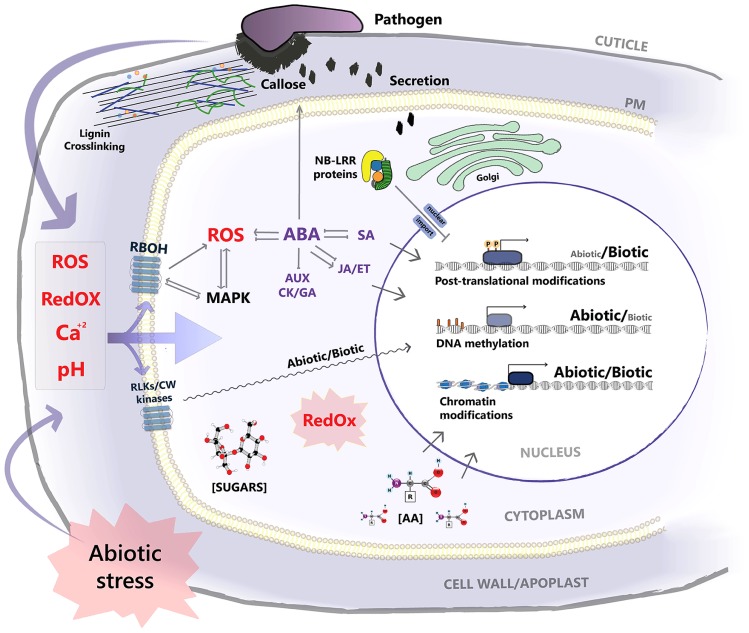
FIGURE 1
FIGURE 1
A scheme for the interaction interface and overlapping signaling pathways of abiotic and biotic stress at the cellular level. Both stress factors affect the homeostasis of chemical signals at the apoplastic space such as Ca2+, ROS, and pH levels. Abiotic stress potentially affects the structure and properties of preformed and inducible physical barriers that function against pathogen penetration. Signaling nodes such as RBOHs and RLKs and other cell wall (CW) kinases localized at the plasma membrane, and MAPKs are shared by both stressors, with downstream signal specificity under stress combination remaining elusive. ABA signaling, central for adaptation to abiotic stress, negatively impinges on defense hormone signaling, while, pathogen dependent, positive interactions are observed for JA signaling. ABA–SA interaction is two sided, as activation of SA signaling by pathogen challenge attenuates ABA responses. ABA positively contributes to pre-invasion defense, enhancing callose deposition. Rewiring of secretory machinery under abiotic stress potentially affects its function in the exocytosis of antimicrobial compounds at the site of infection. Nuclear translocation of R-genes is negatively affected under abiotic stress. Redox state, as well as metabolite concentration such as sugars and amino acids (AA), function as drivers for post-translational modifications, modulating the activity of target proteins/transcription factors. Previously/simultaneously encountered stress effect on chromatin and DNA methylation status, potentially impacts on expression patterns of the recipient genes under stress combination. Transcription factor activation and binding to stress responsive gene promoters is a convergence point regulating the signal output under combinatorial stress with diverse outcomes.
FIGURE 2
FIGURE 2
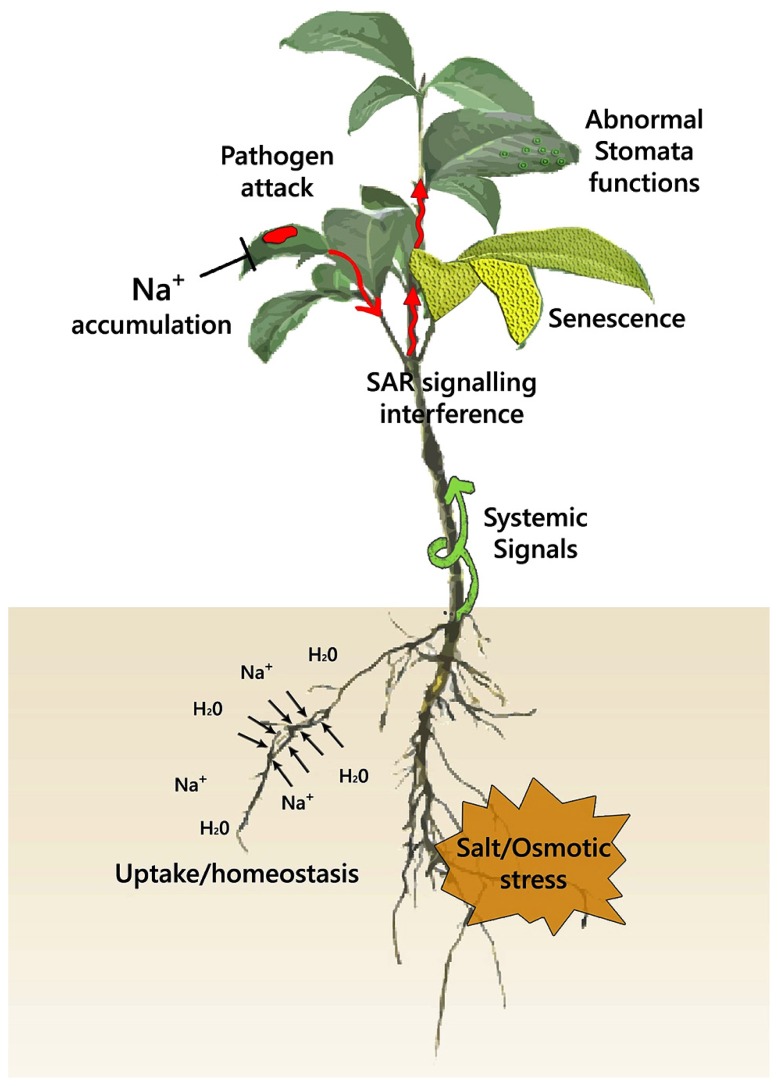
A scheme for the effects of abiotic and biotic stress at the plant level. A combination of abiotic stress with pathogen infection potentially derails hormone and systemic ROS homeostasis. Pathogen infection has been shown to impair stomata closure under non-stress conditions, with the dynamics of this interaction under abiotic stress being unknown. Senescence is a common component of both abiotic and biotic stress that can potentially be amplified under combinatorial stress. Systemic ROS signals generated after pathogen encounter may alter water relation and salt uptake through their effects in root hydraulic conductance and ion transport. Abiotic stress through ABA signaling negatively affects signals that trigger systemic acquired resistance, enhancing pathogen spread from the initial site of infection. Ion accumulation (Na+, Cl-) under salt stress can have a direct toxic effect on pathogen growth.
FIGURE 3
FIGURE 3
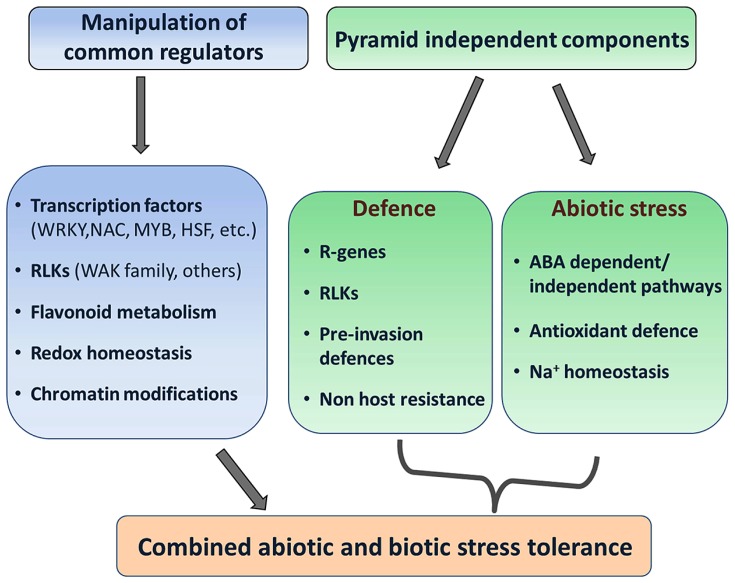
Approaches for building combined abiotic and biotic stress tolerance in plants. Two strategies are proposed through either the manipulation of genetic components which potentially regulate resistance to both stresses in a preferentially unidirectional manner, or the pyramiding of genes that independently confer abiotic or biotic stress resistance and do not (negatively) interact. The selection of individual components might differ depending on the pathogen and the abiotic stress scenario.

References

    1. Abuqamar S., Luo H. L., Laluk K., Mickelbart M. V., Mengiste T. (2009). Crosstalk between biotic and abiotic stress responses in tomato is mediated by the AIM1 transcription factor. Plant J. 58 347–360 10.1111/j.1365-313X.2008.03783.x - DOI - PubMed
    1. Achard P., Renou J. P., Berthome R., Harberd N. P., Genschik P. (2008). Plant DELLAs restrain growth and promote survival of adversity by reducing the levels of reactive oxygen species. Curr. Biol. 18 656–660 10.1016/j.cub.2008.04.034 - DOI - PubMed
    1. Achuo E. A., Prinsen E., Hofte M. (2006). Influence of drought, salt stress and abscisic acid on the resistance of tomato to Botrytis cinerea and Oidium neolycopersici. Plant Pathol. 55 178–186 10.1111/j.1365-3059.2005.01340.x - DOI
    1. Adie B. A. T., Perez-Perez J., Perez-Perez M. M., Godoy M., Sanchez-Serrano J. J., Schmelz E. A., et al. (2007). ABA is an essential signal for plant resistance to pathogens affecting JA biosynthesis and the activation of defenses in Arabidopsis. Plant Cell 19 1665–1681 10.1105/tpc.106.048041 - DOI - PMC - PubMed
    1. Albrecht C., Boutrot F., Segonzac C., Schwessinger B., Gimenez-Ibanez S., Chinchilla D., et al. (2012). Brassinosteroids inhibit pathogen-associated molecular pattern-triggered immune signaling independent of the receptor kinase BAK1. Proc. Natl. Acad. Sci. U.S.A. 109 303–308 10.1073/pnas.1109921108 - DOI - PMC - PubMed

LinkOut - more resources