Review
. 2014 Jun 6;4(3):20130074.
doi: 10.1098/rsfs.2013.0074.

Modelling mammalian cellular quiescence

Affiliations
Review

Modelling mammalian cellular quiescence

Guang Yao. Interface Focus. .

Abstract

Cellular quiescence is a reversible non-proliferating state. The reactivation of 'sleep-like' quiescent cells (e.g. fibroblasts, lymphocytes and stem cells) into proliferation is crucial for tissue repair and regeneration and a key to the growth, development and health of higher multicellular organisms, such as mammals. Quiescence has been a primarily phenotypic description (i.e. non-permanent cell cycle arrest) and poorly studied. However, contrary to the earlier thinking that quiescence is simply a passive and dormant state lacking proliferating activities, recent studies have revealed that cellular quiescence is actively maintained in the cell and that it corresponds to a collection of heterogeneous states. Recent modelling and experimental work have suggested that an Rb-E2F bistable switch plays a pivotal role in controlling the quiescence-proliferation balance and the heterogeneous quiescent states. Other quiescence regulatory activities may crosstalk with and impinge upon the Rb-E2F bistable switch, forming a gene network that controls the cells' quiescent states and their dynamic transitions to proliferation in response to noisy environmental signals. Elucidating the dynamic control mechanisms underlying quiescence may lead to novel therapeutic strategies that re-establish normal quiescent states, in a variety of hyper- and hypo-proliferative diseases, including cancer and ageing.

Keywords: bistable switch; cell cycle; cellular quiescence; gene network.


Figures
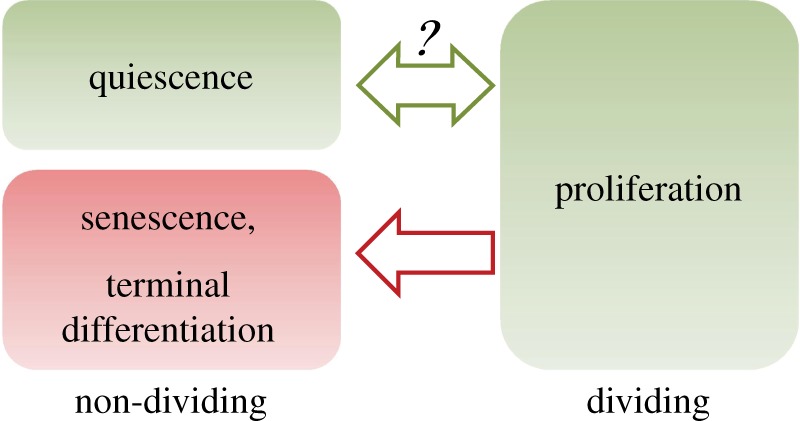
Figure. 1.
Figure. 1.
Cellular quiescence. Quiescence differs from other non-dividing states in that it can be reverted into proliferation. The molecular mechanisms underlying quiescence and its reversibility are unknown. (Online version in colour.)
Figure 2.
Figure 2.
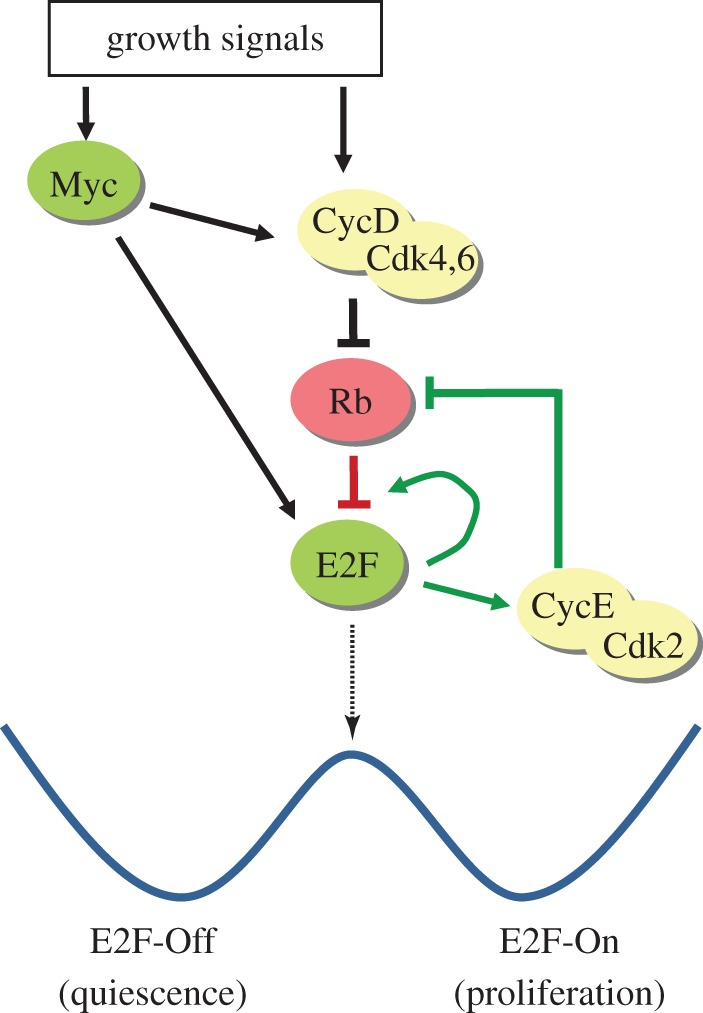
The Rb-E2F bistable switch. A simplified view of the Rb-E2F pathway is shown (at the top). The Rb-E2F pathway functions as a bistable switch, represented by the double-well potential wave (at the bottom). The two wells represent the two stable steady states of the bistable system (E2F-Off and E2F-On), which underlie cellular quiescence and proliferation, respectively. The ‘energy barrier’ that separates the two wells corresponds to the R-point, which is an unstable steady state of the Rb-E2F bistable system. (Online version in colour.)
Figure 3.
Figure 3.
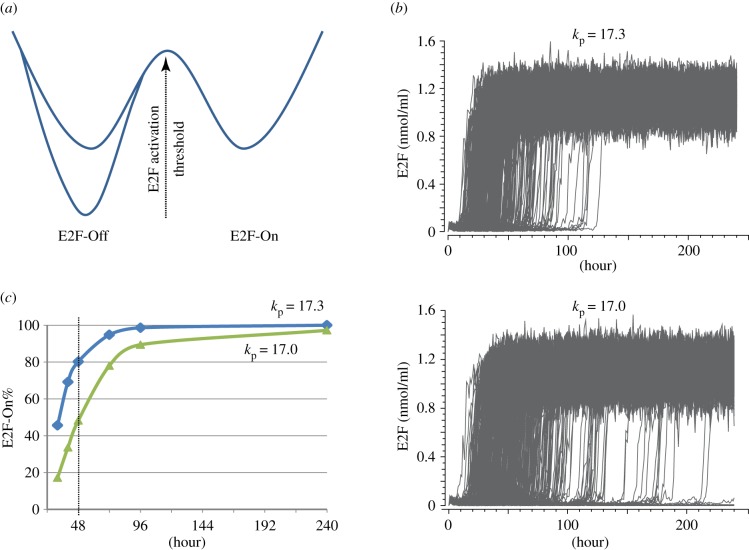
E2F activation threshold defines quiescent state depth. (a) Different quiescent states correspond to the same E2F-Off steady state (indicated by the same horizontal position of the two left wells, relative to the horizontal position of the E2F-On well on the right); however, they correspond to different E2F activation thresholds (indicated by the different depths of the two left E2F-Off wells, from which different serum stimulation strengths are required to turn On the Rb-E2F bistable switch). (b) Stochastic simulations of the Rb-E2F bistable switch model [84]. The parameter kp refers to the phosphorylation rate constants of Rb family proteins by G1 cyclin/Cdk activities. The deeper and shallower quiescent states (determined by the activator/inhibitor balance in the Rb-E2F pathway) are implemented with kp values 17 and 17.3, respectively. A total of 500 stochastic simulations with 1% serum stimulation are shown under each condition. (c) The percentage of E2F-On cells is graphed against time (with 1% serum stimulation) from simulations in (b). For the condition of kp = 17 (the deeper quiescent state), the E2F-On% reaches 50% by 48 h and thus its E2F activation potential is 1%; for the condition of kp = 17.3 (the shallower quiescent state), the E2F activation potential would be less than 1%. (Online version in colour.)

References

    1. Cheung TH, Rando TA. 2013. Molecular regulation of stem cell quiescence. Nat. Rev. Mol. Cell Biol. 14, 329–340. ( 10.1038/nrm3591) - DOI - PMC - PubMed
    1. Legesse-Miller A, et al. 2012. Quiescent fibroblasts are protected from proteasome inhibition-mediated toxicity. Mol. Biol. Cell 23, 3566–3581. ( 10.1091/mbc.E12-03-0192) - DOI - PMC - PubMed
    1. Coller HA, Sang L, Roberts JM. 2006. A new description of cellular quiescence. PLoS Biol. 4, e83 ( 10.1371/journal.pbio.0040083) - DOI - PMC - PubMed
    1. Liu H, Adler AS, Segal E, Chang HY. 2007. A transcriptional program mediating entry into cellular quiescence. PLoS Genet. 3, 996–1008. ( 10.1371/journal.pgen.0030091) - DOI - PMC - PubMed
    1. Yusuf I, Fruman DA. 2003. Regulation of quiescence in lymphocytes. Trends Immunol. 24, 380–386. ( 10.1016/S1471-4906(03)00141-8) - DOI - PubMed