. 2014 May;124(5):2071-5.
doi: 10.1172/JCI73186. Epub 2014 Apr 8.

Testicular differentiation factor SF-1 is required for human spleen development

Testicular differentiation factor SF-1 is required for human spleen development

David Zangen et al. J Clin Invest. 2014 May.

Abstract

The transcription factor steroidogenic factor 1 (SF-1; also known as NR5A1) is a crucial mediator of both steroidogenic and nonsteroidogenic tissue differentiation. Mutations within SF1 underlie different disorders of sexual development (DSD), including sex reversal, spermatogenic failure, ovarian insufficiency, and adrenocortical deficiency. Here, we identified a recessive mutation within SF1 that resulted in a substitution of arginine to glutamine at codon 103 (R103Q) in a child with both severe 46,XY-DSD and asplenia. The R103Q mutation decreased SF-1 transactivation of TLX1, a transcription factor that has been shown to be essential for murine spleen development. Additionally, the SF1 R103Q mutation impaired activation of steroidogenic genes, without affecting synergistic SF-1 and sex-determining region Y (SRY) coactivation of the testis development gene SOX9. Together, our data provide evidence that SF-1 is required for spleen development in humans via transactivation of TLX1 and that mutations that only impair steroidogenesis, without altering the SF1/SRY transactivation of SOX9, can lead to 46,XY-DSD.


Figures
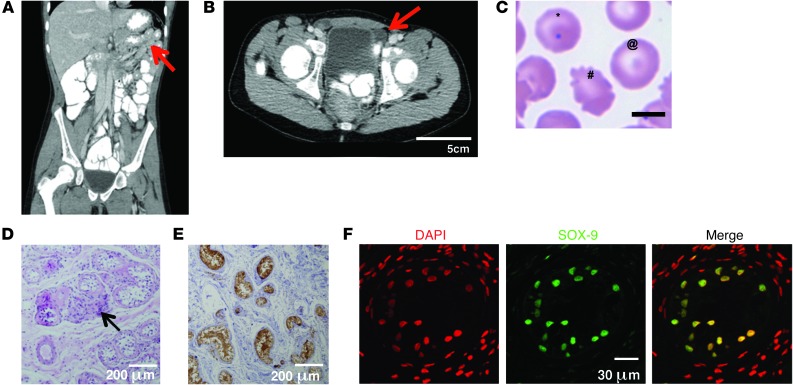
Figure 1
Figure 1. Phenotypic features of the patient.
(A) CT scan of the patient’s abdomen, revealing asplenia (arrow) and lack of uterus. (B) CT scan of the inguinal region, revealing inguinal testes (arrow). (C) Patient’s peripheral blood smear, with Howell-Jolly bodies (*), target cells (@), and poikilocytosis (#) indicative of asplenia. (D) H&E staining showed paucity of Leydig cells (arrow), lack of germinal cells, and abundance of Sertoli cells. (E) Paraffin-embedded sections of the patient’s testes immunostained with anti-inhibin antibody (brown). (F) Immunofluorescent staining of the proband’s testis with anti–SOX-9 antibody (green) and general nuclear staining with DAPI (red). Positive SOX-9 staining in Sertoli cells was similar in strength in the patient’s testes and in the control testes, which had a higher total number of cells, consisting mostly of germinal and pregerminal cells (not shown). Scale bars: 5 μm (C); 200 μm (D and E); 30 μm (F).
Figure 2
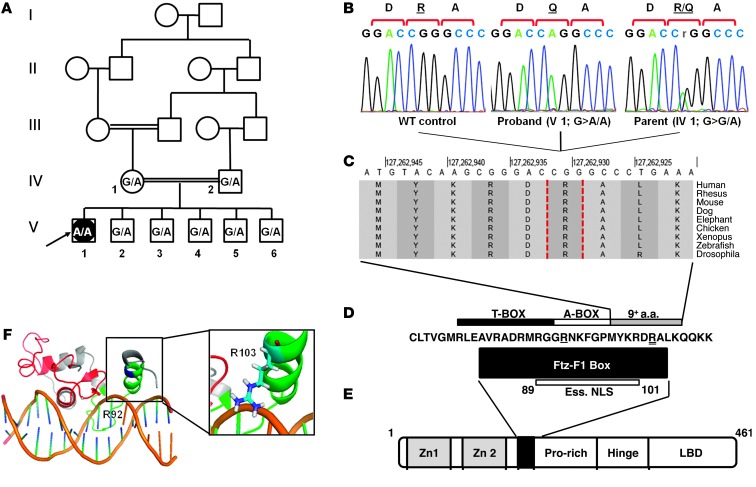
Figure 2. Characterization of the SF1 mutation in the patient’s family.
(A) Pedigree of the patient’s consanguineous family. The proband (V1, arrow) a 46,XY female, has healthy first-cousin parents (IV1 and IV2) and 5 siblings (V2–V6). SF1 c.308 genotype (G, WT; A, mutant) is shown for each. (B) DNA sequencing chromatograms of the c.308G>A mutation (p.R103Q): homozygous in the proband, heterozygous in the mother, absent in a control (subject numbering as in A). (C) Cross-species conservation of the residues adjacent to R103 (dashed vertical outlines). Data were obtained from the UCSC human genome browser (24). (D) Conserved sequence of the Ftz-F1 box, the T-box and A-box subdomains, and the essential nuclear localization signal (Ess. NLS) of SF1 (6, 25). Residues mutated in the R92Q and R103Q mutations are denoted by single and double underline, respectively. (E) SF1 protein domains, including 2 zinc finger motifs, Ftz-F1 box (black box), proline-rich domain, hinge domain, and ligand-binding domain (LBD). (F) 3D model (generated using PyMol software; ref. 26) based on the solution structure of SF1 (7), showing the DNA-binding domain bound to its target sequence in the inhibin α subunit promoter. The 2 zinc finger motifs are shown in red, Ftz-F1 box is green, and R103 is blue. Inset shows the orientation of the R103 side chain, with the positive charge adjacent to the negatively charged DNA backbone.
Figure 3
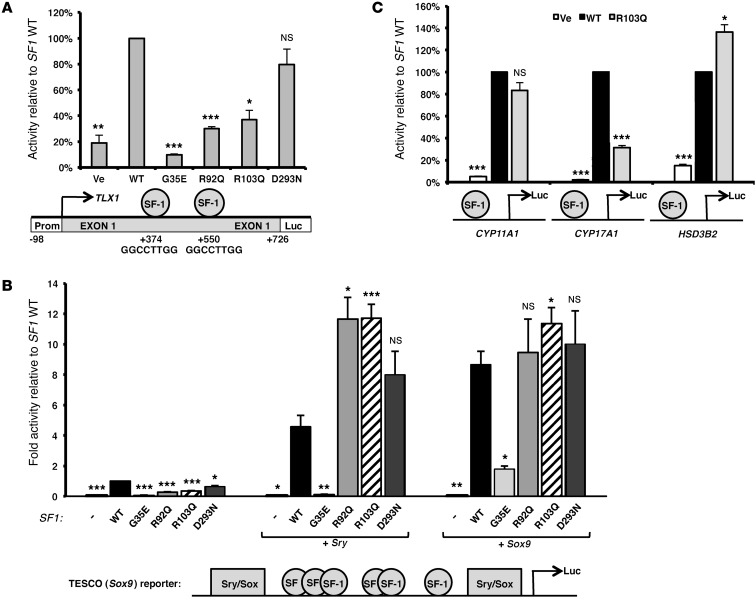
Figure 3. Functional studies of the SF1 R103Q mutant.
Transcriptional activation of spleen-specific (A), testes-specific (B), and steroidogenic (C) promoters by WT or mutant SF1 expression vectors were assayed by transient cotransfection of the expression vectors using the Promega Dual Luciferase assay system. For SF-1 binding elements in the reporters, see Supplemental Table 3. (A) Transcriptional activation of the spleen development–specific TLX1 promoter by WT and mutant SF1 constructs was studied in COS-7 cells. Ve, empty vector control. The TLX1 promoter–luciferase reporter construct is shown below, with the TLX1 promoter, transcription start site (arrow), exon 1 harboring 2 SF-1 binding sequences (spheres), and the luciferase reporter gene (Luc). Numbering is relative to the TLX1 transcription start site, at position +1. (B) Activity of the SOX9 testis-specific TESCO-luciferase enhancer, harboring both SF-1 and SRY/SOX binding sites, was measured in COS-7 cells. Transfections were performed using empty vector control (–) or WT or mutant SF1 expression vectors, either alone or together with Sry-myc or Sox9 expression vectors (3). A schematic illustration of the reporter construct is shown below. (C) Activity of the steroidogenic CYP11A1 (left), CYP17A1 (middle), and HSD3B2 (right) promoter reporter constructs (27) transfected with the SF1 constructs into nonsteroidogenic HEK293 cells. Results represent mean ± SEM relative luciferase activity of 4–5 independent experiments performed in duplicate. *P < 0.05, **P < 0.01, ***P < 0.001 vs. WT.

References

    1. Luo X, Ikeda Y, Parker KL. A cell-specific nuclear receptor is essential for adrenal and gonadal development and sexual differentiation. Cell. 1994;77(4):481–490. doi: 10.1016/0092-8674(94)90211-9. - DOI - PubMed
    1. Shen WH, Moore CC, Ikeda Y, Parker KL, Ingraham HA. Nuclear receptor steroidogenic factor 1 regulates the mullerian inhibiting substance gene: a link to the sex determination cascade. Cell. 1994;77(5):651–661. doi: 10.1016/0092-8674(94)90050-7. - DOI - PubMed
    1. Sekido R, Lovell-Badge R. Sex determination involves synergistic action of SRY and SF1 on a specific Sox9 enhancer. Nature. 2008;453(7197):930–934. doi: 10.1038/nature06944. - DOI - PubMed
    1. Soardi FC, Coeli FB, Maciel-Guerra AT, Guerra-Junior G, Mello MP. Complete XY gonadal dysgenesis due to p.D293N homozygous mutation in the NR5A1 gene: a case study. J Appl Genet. 2010;51(2):223–224. doi: 10.1007/BF03195733. - DOI - PubMed
    1. Achermann JC, et al. Gonadal determination and adrenal development are regulated by the orphan nuclear receptor steroidogenic factor-1, in a dose-dependent manner. J Clin Endocrinol Metab. 2002;87(4):1829–1833. - PubMed

Publication types

MeSH terms