


Spousal involvement and CPAP adherence: a dyadic perspective
- PMID: 24906222
- PMCID: PMC4225184
- DOI: 10.1016/j.smrv.2014.04.005
Spousal involvement and CPAP adherence: a dyadic perspective
Abstract
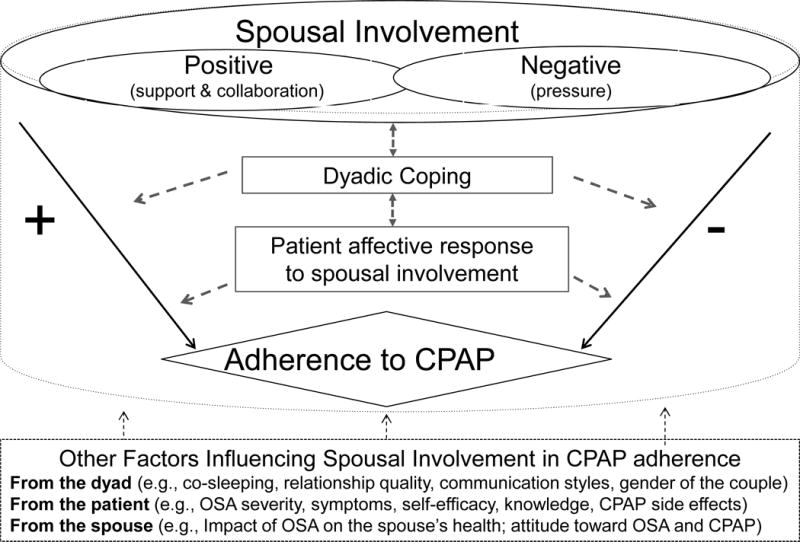
Poor adherence to continuous positive airway pressure (CPAP) treatment is associated with substantial health care costs, morbidity and mortality, and has been a leading obstacle in the effective management of obstructive sleep apnea (OSA). Successful interventions to improve CPAP adherence may ultimately include a variety of components. For patients living with spouses (refers to all domestic partners), the spouse will likely be an integral component to any successful intervention. Developing understanding of the role of spouses in adherence to CPAP has been identified to be a critical research need. This review expands the investigation of CPAP adherence to a broader context, from an exclusive focus on individual patients to a dyadic perspective encompassing both patients and their spouses. A conceptual framework based on social support and social control theories is proposed to understand spousal involvement in CPAP adherence. Methodologies for future investigations are discussed, along with implications for developing interventions that engage both patients and their spouses to improve CPAP use.
Keywords: Continuous positive airway pressure; Lung; Obstructive sleep apnea; Spousal involvement; Treatment adherence.
Copyright © 2014 Elsevier Ltd. All rights reserved.
Conflict of interest statement
Disclosure Statement: Dr. Weaver has received research grant support from TEVA, Inc., research equipment from Philips Respironics, Inc., royalty fees for use of the Functional Outcomes of Sleep Questionnaire from Nova Som, GlaxoSmithKline, Philips Respironics, TEVA, Inc., and Nova Nordsk, and has served on Board of Directors of ViMedicus, Inc. Dr. Aloia is a paid employee and stock holder for Philips Healthcare. The other authors have no pertinent personal financial interests.
Figures
References
-
- Gay P, Weaver T, Loube D, Iber C. Evaluation of positive airway pressure treatment for sleep related breathing disorders in adults. Sleep. 2006;29:381–401. - PubMed
-
- Giles TL, Lasserson TJ, Smith BH, White J, Wright J, Cates CJ. Continuous positive airways pressure for obstructive sleep apnoea in adults. Cochrane Database Syst Rev. 2006;3:CD001106. - PubMed
-
- McDaid C, Duree KH, Griffin SC, Weatherly HL, Stradling JR, Davies RJ, et al. A systematic review of continuous positive airway pressure for obstructive sleep apnoea-hypopnoea syndrome. Sleep Med Rev. 2009;13:427–36. - PubMed
-
- Weaver TE, Kribbs NB, Pack AI, Kline LR, Chugh DK, Maislin G, et al. Night-to-night variability in CPAP use over the first three months of treatment. Sleep. 1997;20:278–83. - PubMed
Publication types
MeSH terms
Grants and funding
LinkOut - more resources
Full Text Sources
Other Literature Sources
