. 2014 Aug;64(Pt 8):2738-2752.
doi: 10.1099/ijs.0.063172-0. Epub 2014 Jun 6.

Nitrososphaera viennensis gen. nov., sp. nov., an aerobic and mesophilic, ammonia-oxidizing archaeon from soil and a member of the archaeal phylum Thaumarchaeota

Affiliations

Nitrososphaera viennensis gen. nov., sp. nov., an aerobic and mesophilic, ammonia-oxidizing archaeon from soil and a member of the archaeal phylum Thaumarchaeota

Michaela Stieglmeier et al. Int J Syst Evol Microbiol. 2014 Aug.

Abstract

A mesophilic, neutrophilic and aerobic, ammonia-oxidizing archaeon, strain EN76(T), was isolated from garden soil in Vienna (Austria). Cells were irregular cocci with a diameter of 0.6-0.9 µm and possessed archaella and archaeal pili as cell appendages. Electron microscopy also indicated clearly discernible areas of high and low electron density, as well as tubule-like structures. Strain EN76(T) had an S-layer with p3 symmetry, so far only reported for members of the Sulfolobales. Crenarchaeol was the major core lipid. The organism gained energy by oxidizing ammonia to nitrite aerobically, thereby fixing CO2, but growth depended on the addition of small amounts of organic acids. The optimal growth temperature was 42 °C and the optimal pH was 7.5, with ammonium and pyruvate concentrations of 2.6 and 1 mM, respectively. The genome of strain EN76(T) had a DNA G+C content of 52.7 mol%. Phylogenetic analyses of 16S rRNA genes showed that strain EN76(T) is affiliated with the recently proposed phylum Thaumarchaeota, sharing 85% 16S rRNA gene sequence identity with the closest cultivated relative 'Candidatus Nitrosopumilus maritimus' SCM1, a marine ammonia-oxidizing archaeon, and a maximum of 81% 16S rRNA gene sequence identity with members of the phyla Crenarchaeota and Euryarchaeota and any of the other recently proposed phyla (e.g. 'Korarchaeota' and 'Aigarchaeota'). We propose the name Nitrososphaera viennensis gen. nov., sp. nov. to accommodate strain EN76(T). The type strain of Nitrososphaera viennensis is strain EN76(T) ( = DSM 26422(T) = JMC 19564(T)). Additionally, we propose the family Nitrososphaeraceae fam. nov., the order Nitrososphaerales ord. nov. and the class Nitrososphaeria classis nov.


Figures

Fig. 1.
Fig. 1.
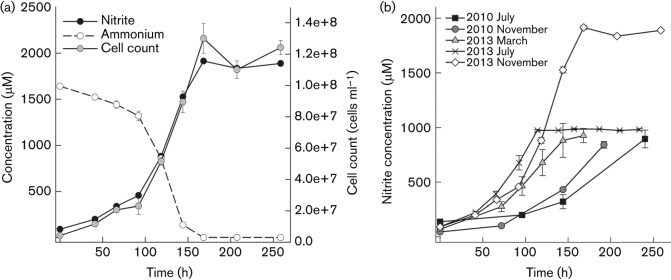
(a) Growth curve of a culture of strain EN76T grown at 42 °C with 2 mM NH4Cl and 1 mM pyruvate. Cell counts, ammonium consumption and nitrite production were used to follow growth. Data represent mean values of triplicate cultures with standard deviations plotted (sometimes smaller than symbols). (b) Acceleration of growth of strain EN76T since purification of the strain in 2010 (Tourna et al., 2011). The cultivation conditions were as follows: July 2010 and November 2010, 37 °C, 1 mM NH4Cl, 1 mM pyruvate; March 2013, 37 °C, 1 mM NH4Cl, 0.1 mM pyruvate; July 2013, 42 °C, 1 mM NH4Cl, 0.8 mM pyruvate; November 2013, 42 °C, 2 mM NH4Cl, 1 mM pyruvate. Nitrite production was used to follow growth. Data represent mean values of replicated cultures (three to five replicates) with standard deviations plotted (sometimes smaller than symbols). Data points previously published in Fig. 3(b) of Tourna et al. (2011) (i.e. July 2010) were included in the figure.
Fig. 2.
Fig. 2.
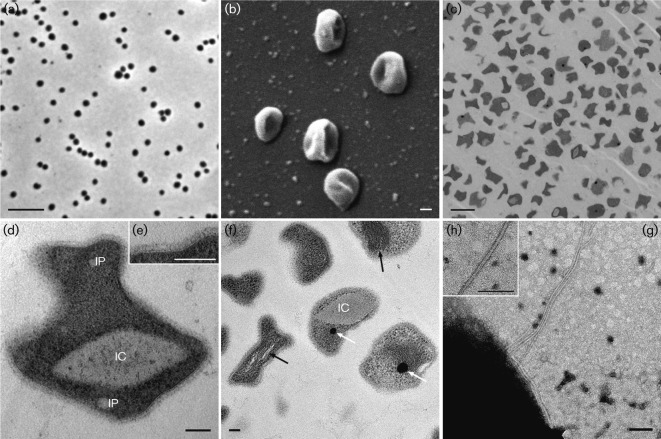
Ultrastructure of cells of strain EN76T. (a) Phase-contrast image; bar, 5 µm. (b) Scanning electron micrograph of several cells depicting the irregular coccoid shape; bar, 100 nm. (c–f) TEM images of ultrathin sections of chemically fixed cells of strain EN76T. (c) Overview displaying the irregular cell shape; bar, 1 µm. (d) Magnified cell showing intracellular features including a clearly discernible area [potential intracellular compartment (IC)] and incorporations (IP). The inset (e) illustrates the cell membrane, pseudo-periplasm and S-layer at higher magnification; bars, 100 nm. (f) Potential intracellular compartment (IC), tubule-like structures (white arrows) and electron-dense particles (black arrows) are highlighted; bar, 100 nm. (g, h) Transmission electron micrographs of a cell with an archaellum; inset (h) shows the magnified archaellum. Bars, 100 nm.
Fig. 3.
Fig. 3.
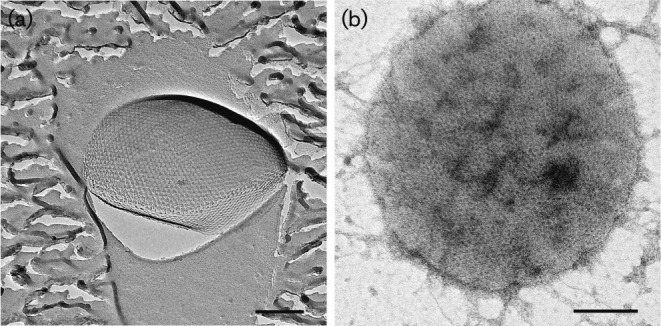
Electron micrographs of a freeze-etching replica (a) and a negatively stained purified S-layer sheet (b) of a cell of strain EN76T. Bars, 200 nm.
Fig. 4.
Fig. 4.
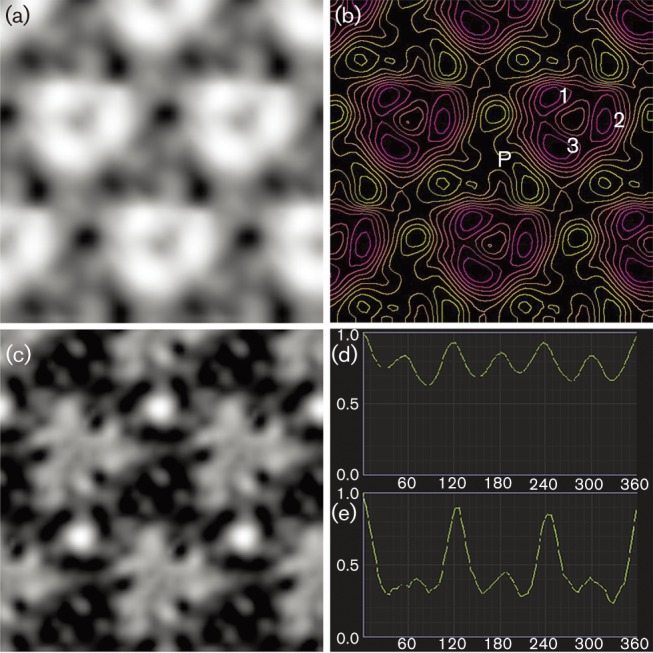
Determination of S-layer symmetry of EN76T. (a) Correlation averaging of the freeze-etched S-layer from Fig. 3(a), showing the protein subunits (white areas) and pores (grey and black areas). (b) Relief reconstruction of the averaged image from (a). The crystal unit cell probably consists of a trimer of protein-trimers, of which one is indicated (1–3). Elevated areas are labelled violet and red and depths are labelled yellow, revealing a triangular cavity or pore (P). (c) Correlation averaging of the negatively stained S-layer from Fig. 3(b). Similar to (a), the proteins are represented by white and light-grey areas and uranyl acetate-filled cavities by dark-grey and black areas. (d) and (e) show the determination of S-layer symmetry of the unit cells in (a) and (c), respectively. The images were tilted by increments of 5° and the correlation with the original, untilted image (set as 1) is plotted against the tilting angle.
Fig. 5.
Fig. 5.
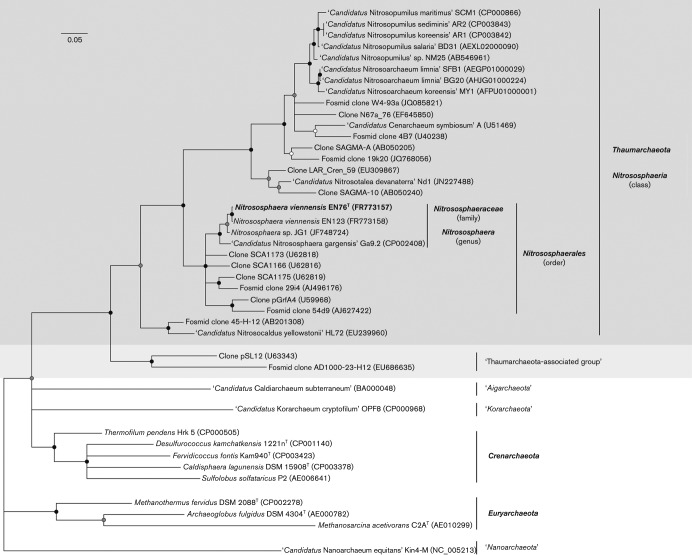
Maximum-likelihood 16S rRNA gene phylogeny of the Thaumarchaeota and representative strains of the Crenarchaeota, Euryarchaeota and other proposed archaeal phyla. The tree depicts Nitrososphaera viennensis EN76T (bold), the marine pure culture ‘Candidatus Nitrosopumilus maritimus’ SCM1, organisms from laboratory or natural enrichment cultures (labelled Candidatus) and a selection of environmental sequences representing major uncultured lineages. Proposed phyla and uncharacterized archaeal lineages are placed in quotes. Phylogeny reconstruction was based on 1202-bp 16S rRNA gene fragments and calculated with RaxML VI-HPC using the GTR+I+G model. Bootstrap support values (1000 replicates) are indicated by circles: filled, ≥90 %; shaded, ≥80 % but <90 %; open, ≥70 % but <80 %. Some branching points are not well supported in the displayed tree, such as the lineages of ‘Candidatus Caldiarchaeum’ and ‘Candidatus Korarchaeum’. The former was affiliated rather with Thaumarchaeota in more comprehensive phylogenetic calculations (see e.g. Eme et al., 2013).

References

    1. Adair K. L., Schwartz E. (2008). Evidence that ammonia-oxidizing archaea are more abundant than ammonia-oxidizing bacteria in semiarid soils of northern Arizona, USA. Microb Ecol 56, 420–426 10.1007/s00248-007-9360-9 - DOI - PubMed
    1. Alonso-Sáez L., Waller A. S., Mende D. R., Bakker K., Farnelid H., Yager P. L., Lovejoy C., Tremblay J. E., Potvin M. & other authors (2012). Role for urea in nitrification by polar marine archaea. Proc Natl Acad Sci U S A 109, 17989–17994 10.1073/pnas.1201914109 - DOI - PMC - PubMed
    1. Alves R. J. E., Wanek W., Zappe A., Richter A., Svenning M. M., Schleper C., Urich T. (2013). Nitrification rates in Arctic soils are associated with functionally distinct populations of ammonia-oxidizing archaea. ISME J 7, 1620–1631 10.1038/ismej.2013.35 - DOI - PMC - PubMed
    1. Amano F., Noda T. (1995). Improved detection of nitric oxide radical (NO·) production in an activated macrophage culture with a radical scavenger, carboxy PTIO and Griess reagent. FEBS Lett 368, 425–428 10.1016/0014-5793(95)00700-J - DOI - PubMed
    1. Andrews S. C., Robinson A. K., Rodríguez-Quiñones F. (2003). Bacterial iron homeostasis. FEMS Microbiol Rev 27, 215–237 10.1016/S0168-6445(03)00055-X - DOI - PubMed

Publication types

Associated data