


Nutrient-induced changes in the phenotype and function of the enteric nervous system
- PMID: 24907307
- PMCID: PMC4214652
- DOI: 10.1113/jphysiol.2014.272948
Nutrient-induced changes in the phenotype and function of the enteric nervous system
Abstract
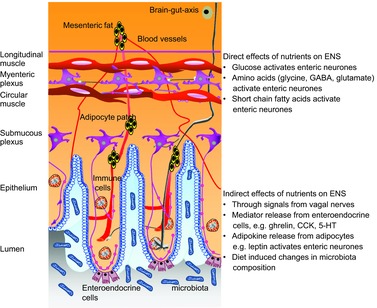
The enteric nervous system (ENS) integrates numerous sensory signals in order to control and maintain normal gut functions. Nutrients are one of the prominent factors which determine the chemical milieu in the lumen and, after absorption, also within the gut wall. This review summarizes current knowledge on the impact of key nutrients on ENS functions and phenotype, covering their acute and long-term effects. Enteric neurones contain the molecular machinery to respond specifically to nutrients. These transporters and receptors are not expressed exclusively in the ENS but are also present in other cells such as enteroendocrine cells (EECs) and extrinsic sensory nerves, signalling satiety or hunger. Glucose, amino acids and fatty acids all activate enteric neurones, as suggested by enhanced c-Fos expression or spike discharge. These excitatory effects are the result of a direct neuronal activation but also involve the activation of EECs which, upon activation by luminal nutrients, release mediators such as ghrelin, cholecystokinin or serotonin. The presence or absence of nutrients in the intestinal lumen induces long-term changes in neurotransmitter expression, excitability, neuronal survival and ultimately impact upon gut motility, secretion or intestinal permeability. Together with EECs and vagal nerves, the ENS must be recognized as an important player initiating concerted responses to nutrients. It remains to be studied how, for instance, nutrient-induced changes in the ENS may influence additional gut functions such as intestinal barrier repair, intestinal epithelial stem cell proliferation/differentiation and also the signalling of extrinsic nerves to brain regions which control food intake.
© 2014 The Authors. The Journal of Physiology © 2014 The Physiological Society.
Figures
References
-
- Balen D, Ljubojević M, Breljak D, Brzica H, Žlender V, Koepsell H, Sabolić I. Revised immunolocalization of the Na+d-glucose cotransporter SGLT1 in rat organs with an improved antibody. Am J Physiol Cell Physiol. 2008;295:C475–C489. - PubMed
-
- Bertrand PP, Kunze WA, Bornstein JC, Furness JB, Smith ML. Analysis of the responses of myenteric neurons in the small intestine to chemical stimulation of the mucosa. Am J Physiol Gastrointest Liver Physiol. 1997;273:G422–G435. - PubMed
-
- Carey HV, Cooke HJ. Intestinal secretion after jejunal bypass in the ground squirrel. Am J Physiol Regul Integr Comp Physiol. 1992;263:R1209–R1214. - PubMed
Publication types
MeSH terms
LinkOut - more resources
Full Text Sources
Other Literature Sources
Medical
