


Carriage of Staphylococcus aureus by free-living wild animals in Spain
- PMID: 24907325
- PMCID: PMC4135777
- DOI: 10.1128/AEM.00647-14
Carriage of Staphylococcus aureus by free-living wild animals in Spain
Abstract
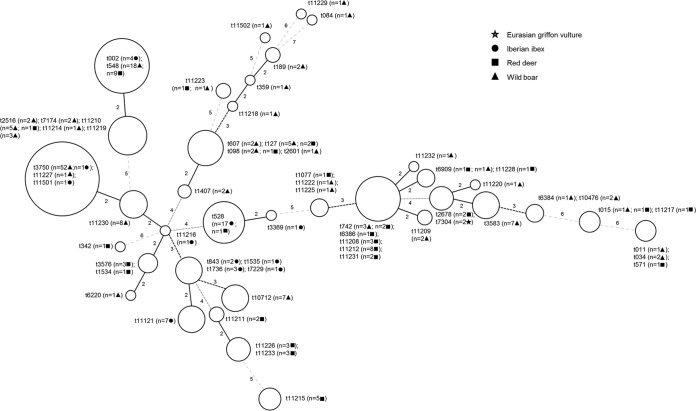
The presence of methicillin-susceptible Staphylococcus aureus (MSSA) was analyzed in different free-living wild animals to assess the genetic diversity and predominant genotypes on each animal species. Samples were taken from the skin and/or nares, and isolates were characterized by spa typing, multilocus sequence typing (MLST) and antimicrobial susceptibility testing. The proportion of MSSA carriers were 5.00, 22.93, 19.78, and 17.67% in Eurasian griffon vulture, Iberian ibex, red deer, and wild boar, respectively (P = 0.057). A higher proportion of isolates (P = 0.000) were recovered from nasal samples (78.51%) than skin samples (21.49%), but the 9.26% of red deer and 18.25% of wild boar would have been undetected if only nasal samples had been tested. Sixty-three different spa types were identified, including 25 new spa types. The most common were t528 (43.59%) in Iberian ibex, t548 and t11212 (15.79% and 14.04%) in red deer, and t3750 (36.11%) in wild boar. By MLST, 27 STs were detected, of which 12 had not been described previously. The most frequent were ST581 for Iberian ibex (48.72%), ST425 for red deer (29.82%), and ST2328 for wild boar (42.36%). Isolates from Eurasian griffon vulture belong to ST133. Host specificity has been observed for the most frequent spa types and STs (P = 0.000). The highest resistance percentage was found against benzylpenicillin (average, 22.2%), although most of the S. aureus isolates were susceptible to all antimicrobial tested. Basically, MSSA isolates were different from those MRSA isolates previously detected in the same animal species.
Copyright © 2014, American Society for Microbiology. All Rights Reserved.
Figures
References
-
- Quinn PJ, Carter ME, Markey B, Carter GR. 1999. Staphylococcus species, p 118–126 In Quinn PJ, Carter ME, Markey BK, Carter GR. (ed), Clinical veterinary microbiology. Mosby, Edinburgh, Scotland
Publication types
MeSH terms
Substances
LinkOut - more resources
Full Text Sources
Other Literature Sources
