


Induced antiviral innate immunity in Drosophila
- PMID: 24907422
- PMCID: PMC4133299
- DOI: 10.1016/j.mib.2014.05.006
Induced antiviral innate immunity in Drosophila
Abstract
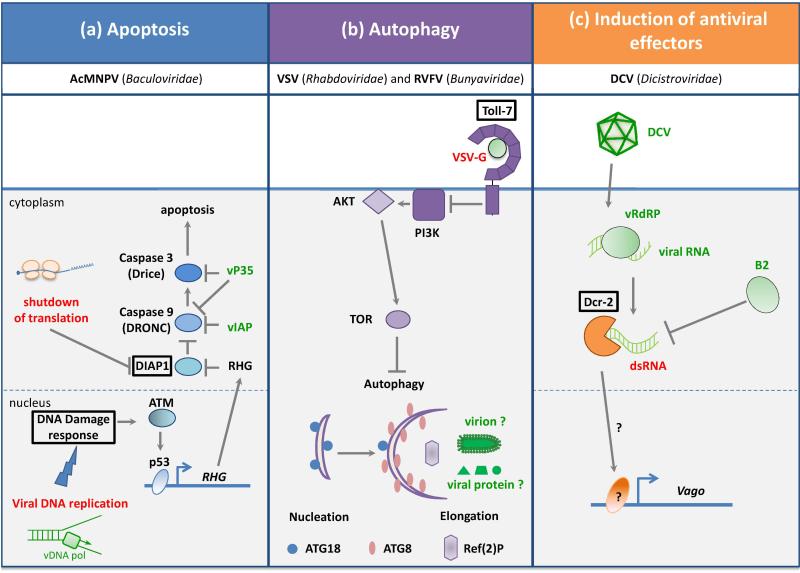
Immunity to viral infections in the model organism Drosophila melanogaster involves both RNA interference and additional induced responses. The latter include not only cellular mechanisms such as programmed cell death and autophagy, but also the induction of a large set of genes, some of which contribute to the control of viral replication and resistance to infection. This induced response to infection is complex and involves both virus-specific and cell-type specific mechanisms. We review here recent developments, from the sensing of viral infection to the induction of signaling pathways and production of antiviral effector molecules. Our current understanding, although still partial, validates the Drosophila model of antiviral induced immunity for insect pests and disease vectors, as well as for mammals.
Copyright © 2014 Elsevier Ltd. All rights reserved.
Figures
References
-
- Nayak A, Tassetto M, Kunitomi M, Andino R. RNA interference-mediated intrinsic antiviral immunity in invertebrates. Curr. Top. Microbiol. Immunol. 2013;371:183–200. - PubMed
-
- Orme M, Meier P. Inhibitor of apoptosis proteins in Drosophila: gatekeepers of death. Apoptosis. 2009;14:950–960. - PubMed
-
- Liu B, Behura SK, Clem RJ, Schneemann A, Becnel J, Severson DW, Zhou L. P53-mediated rapid induction of apoptosis conveys resistance to viral infection in Drosophila melanogaster. PLoS Pathog. 2013;9:e1003137. An elegant in vivo study demonstrating that apoptosis contributes to the control of viral infection. - PMC - PubMed
Publication types
MeSH terms
Grants and funding
LinkOut - more resources
Full Text Sources
Other Literature Sources
Molecular Biology Databases
