


Perceived barriers to mammography among underserved women in a Breast Health Center Outreach Program
- PMID: 24908357
- PMCID: PMC4135000
- DOI: 10.1016/j.amjsurg.2014.03.005
Perceived barriers to mammography among underserved women in a Breast Health Center Outreach Program
Abstract
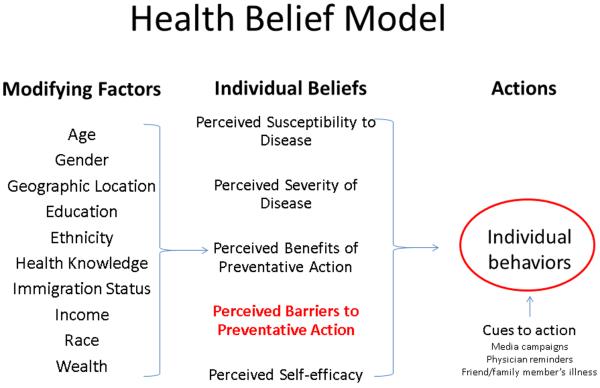
Background: To investigate perceived barriers to mammography among underserved women, we asked participants in the Siteman Cancer Center Mammography Outreach Registry-developed in 2006 to evaluate mobile mammography's effectiveness among the underserved-why they believed women did not get mammograms.
Methods: The responses of approximately 9,000 registrants were analyzed using multivariable logistic regression. We report adjusted odds ratios (OR) and 95% confidence intervals (CI) significant at 2-tailed P values less than .05.
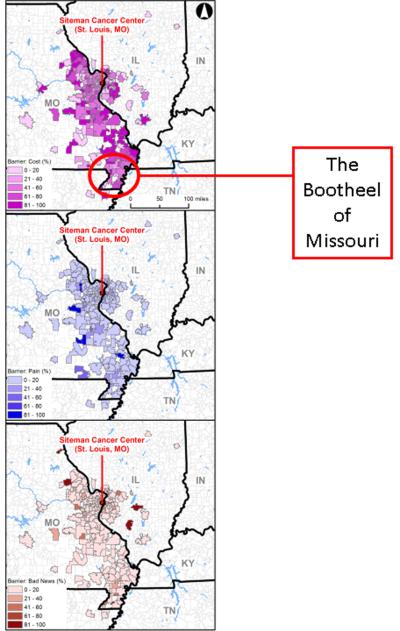
Results: Fears of cost (40%), mammogram-related pain (13%), and bad news (13%) were the most commonly reported barriers. Having insurance was associated with not perceiving cost as a barrier (OR .44, 95% CI .40 to .49), but with perceiving fear of both mammogram-related pain (OR 1.39, 95% CI 1.21 to 1.60) and receiving bad news (OR 1.38, 95% CI 1.19 to 1.60) as barriers.
Conclusion: Despite free services, underserved women continue to report experiential and psychological obstacles to mammography, suggesting the need for more targeted education and outreach in this population.
Keywords: Breast cancer; Health beliefs; Health disparities; Mobile mammography; Screening.
Copyright © 2014 Elsevier Inc. All rights reserved.
Figures
References
-
- [Accessed 5 October 2012];The Burden of Cancer in Missouri: A comprehensive analysis and plan, 2010–2015. 2012 http://health.mo.gov/living/healthcondiseases/chronic/chronicdisease/can....
-
- U.S. Cancer Statistics Working Group [Accessed 23 July 2013];United States Cancer Statistics: 1999–2009 Incidence and Mortality Web-based Report. 2013 www.cdc.gov/uscs.
-
- Schootman M, Jeffe DB, Gillanders WE, Yan Y, Jenkins B, Aft R. Geographic Clustering of Adequate Diagnostic Follow-Up after Abnormal Screening Results for Breast Cancer among Low-income Women in Missouri. Ann Epidemiol. 2007;17:704–712. - PubMed
-
- Quesada LC. [Accessed 16 October 2012];Public Health: Understanding Our Needs - The City of Saint Louis Department of Health. 2007 http://stlouis-mo.gov/government/departments/health/documents/upload//UO....
Publication types
MeSH terms
Grants and funding
LinkOut - more resources
Full Text Sources
Other Literature Sources
Medical
Research Materials
