


Prospective evaluation of local control and late effects of conformal radiation therapy in children, adolescents, and young adults with high-grade glioma
- PMID: 24908655
- PMCID: PMC4232080
- DOI: 10.1093/neuonc/nou101
Prospective evaluation of local control and late effects of conformal radiation therapy in children, adolescents, and young adults with high-grade glioma
Abstract
Background: A phase II trial of conformal radiotherapy (CRT) for pediatric high-grade glioma (HGG) was performed to evaluate disease control and late effects.
Methods: Between July 1997 and January 2003, 34 pediatric patients (median age, 13.2 ± 6.7 years) with HGG were enrolled on an International Commission on Radiation Units and Measurements Report 50-compliant prospective trial using CRT with a 2 cm clinical target volume margin. Baseline and serial evaluations were performed to assess functional outcomes.
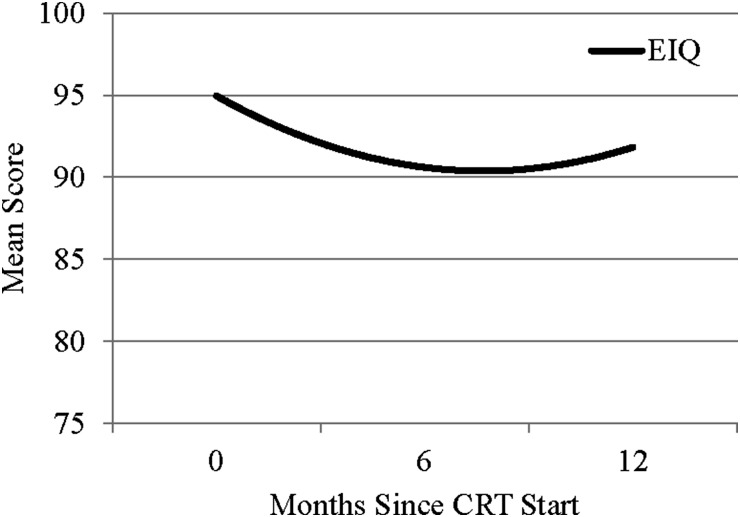
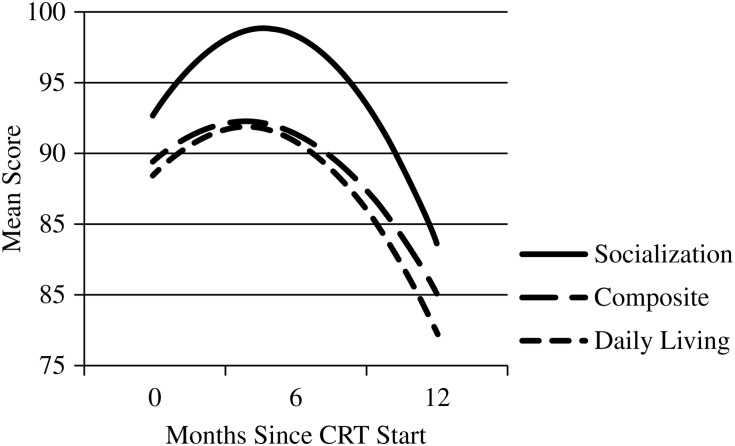
Results: Median follow-up for the entire group was 18 months (range, 2-134 months). Twenty (58.8%) patients developed local progression, and 6 (17.6%) patients developed distant progression. Progression-free and overall survival at 10 years were 18.8% ± 6.9% and 16.8% ± 6.5%, respectively. At baseline, 40% of patients evaluated for intelligence quotient (IQ) scored below 85. Measures of cognitive function obtained during the first 12 months fit a mixed model with a quadratic function. The relationship between IQ and time was -1.1883 points/month for the linear term and 0.07728 points/month for the quadratic term (P = .0454). IQ decreased between baseline and 6 months and then increased slightly through 12 months. The opposite was found for (all P values of the quadratic term) activities of daily living (P = .0155), socialization (P = .0049), and the composite score (P = .0257) of adaptive behavior.
Conclusion: CRT using a 2 cm clinical target volume margin in pediatric HGG demonstrated tumor control comparable to conventional radiation therapy. Disrupted cognitive and adaptive behavioral functioning were present at baseline and throughout the course of disease.
Keywords: high-grade glioma; pediatrics; radiation therapy.
© The Author(s) 2014. Published by Oxford University Press on behalf of the Society for Neuro-Oncology. All rights reserved. For permissions, please e-mail: journals.permissions@oup.com.
Figures
References
-
- Fritz A, Percy C, Jack A, et al. International Classification of Diseases for Oncology. Third Edition. World Health Organization; 2000.
-
- National Cancer Institute. US population data. Surveillance, Epidemiology, and End Results (SEER) Program Populations (1990-2007) DCCPS, Surveillance Research Program, Cancer Statistics Branch; 2013. released November 2009.
-
- Louis DN, Ohgaki H, Wiesteler OD, et al. WHO Classification of Tumours of the Central Nervous System. Albany, NY: WHO Publication Center; 2007.
-
- Duffner PK, Krischer JP, Burger PC, et al. Treatment of infants with malignant gliomas: the Pediatric Oncology Group experience. J Neurooncol. 1996;28(2–3):245–256. - PubMed
Publication types
MeSH terms
Grants and funding
LinkOut - more resources
Full Text Sources
Other Literature Sources
Medical
Research Materials
