. 2014 Jun 16;24(12):1331-1340.
doi: 10.1016/j.cub.2014.05.001. Epub 2014 Jun 5.

The hippocampus and entorhinal cortex encode the path and Euclidean distances to goals during navigation

Affiliations

The hippocampus and entorhinal cortex encode the path and Euclidean distances to goals during navigation

Lorelei R Howard et al. Curr Biol. .

Abstract

Background: Despite decades of research on spatial memory, we know surprisingly little about how the brain guides navigation to goals. While some models argue that vectors are represented for navigational guidance, other models postulate that the future path is computed. Although the hippocampal formation has been implicated in processing spatial goal information, it remains unclear whether this region processes path- or vector-related information.

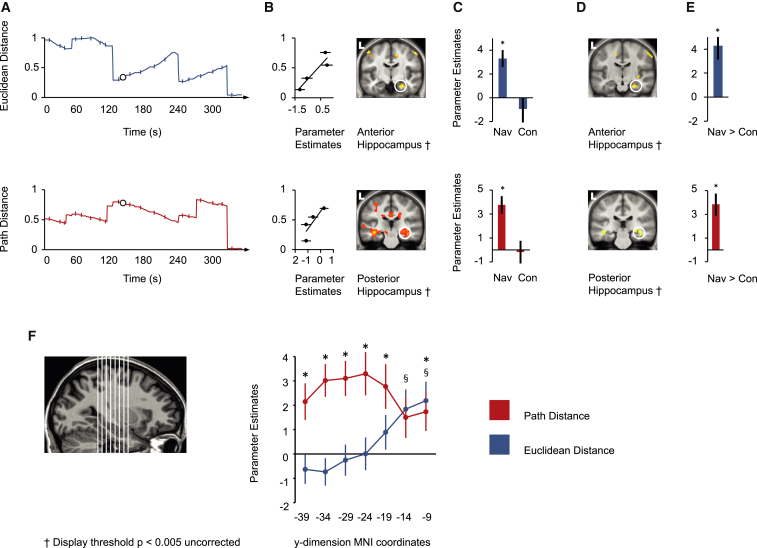
Results: We report neuroimaging data collected from subjects navigating London's Soho district; these data reveal that both the path distance and the Euclidean distance to the goal are encoded by the medial temporal lobe during navigation. While activity in the posterior hippocampus was sensitive to the distance along the path, activity in the entorhinal cortex was correlated with the Euclidean distance component of a vector to the goal. During travel periods, posterior hippocampal activity increased as the path to the goal became longer, but at decision points, activity in this region increased as the path to the goal became closer and more direct. Importantly, sensitivity to the distance was abolished in these brain areas when travel was guided by external cues.

Conclusions: The results indicate that the hippocampal formation contains representations of both the Euclidean distance and the path distance to goals during navigation. These findings argue that the hippocampal formation houses a flexible guidance system that changes how it represents distance to the goal depending on the fluctuating demands of navigation.


Figures

None
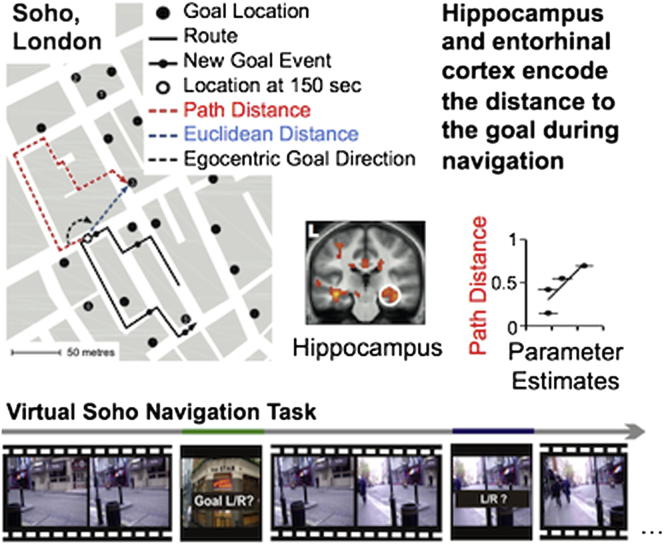
Graphical abstract
Figure 1
Figure 1
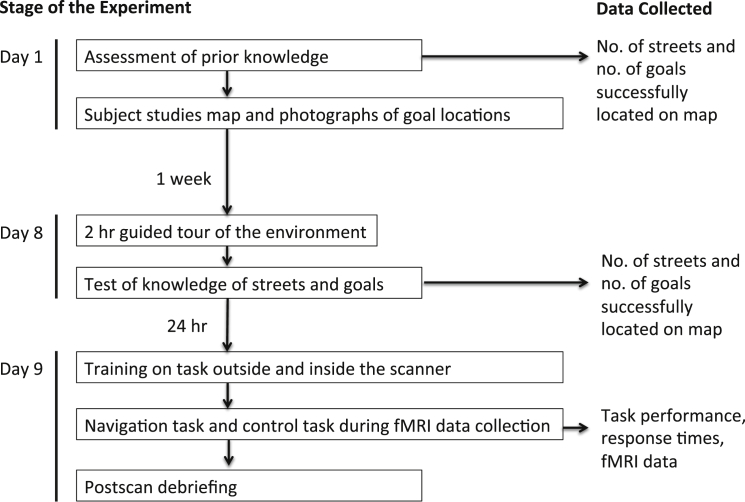
A Flow Chart of the Experimental Protocol Subjects were instructed to spend at least 30 min studying the training material between days 1 and 8. On day 8, all subjects confirmed that they had completed the training material. See Figure S1 for training materials.
Figure 2
Figure 2
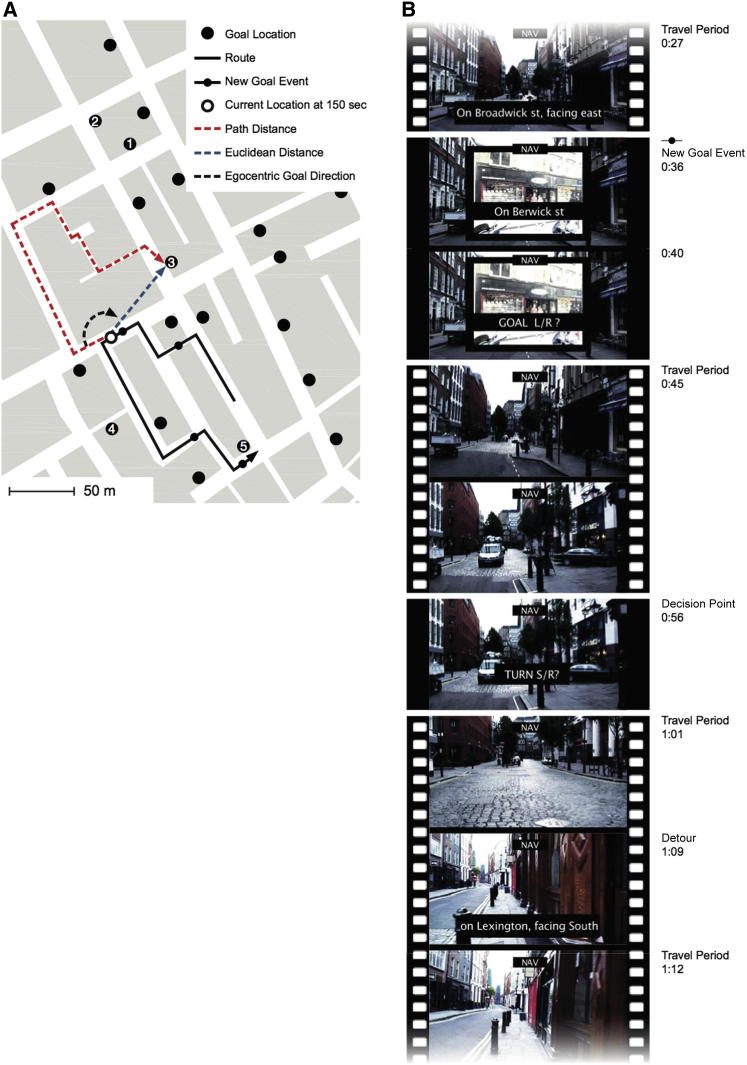
Task (A) Map of the environment (Soho, London). One of the ten routes is shown (black line) with New Goal Events (black circles on route), and their corresponding goal locations (numbered) are marked. The Euclidean distance (blue dashed line), path distance (red dashed line), and egocentric direction (black dashed line) to the goal are plotted for one location on the route. (B) An example sequence of movie frames from a small section of one route in the navigation task. At New Goal Events, subjects were given a new goal to navigate to, and they were required to decide whether that new goal was on the left or right in relation to their current facing direction. In between New Goal Events, movies contained footage of travel along the streets (travel periods) and paused near each street junction (Decision Points), where subjects judged which direction provided the shortest route to the goal. On entry to every street (temporally jittered in relation to Decision Points), the street name and cardinal direction were displayed. Occasionally, forced Detours occurred at street junctions where the movie took a suboptimal path to reach the goal. The control task was similar, but no navigational judgments were required. See Figure S2 for comparisons of activity in navigation and control tasks.
Figure 3
Figure 3
Hippocampal Activity Positively Correlates with Euclidean and Path Distances to the Goal during Travel Periods in Navigation Tasks (A) Top: the normalized Euclidean distance to the goal is plotted against time for the route shown in Figure 2A. Bottom: the normalized path distance to the goal is plotted against time for the route shown in Figure 2A. Normalization was with respect to the maximum over all routes. On both plots, the circle indicates the time point at 150 s (marked in Figure 2A), and Travel Period Events are indicated with bisecting lines. (B) Top: right anterior hippocampal activity correlated significantly with the Euclidean distance to the goal during navigation. Bottom: right posterior hippocampal activity correlated significantly with the path distance to the goal during navigation. Accompanying scatter plots show the normalized Euclidean distance (top) and path distance (below; separated into four levels) plotted against parameter estimates at the peak voxel for these regions. Note that these plots were not used for statistical inference (which was carried out within the statistical parametric mapping framework) and are shown solely for illustrative purposes. The following abbreviation is used: L, left. (C) Top: the parameter estimates for the peak voxel in the right anterior hippocampus in the navigation (Nav) condition are plotted for navigation and control (Con) conditions. Bottom: the parameter estimates for the peak voxel in the right posterior hippocampus in the navigation condition are plotted for the navigation and control conditions. Asterisks indicate significance at a threshold of p < 0.05 (family-wise error was corrected for a priori regions of interest). See Figure S3 for parameter estimates in all ROIs. (D) Top: right anterior hippocampal activity correlated significantly more positively with the Euclidean distance to the goal during navigation conditions than during control conditions. Bottom: right posterior hippocampal activity correlated significantly more positively with the path distance to the goal during navigation conditions than during control conditions. The following abbreviation is used: L, left. (E) Top: the bar graph shows the parameter estimate for the peak voxel in the right anterior hippocampus in the navigation > control contrast for the Euclidean distance. Bottom: the bar graph shows the parameter estimate for the peak voxel in the right posterior hippocampus in the navigation > control contrast for the path distance. Asterisks indicate significance at a threshold of p < 0.05 (family-wise error was corrected for a priori regions of interest). (F) Left: illustration of the seven sections through the longitudinal axis of the hippocampus. Middle: the parameter estimates of the parametric response to Euclidean and path distances for each of the seven sections (numbers on the x axis indicate the middle MNI y coordinate of each ROI) during Travel Period Events in navigation tasks. These parameter estimates were not used for detecting effects of interest but rather for characterizing the response post hoc. § symbols indicate a significant Euclidean distance, and asterisks indicate a significant path distance in relation to zero at p < 0.05 (see Table S5). Error bars in (B), (C), (E), and (F) denote the SEM.
Figure 4
Figure 4
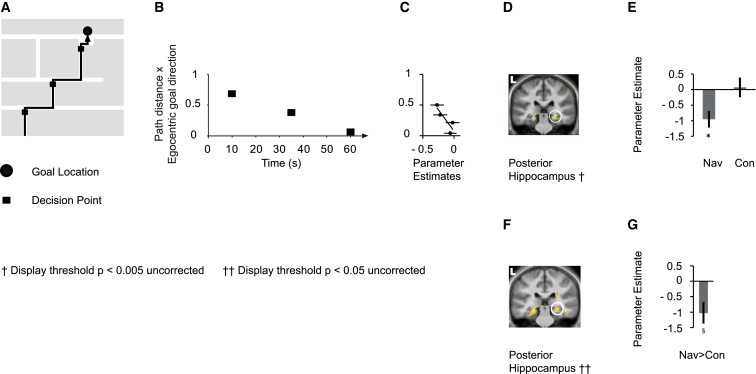
Posterior Hippocampal Activity Negatively Correlates with the Distance and Direction to the Goal during Decision Points in Navigation Tasks (A) Illustrative map with part of a route (black line) to a goal location (black circle) and Decision Points (black squares). (B) The parameter “normalized path distance to the goal × egocentric goal direction” (PD×EGD) at the three Decision Points from the example route in (A) is plotted against time. (C) Normalized PD×EGD separated into four levels is plotted against parameter estimates at the peak voxel of the posterior right hippocampus. Note that the scatter plot was not used for statistical inference (which was carried out within the SPM framework) and is shown solely for illustrative purposes. (D) Right posterior hippocampal activity correlated significantly negatively with PD×EGD during Decision Points in navigation. The following abbreviation is used: L, left. See Figure S4 for other coronal sections with this and other contrasts. (E) The parameter estimates for the peak voxel in the right posterior hippocampus in the navigation condition are plotted for navigation (Nav) and control (Con) conditions. Asterisks indicate significance at a threshold of p < 0.05 (family-wise error was corrected for a priori regions of interest). (F) Right posterior hippocampal activity correlated significantly more negatively with PD×EGD during navigation routes than during control routes. The following abbreviation is used: L, left. (G) The bar graph shows the parameter estimate for the peak voxel in the right posterior hippocampus in the navigation > control contrast for PD×EGD. § symbols indicate significance at a threshold of p < 0.005 (uncorrected). Errors bars in (C), (E), and (G) denote the SEM.
Figure 5
Figure 5
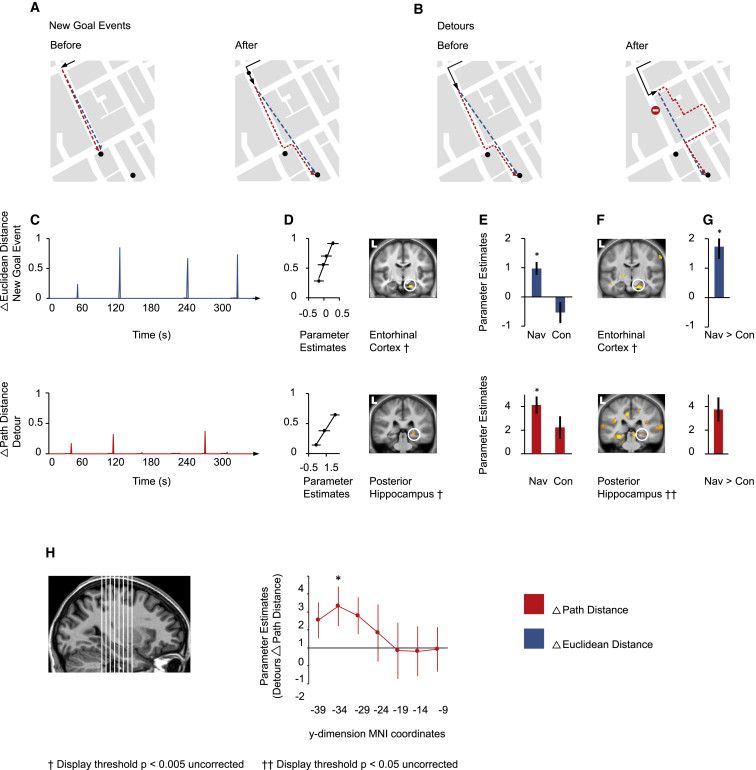
Entorhinal Activity and Posterior Hippocampal Activity Positively Correlate with the Change in the Euclidean Distance to the Goal during New Goal Events and the Change in the Path Distance to the Goal during Detours, Respectively (A) Illustrative example of how the Euclidean and path distances to the goal can change at New Goal Events. (B) Illustrative example of how the path distance to the goal can change at Detours. The “no entry” sign marks the Detour, but no marker was presented in the movie. (C) Top: the normalized differential (Δ) of the Euclidean distance to the goal at New Goal Events is plotted against time for the route shown in Figure 2A. Bottom: the normalized differential (Δ) of the path distance to the goal at Detours is plotted against time for the route shown in Figure 2A. Normalization was with respect to the maximum over all routes. (D) Top: right entorhinal activity significantly correlated with the Δ Euclidean distance to the goal during New Goal Events in navigation. Bottom: right posterior hippocampal activity significantly correlated with the Δ path distance during Detours in navigation. Accompanying scatter plots show the normalized Δ Euclidean distance (top) and the Δ path distance (bottom) (separated into four and three levels, respectively) plotted against parameter estimates at the peak voxel for these regions. Note that these plots were not used for statistical inference (which was carried out within the SPM framework) and are shown solely for illustrative purposes. See Figure S5 for a display of results on other coronal sections. The following abbreviation is used: L, left. (E) Top: the parameter estimates for the peak voxel in the entorhinal cortex in the navigation condition are plotted for navigation (Nav) and control (Con) conditions. Bottom: the parameter estimates for the peak voxel in the posterior hippocampus in the navigation condition are plotted for the navigation and control conditions. Asterisks indicate significance at a threshold of p < 0.05 (family-wise error was corrected for a priori regions of interest). (F) Top: right entorhinal activity correlated significantly more positively with the Δ Euclidean distance to the goal at New Goal Events during navigation routes than during control routes. Bottom: right posterior hippocampal activity correlated more positively with the Δ path distance at Detours during navigation routes than during control routes, but not significantly. (G) Top: the bar graph shows the parameter estimate for the peak voxel in the right entorhinal cortex in the navigation > control contrast for the Δ Euclidean distance to the goal at New Goal Events. Bottom: the bar graph shows the parameter estimate for the peak voxel in the right posterior hippocampus in the navigation > control contrast for the Δ path distance at Detours. Asterisks indicate significance at a threshold of p < 0.05 (family-wise error was corrected for a priori regions of interest). (H) Left: illustration of seven sections through the longitudinal axis of the hippocampus (these were used for plotting the parameter estimates in the middle panel). Middle: parameter estimates of the parametric response to the Δ path distance at Detours during navigation for each of the seven hippocampal ROIs (numbers on the x axis indicate the middle MNI y coordinate of each ROI). These parameter estimates were not used for detecting effects of interest but rather for characterizing the response post hoc. Asterisks indicate significance relative to zero at p < 0.05 (see Table S5). Error bars in (D), (E), (G), and (H) denote the SEM.

References

    1. Hafting T., Fyhn M., Molden S., Moser M.-B., Moser E.I. Microstructure of a spatial map in the entorhinal cortex. Nature. 2005;436:801–806. - PubMed
    1. O’Keefe J., Nadel L. Oxford University Press; Oxford: 1978. The Hippocampus as a Cognitive Map.
    1. Taube J.S., Muller R.U., Ranck J.B., Jr. Head-direction cells recorded from the postsubiculum in freely moving rats. I. Description and quantitative analysis. J. Neurosci. 1990;10:420–435. - PMC - PubMed
    1. Brown T.I., Ross R.S., Keller J.B., Hasselmo M.E., Stern C.E. Which way was I going? Contextual retrieval supports the disambiguation of well learned overlapping navigational routes. J. Neurosci. 2010;30:7414–7422. - PMC - PubMed
    1. Hartley T., Maguire E.A., Spiers H.J., Burgess N. The well-worn route and the path less traveled: distinct neural bases of route following and wayfinding in humans. Neuron. 2003;37:877–888. - PubMed

Publication types

LinkOut - more resources