


The morphology of the thumb carpometacarpal joint does not differ between men and women, but changes with aging and early osteoarthritis
- PMID: 24909332
- PMCID: PMC4130650
- DOI: 10.1016/j.jbiomech.2014.05.005
The morphology of the thumb carpometacarpal joint does not differ between men and women, but changes with aging and early osteoarthritis
Abstract
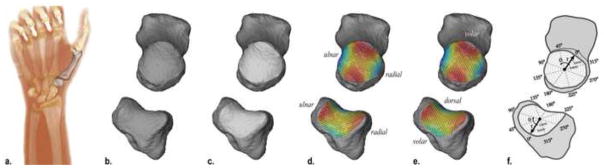
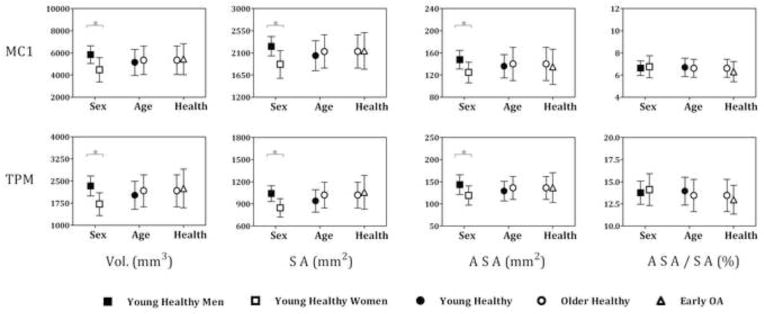
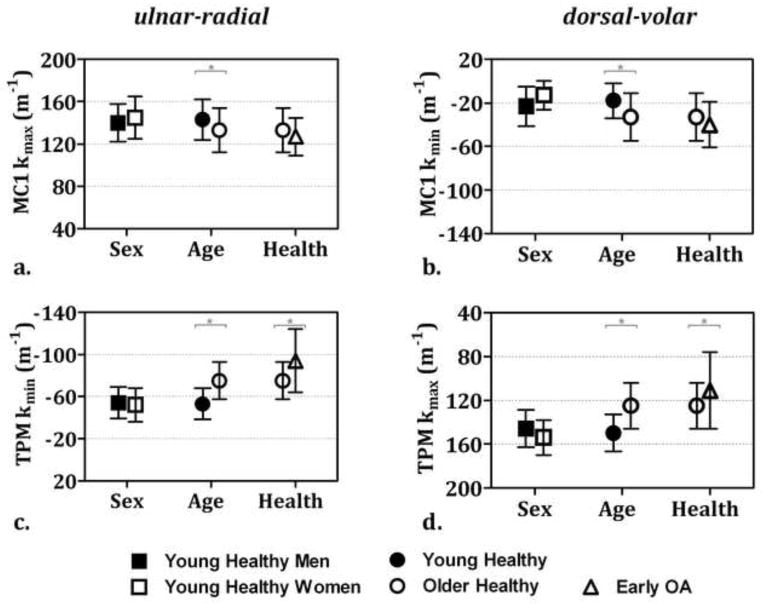
The high prevalence of thumb carpometacarpal (CMC) joint osteoarthritis (OA) in women has been previously linked to the articular morphology of the trapezium. Studies report conflicting results on how the articular shapes of male and female trapezia compare to one another, however, mainly because their findings are based on data from older cadaveric specimens. The purpose of this in vivo study was to dissociate the effect of sex from that of aging and early OA by using cohorts of healthy young and healthy older subjects, as well as patients with early stage OA. Computed tomography scans from 68 healthy subjects and 87 arthritic subjects were used to obtain 3-D bone models. The trapezial and metacarpal articular surfaces were manually delineated on scaled bone models and compared between sex, age, and health groups by using polar histograms of curvature and average curvatures. We found no sex-related differences, but significant age-group and health-group differences, in the articular surfaces of both bones. Older healthy subjects had higher curvature in the concave and lower curvature in the convex directions of both the trapezial and metacarpal saddles than healthy young subjects. Subjects with early OA had significantly different metacarpal and trapezial articular shapes from healthy subjects of the same age group. These findings suggest that aging and OA affect the articular shape of the CMC joint, but that, in contrast to previously held beliefs, inherent sex differences are not responsible for the higher incidence of CMC OA in women.
Keywords: Articular joint shape; Computed tomography; Osteoarthritis; Thumb CMC joint; in vivo.
Copyright © 2014 Elsevier Ltd. All rights reserved.
Conflict of interest statement
Figures
References
-
- Andriacchi TP, Mundermann A, Smith RL, Alexander EJ, Dyrby CO, Koo S. A framework for the in vivo pathomechanics of osteoarthritis at the knee. Ann Biomed Engin. 2004;33:447–457. - PubMed
-
- Ateshian GA, Ark JW, Rosenwasser MP, Pawluk RJ, Soslowsky LJ, Mow VC. Contact areas in the thumb carpometacarpal joint. J Orthop Res Off Publ Orthop Res Soc. 1995;13:450–458. - PubMed
-
- Ateshian GA, Rosenwasser MP, Mow VC. Curvature characteristics and congruence of the thumb carpometacarpal joint: differences between female and male joints. J Biomech. 1992;25:591–607. - PubMed
-
- Aune S. Osteo-arthritis in the first carpo-metacarpal joint; an investigation of 22 cases. Acta Chir Scand. 1955;109:449–56. - PubMed
-
- Bullough P, Goodfellow J, O’Conner J. The relationship between degenerative changes and load-bearing in the human hip. J Bone Joint Surg Br. 1973;55:746–758. - PubMed
Publication types
MeSH terms
Grants and funding
LinkOut - more resources
Full Text Sources
Other Literature Sources
Medical
