Review
. 2014 Oct;25(5):543-50.
doi: 10.1016/j.cytogfr.2014.05.002. Epub 2014 May 17.

IFIT1: A dual sensor and effector molecule that detects non-2'-O methylated viral RNA and inhibits its translation

Affiliations
Review

IFIT1: A dual sensor and effector molecule that detects non-2'-O methylated viral RNA and inhibits its translation

Michael S Diamond. Cytokine Growth Factor Rev. 2014 Oct.

Abstract

Our understanding of the antiviral actions of IFIT1, one of the most strongly induced interferon stimulated genes (ISGs), has advanced remarkably within the last few years. This review focuses on the recent cellular, biochemical, and structural discoveries that have provided new insight as to how IFIT1 functions as both a sensor and effector molecule of the cellular innate immune system. IFIT1 can detect viral RNA lacking 2'-O methylation on their cap structures or displaying a 5'-triphosphate moiety and inhibit their translation or sequester them from active replication. Because of these inhibitory actions, many viruses have evolved unique mechanisms to evade IFIT1 to facilitate replication, spread of infection, and disease pathogenesis.

Keywords: 2′-O methylation; Antiviral; Cap structure; Immune evasion; Interferon.


Figures

Fig. 1
Fig. 1
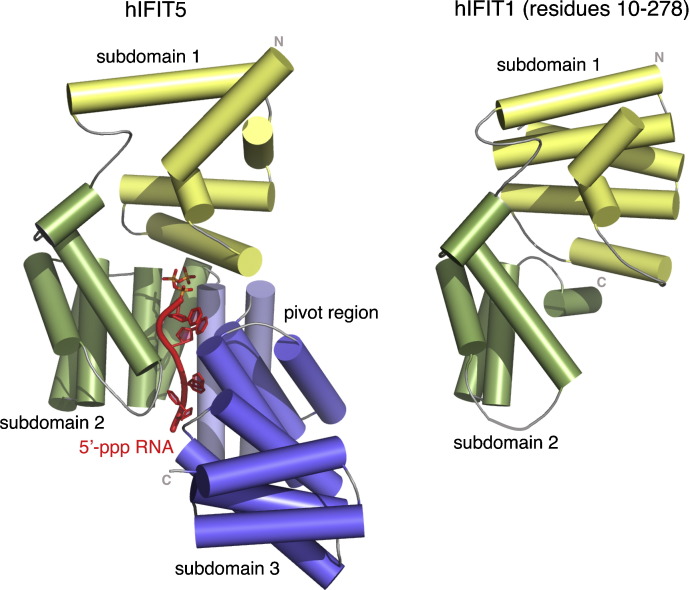
Structure of IFIT5 and N-terminal protease resistant fragment of IFIT1. Cartoon diagram of the structure of the IFIT5 monomer (PDB 4HOR) and N-terminal protease resistant fragment of IFIT1 (PDB 4HOU). α-helical structural elements are shown as cylinders. The subdomains are labeled: subdomain 1 (yellow), subdomain 2 (green), pivot region (light blue), and subdomain 3 (blue). In the IFIT5 structure, the 5′-ppp RNA is shown in red with the phosphate atoms in orange. The Figure was prepared with PyMOL (http://pymol.org/) and is adapted from the original publication .
Fig. 2
Fig. 2
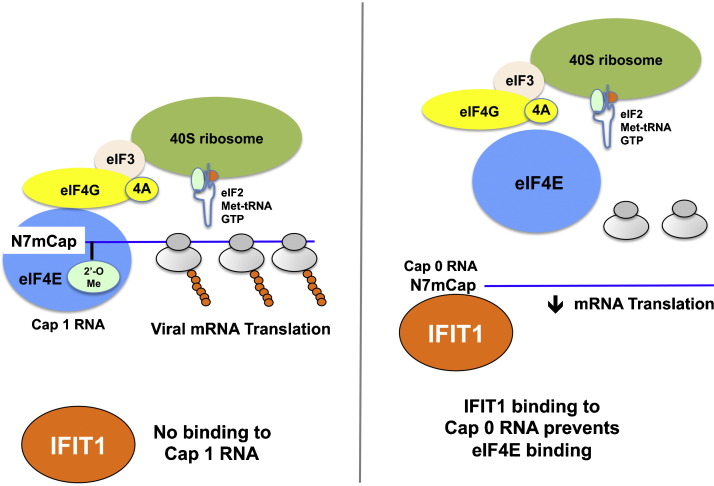
IFIT1 inhibits translation initiation by competing with eIF4E for binding to viral mRNA lacking 2-O methylation. Assembly of the ribosome initiation complex at the 5′ end of a viral mRNA. eIF4E, as part of the eIF4F complex, binds the m7G-cap structure. eIF4G binds eIF3, which recruits the 40S ribosomal subunit and its associated ternary complex (eIF2-Met-tRNA-GTP). (Left) Viral mRNA with cap 1 structures (N-7 and 2-O methylation) recruit eIF4E and initiates translation and polyribosome formation. IFIT1 binds poorly to cap 1 mRNA. (Right) Viral mRNA with cap 0 structures lacking 2-O methylation are recognized by preferentially by IFIT1, which prevents binding of eIF4E and efficient translation. This Figure was adapted from published models , .
Fig. 3
Fig. 3
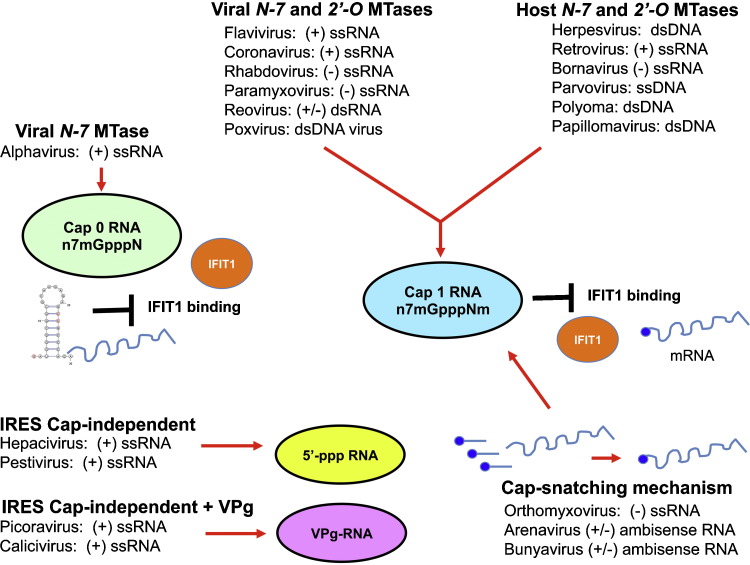
Mechanisms of evasion of IFIT1 by viruses. Different families of RNA and RNA viruses use distinct mechanisms to evade IFIT1-dependent restriction. These include: (i) viral-encoded N-7 and 2-O methyltranferases (MTase) to generate a cap 1 structure on their mRNA (flavivirus, coronavirus, rhabdovirus, paramyxovirus, reovirus, and poxvirus), which prevents IFIT1 binding; (ii) use of host-encoded N-7 and 2-O methyltranferases (MTase) in the nucleus to generate a cap 1 structure on their mRNA (herpesvirus, retrovirus, bornavirus, parvovirus, polyomavirus, and papillomavirus); (iii) ‘cap-snatching’ mechanisms to cleave cap 1 structures from host mRNA (10–20 nucleotides). The capped leader RNA is used to prime transcription on the viral genome, which leads to the synthesis of capped, translatable viral mRNAs (orthomyxovirus, arenavirus, and bunyavirus); (iv) RNA structural elements at the 5′-end of type 0 capped alphavirus RNA antagonize IFIT1 binding and function; and (v) some positive sense RNA viruses utilize IRES elements to mediate cap-independent translation. For hepaciviruses and pestiviruses the 5′-end remains as an uncapped 5′-ppp RNA. Picornaviruses and caliciviruses covalently attach a viral protein (VPg) to the 5′-end. This figure was adapted from a published model .

References

    1. Kawai T., Akira S. Innate immune recognition of viral infection. Nat Immunol. 2006;7:131–137. - PubMed
    1. Keating S.E., Baran M., Bowie A.G. Cytosolic DNA sensors regulating type I interferon induction. Trends Immunol. 2011;32:574–581. - PubMed
    1. Cai X., Chiu Y.H., Chen Z.J. The cGAS-cGAMP-STING pathway of cytosolic DNA sensing and signaling. Mol Cell. 2014;54:289–296. - PubMed
    1. Theofilopoulos A.N., Baccala R., Beutler B., Kono D.H. Type I interferons (alpha/beta) in immunity and autoimmunity. Annu Rev Immunol. 2005;23:307–336. - PubMed
    1. Pestka S., Krause C.D., Walter M.R. Interferons, interferon-like cytokines, and their receptors. Immunol Rev. 2004;202:8–32. - PubMed

Publication types