. 2014 Aug;134(2):429-39.
doi: 10.1016/j.jaci.2014.04.020. Epub 2014 Jun 6.

Neonatal rhinovirus induces mucous metaplasia and airways hyperresponsiveness through IL-25 and type 2 innate lymphoid cells

Affiliations

Neonatal rhinovirus induces mucous metaplasia and airways hyperresponsiveness through IL-25 and type 2 innate lymphoid cells

Jun Young Hong et al. J Allergy Clin Immunol. 2014 Aug.

Abstract

Background: Early-life human rhinovirus infection has been linked to asthma development in high-risk infants and children. Nevertheless, the role of rhinovirus infection in the initiation of asthma remains unclear.

Objective: We hypothesized that, in contrast to infection of mature BALB/c mice, neonatal infection with rhinovirus promotes an IL-25-driven type 2 response, which causes persistent mucous metaplasia and airways hyperresponsiveness.

Methods: Six-day-old and 8-week-old BALB/c mice were inoculated with sham HeLa cell lysate or rhinovirus. Airway responses from 1 to 28 days after infection were assessed by using quantitative PCR, ELISA, histology, immunofluorescence microscopy, flow cytometry, and methacholine responsiveness. Selected mice were treated with a neutralizing antibody to IL-25.

Results: Compared with mature mice, rhinovirus infection in neonatal mice increased lung IL-13 and IL-25 production, whereas IFN-γ, IL-12p40, and TNF-α expression was suppressed. In addition, the population of IL-13-secreting type 2 innate lymphoid cells (ILC2s) was expanded with rhinovirus infection in neonatal but not mature mice. ILC2s were the major cell type secreting IL-13 in neonates. Finally, anti-IL-25 neutralizing antibody attenuated ILC2 expansion, mucous hypersecretion, and airways responsiveness.

Conclusions: These findings suggest that early-life viral infection could contribute to asthma development by provoking age-dependent, IL-25-driven type 2 immune responses.

Keywords: Asthma; IL-25; mouse; neonatal; rhinovirus; type 2 innate lymphoid cells.


Figures

FIG 1
FIG 1
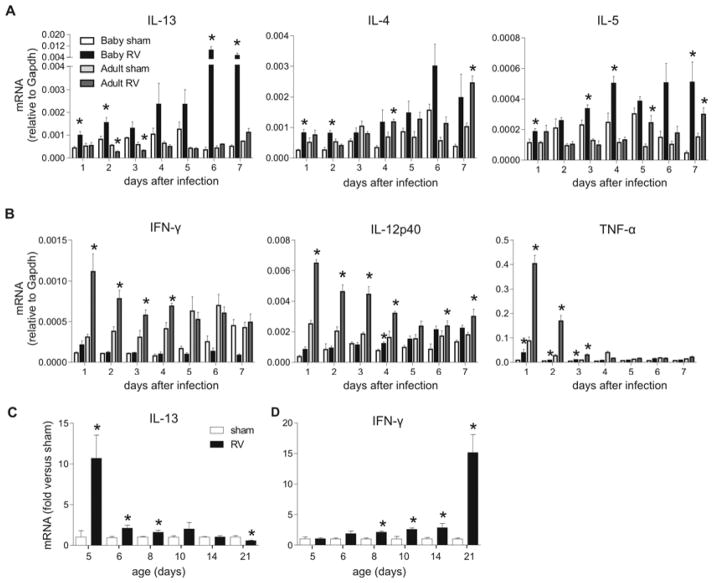
Cytokine expression after RV infection. A and B, Six-day-old and eight-week-old mice were inoculated with sham or RV (n=4–8 sham, n=5–14 RV) and lung mRNA measured 1–7 days later. *P<0.05 compared to sham (unpaired t-test). C and D, Mice of different ages (n=3–10/group) were inoculated with sham or RV and mRNA expression measured one day later. *P<0.05 versus sham (unpaired t-test).
FIG 2
FIG 2
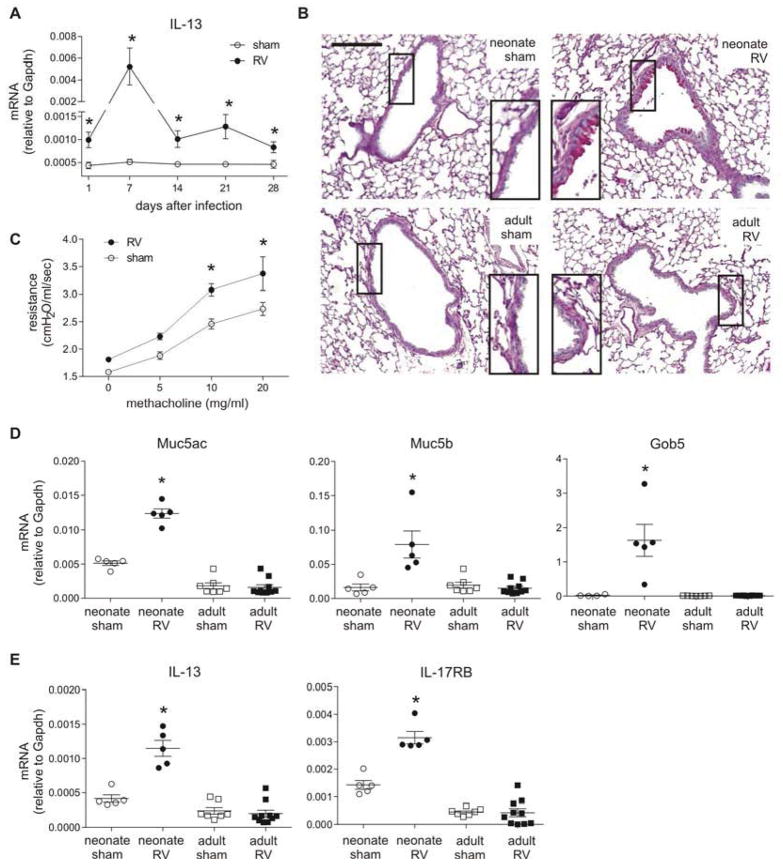
Mucous metaplasia and airway hyperresponsiveness after neonatal RV infection. A, Lung IL-13 from six day-old mice. *P<0.05 versus sham (unpaired t-test). B, PAS-stained lung sections prepared 3 weeks after inoculation of six day-old and eight week-old mice (magnification, 100X; bar. 200 μm). C, Airway responsiveness four weeks after inoculation of neonatal mice (n=4/group). * P<0.05 versus sham (two-way ANOVA). D and E, Lung mRNA expression three weeks after inoculation. *P<0.05 versus sham (unpaired t-test).
FIG 3
FIG 3
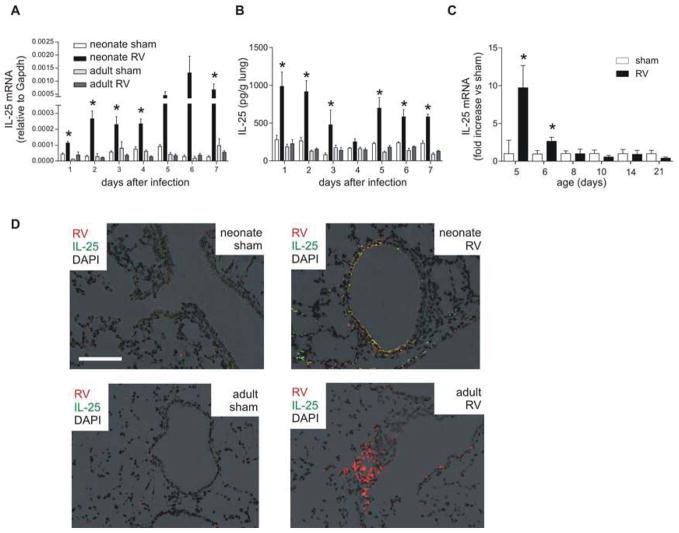
Lung IL-25 after RV infection. A, Six-day-old and eight-week-old mice were inoculated with sham or RV (n=4–7/group) and mRNA measured 1–7 days after infection. *P<0.05 versus sham (unpaired t-test). B, IL-25 protein. *P≤0.05 versus sham (one-way ANOVA). C, Mice were inoculated at different ages (n = 3–10/group) and mRNA measured one day after treatment. *P<0.05 versus sham (unpaired t-test). D, Two days after infection, lungs were stained for IL-25 (green), RV (red) and nuclei (DAPI, black). (Bar, 200 μm; magnification, 200X).
FIG 4
FIG 4
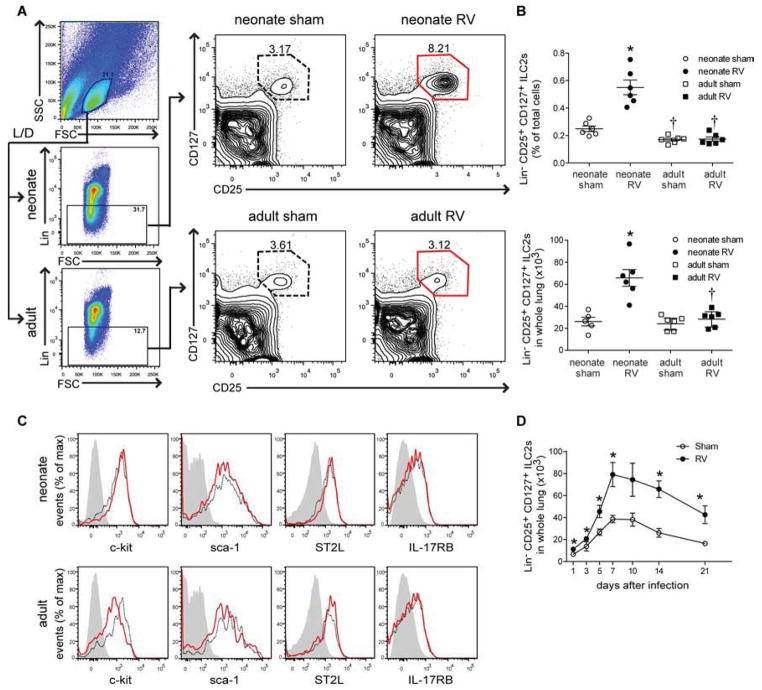
Lung lineage-, CD25+, CD127+ ILC2s. A, Six day-old and eight week-old mice were inoculated with sham or RV and live ILC2s identified fourteen days later. B, Percentage (upper panel) and total (lower panel) ILC2s for each group. *P<0.05 versus sham, †P<0.05 versus mature mice (unpaired t-test). C, C-kit/CD117, Sca-1, T1/ST2 and IL-17RB expression in ILC2s from sham- (black, dotted) and RV-treated mice (red, solid). (Isotype control is grey, filled). D, ILC2 time course after neonatal infection (n = 3–6/group). *P<0.05 versus sham (unpaired t-test).
FIG 5
FIG 5
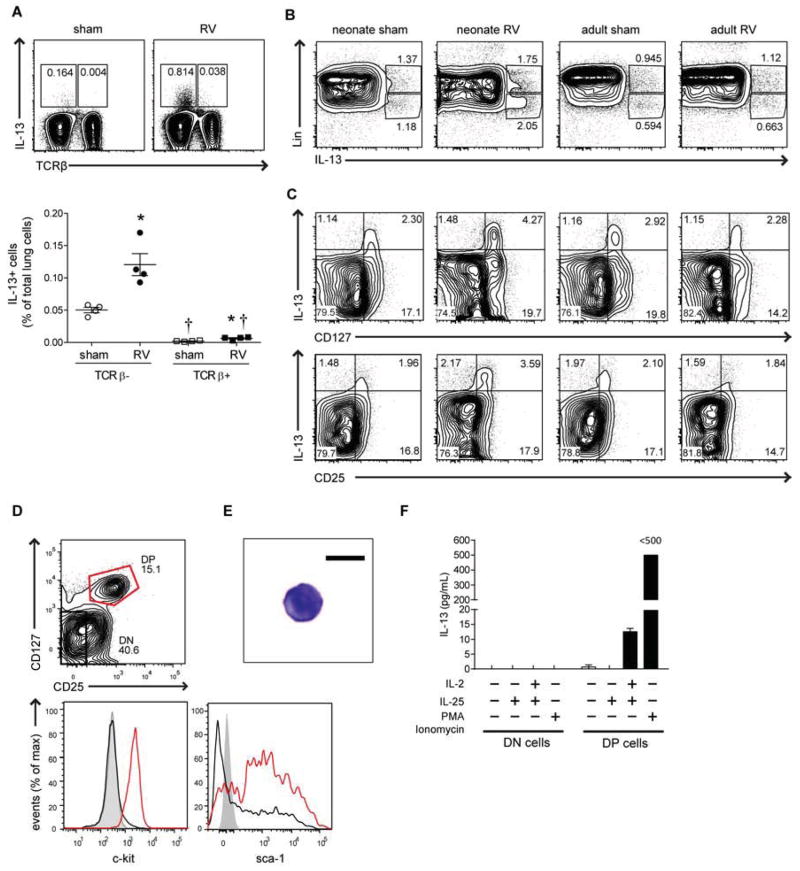
IL-13 producing cells. A, Percentages of IL-13+, TCRβ- and TCRβ+ cells two weeks after neonatal sham or RV. *P<0.05 versus sham, †P<0.05 versus TCRβ- cells (unpaired t-test). B and C, Percentages of lineage+ and lineage- IL-13+ cells (B). Percentages of lineage- IL-13+, CD127+ and CD25+ cells (C). D–F, Eight days after infection, Lin- CD25+ CD127+ double-positive (DP) and CD25- CD127- double-negative (DN) ILC2s were characterized for c-kit and Sca-1 (D). Image of ILC2 (E). IL-13 production by stimulated DP and DN cells (F).
FIG 6
FIG 6
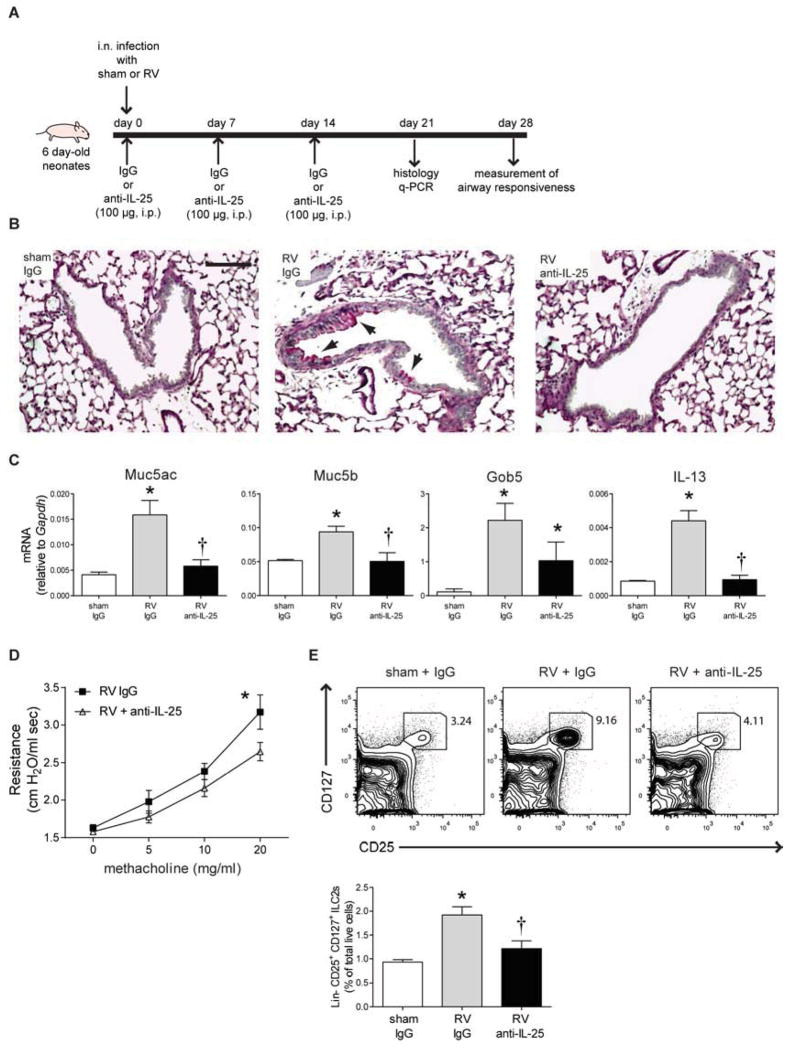
Effect of IL-25 neutralization on RV-infected neonatal mice. A, Protocol for anti-IL-25 treatment. B, Three weeks after inoculation, lungs were harvested and stained with PAS. Bar, 100 μm. C, Lung mRNA expression (n = 4–10/group). *P<0.05 versus sham, †P<0.05 versus RV+IgG (unpaired t-test). D, Airway resistance four weeks after RV infection and antibody treatment (n = 4–5 in each group). *P<0.05 versus RV+IgG (two-way ANOVA). E, Lineage-negative CD25+ CD127+ ILC2s four weeks after infection (top). Group percentages of live ILC2s (n = 3–8/group, bottom). *P<0.05 versus sham, †P<0.05 versus RV+IgG (unpaired t-test).

References

    1. Webster RB, Rodriguez Y, Klimecki WT, Vercelli D. The human IL-13 locus in neonatal CD4+ T cells is refractory to the acquisition of a repressive chromatin architecture. J Biol Chem. 2007;282:700–9. - PubMed
    1. Rose S, Lichtenheld M, Foote MR, Adkins B. Murine neonatal CD4+ cells are poised for rapid Th2 effector-like function. J Immunol. 2007;178:2667–78. - PMC - PubMed
    1. Li L, Lee H-H, Bell JJ, Gregg RK, Ellis JS, Gessner A, et al. IL-4 utilizes an alternative receptor to drive apoptosis of Th1 cells and skews neonatal immunity toward Th2. Immunity. 2004;20:429–40. - PubMed
    1. Lee H-H, Hoeman CM, Hardaway JC, Guloglu FB, Ellis JS, Jain R, et al. Delayed maturation of an IL-12–producing dendritic cell subset explains the early Th2 bias in neonatal immunity. J Exp Med. 2008;205:2269–80. - PMC - PubMed
    1. Langrish CL, Buddle JC, Thrasher AJ, Goldblatt D. Neonatal dendritic cells are intrinsically biased against Th-1 immune responses. Clin Exp Immunol. 2002;128:118–23. - PMC - PubMed

MeSH terms