


Pathway and network analysis in proteomics
- PMID: 24911777
- PMCID: PMC4253643
- DOI: 10.1016/j.jtbi.2014.05.031
Pathway and network analysis in proteomics
Abstract
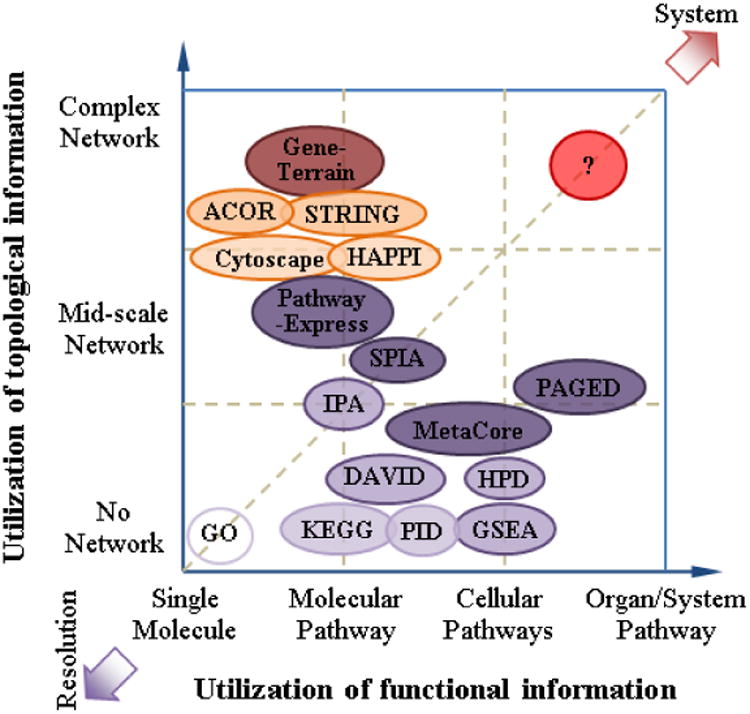
Proteomics is inherently a systems science that studies not only measured protein and their expressions in a cell, but also the interplay of proteins, protein complexes, signaling pathways, and network modules. There is a rapid accumulation of Proteomics data in recent years. However, Proteomics data are highly variable, with results sensitive to data preparation methods, sample condition, instrument types, and analytical methods. To address the challenge in Proteomics data analysis, we review current tools being developed to incorporate biological function and network topological information. We categorize these tools into four types: tools with basic functional information and little topological features (e.g., GO category analysis), tools with rich functional information and little topological features (e.g., GSEA), tools with basic functional information and rich topological features (e.g., Cytoscape), and tools with rich functional information and rich topological features (e.g., PathwayExpress). We first review the potential application of these tools to Proteomics; then we review tools that can achieve automated learning of pathway modules and features, and tools that help perform integrated network visual analytics.
Keywords: Complex networks; Functional analysis; Hybrid strategy; Network modules; Pathway analysis.
Copyright © 2014 Elsevier Ltd. All rights reserved.
Conflict of interest statement
The authors declare no conflict of interest.
Figures
References
-
- Ideker T, Thorsson V, Ranish JA, Christmas R, Buhler J, Eng JK, Bumgarner R, Goodlett DR, Aebersold R, Hood L. Integrated genomic and proteomic analyses of a systematically perturbed metabolic network. Science. 2001;292(5518):929–934. - PubMed
-
- MacBeath G. Protein microarrays and proteomics. nature genetics. 2002;32:526–532. - PubMed
-
- Bensimon A, Heck AJ, Aebersold R. Mass spectrometry-based proteomics and network biology. Annual review of biochemistry. 2012;81:379–405. - PubMed
-
- Sabidó E, Selevsek N, Aebersold R. Mass spectrometry-based proteomics for systems biology. Current opinion in biotechnology. 2012;23(4):591–597. - PubMed
-
- Goh WWB, Wong L. Networks in proteomics analysis of cancer. Current opinion in biotechnology. 2013 - PubMed
Publication types
MeSH terms
Substances
Grants and funding
LinkOut - more resources
Full Text Sources
Other Literature Sources
