


Structural biology at the European X-ray free-electron laser facility
- PMID: 24914145
- PMCID: PMC4052854
- DOI: 10.1098/rstb.2013.0311
Structural biology at the European X-ray free-electron laser facility
Abstract
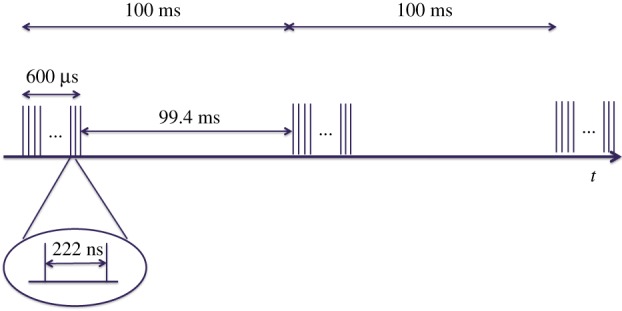
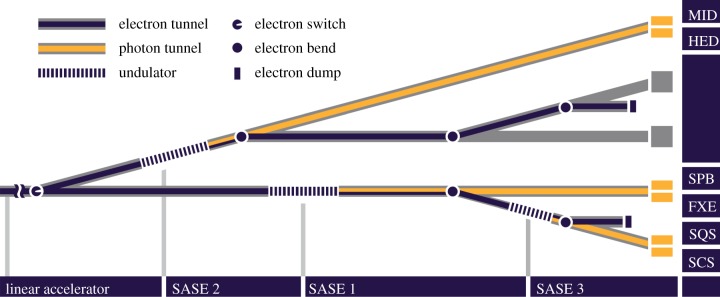
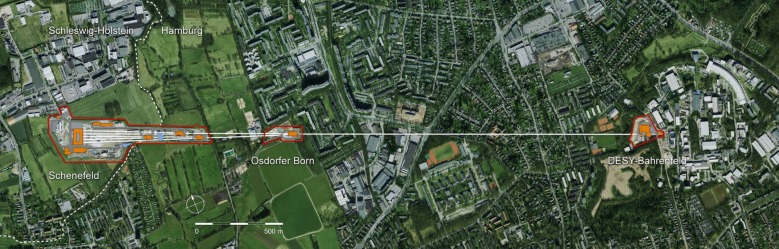
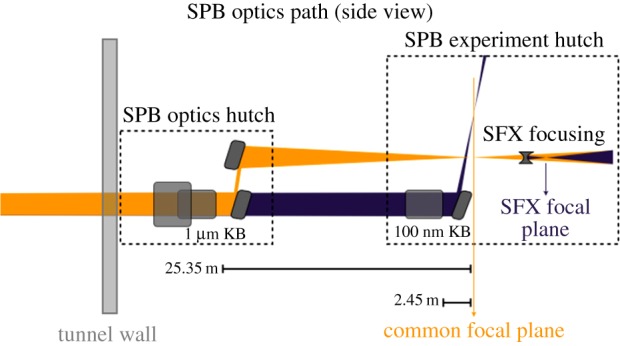
The European X-ray free-electron laser (XFEL) facility, under construction in the Hamburg region, will provide high-peak brilliance (greater than 10(33) photons s(-1) mm(-2) mrad(-2) per 0.1% BW), ultrashort pulses (approx. 10 fs) of X-rays, with a high repetition rate (up to 27 000 pulses s(-1)) from 2016 onwards. The main features of this exceptional X-ray source, and the instrumentation developments necessary to exploit them fully, for application to a variety of scientific disciplines, are briefly summarized. In the case of structural biology, that has a central role in the scientific case of this new facility, the instruments and ancillary laboratories that are being planned and built within the baseline programme of the European XFEL and by consortia of users are also discussed. It is expected that the unique features of the source and the advanced features of the instrumentation will allow operation modes with more efficient use of sample materials, faster acquisition times, and conditions better approaching feasibility of single molecule imaging.
Keywords: X-ray instrumentation; X-ray lasers; free-electron lasers; structural biology.
© 2014 The Author(s) Published by the Royal Society. All rights reserved.
Figures
References
-
- Emma P, et al. 2010. First lasing and operation of an Ångstrom-wavelength free-electron laser. Nat. Photon. 4, 641–647. ( 10.1038/nphoton.2010.176) - DOI
-
- Ishikawa T, et al. 2012. A compact X-ray free-electron laser emitting in the sub-Ångström region. Nat. Photon. 6, 540–544. ( 10.1038/nphoton.2012.141) - DOI
-
- Ganter R. (ed) 2010. SwissFEL Conceptual Design Report, PSI Report 10-06; see also Oberta P, Flechsig U. and Abela R. 2011 The SwissFEL facility and its preliminary optics beamline layout, in Proc. SPIE 8078, Advances in X-ray Free-Electron Lasers: Radiation Schemes, X-ray Optics, and Instrumentation, 807805 (20 May 2011).
-
- Han J-H, Kang H-S, Ko IS. 2012. Status of the PAL-XFEL project. In Proc. IPAC2012, New Orleans, LA, USA, pp. 1735–1737. See http://accelconf.web.cern.ch/Accelconf/IPAC2012/index.htm.
MeSH terms
LinkOut - more resources
Full Text Sources
Other Literature Sources
