


X chromosome-linked CNVs in male infertility: discovery of overall duplication load and recurrent, patient-specific gains with potential clinical relevance
- PMID: 24914684
- PMCID: PMC4051606
- DOI: 10.1371/journal.pone.0097746
X chromosome-linked CNVs in male infertility: discovery of overall duplication load and recurrent, patient-specific gains with potential clinical relevance
Abstract
Introduction: Spermatogenesis is a highly complex process involving several thousand genes, only a minority of which have been studied in infertile men. In a previous study, we identified a number of Copy Number Variants (CNVs) by high-resolution array-Comparative Genomic Hybridization (a-CGH) analysis of the X chromosome, including 16 patient-specific X chromosome-linked gains. Of these, five gains (DUP1A, DUP5, DUP20, DUP26 and DUP40) were selected for further analysis to evaluate their clinical significance.
Materials and methods: The copy number state of the five selected loci was analyzed by quantitative-PCR on a total of 276 idiopathic infertile patients and 327 controls in a conventional case-control setting (199 subjects belonged to the previous a-CGH study). For one interesting locus (intersecting DUP1A) additional 338 subjects were analyzed.
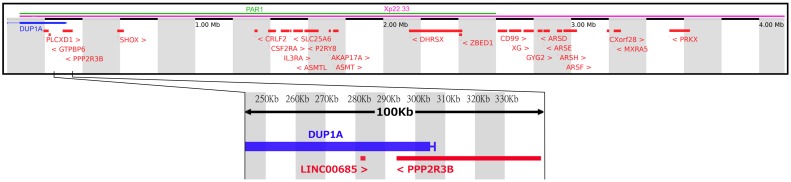
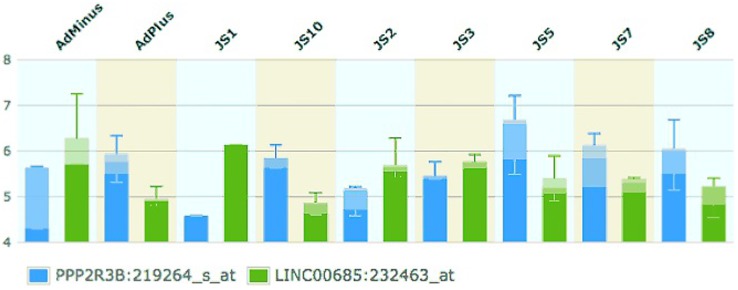
Results and discussion: All gains were confirmed as patient-specific and the difference in duplication load between patients and controls is significant (p = 1.65 × 10(-4)). Two of the CNVs are private variants, whereas 3 are found recurrently in patients and none of the controls. These CNVs include, or are in close proximity to, genes with testis-specific expression. DUP1A, mapping to the PAR1, is found at the highest frequency (1.4%) that was significantly different from controls (0%) (p = 0.047 after Bonferroni correction). Two mechanisms are proposed by which DUP1A may cause spermatogenic failure: i) by affecting the correct regulation of a gene with potential role in spermatogenesis; ii) by disturbing recombination between PAR1 regions during meiosis. This study allowed the identification of novel spermatogenesis candidate genes linked to the 5 CNVs and the discovery of the first recurrent, X-linked gain with potential clinical relevance.
Conflict of interest statement
Figures
References
Publication types
MeSH terms
LinkOut - more resources
Full Text Sources
Other Literature Sources
Medical
