


Sex hormones and macronutrient metabolism
- PMID: 24915409
- PMCID: PMC4151815
- DOI: 10.1080/10408398.2011.651177
Sex hormones and macronutrient metabolism
Abstract
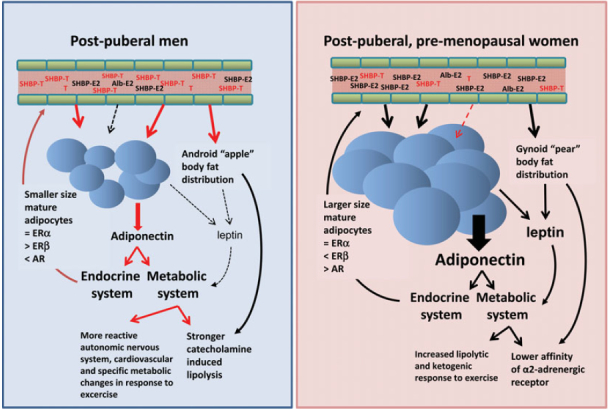
The biological differences between males and females are determined by a different set of genes and by a different reactivity to environmental stimuli, including the diet, in general. These differences are further emphasized and driven by the exposure to a different hormone flux throughout the life. These differences have not been taken into appropriate consideration by the scientific community. Nutritional sciences are not immune from this "bias" and when nutritional needs are concerned, females are considered only when pregnant, lactating or when their hormonal profile is returning back to "normal," i.e., to the male-like profile. The authors highlight some of the most evident differences in aspects of biology that are associated with nutrition. This review presents and describes available data addressing differences and similarities of the "reference man" vs. the "reference woman" in term of metabolic activity and nutritional needs. According to this assumption, available evidences of sex-associated differences of specific biochemical pathways involved in substrate metabolism are reported and discussed. The modulation by sexual hormones affecting glucose, amino acid and protein metabolism and the metabolization of nutritional fats and the distribution of fat depots, is considered targeting a tentative starting up background for a gender concerned nutritional science.
Keywords: Gender; amino acids; fat; polymorphism.
Figures
References
-
- Abe T. Brechue W.F. Fujita S. Brown J.B. Gender differences in FFM accumulation and architectural characteristics of muscle. Med. Sci. Sports Exerc. 1998;30:1066–1070. - PubMed
-
- Andersen G. Wegner L. Jensen D.P. Glumer C. Tarnow L. Drivsholm T. Poulsen P. Hansen S.K. Nielsen E.M. Ek J. PGC-1alpha Gly482Ser polymorphism associates with hypertension among Danish whites. Hypertension. 2005;45:565–570. - PubMed
-
- Aoki K. Kikuchi T. Mukasa K. Ito S. Nakajima A. Satoh S. Okamura A. Sekihara H. Dehydroepiandrosterone suppresses elevated hepatic glucose-6-phosphatase mRNA level in C57BL/KsJ-db/db mice: Comparison with troglitazone. Endocr. J. 2000;47:799–804. - PubMed
-
- Arita Y. Kihara S. Ouchi N. Takahashi M. Maeda K. Miyagawa J. Hotta K. Shimomura I. Nakamura T. Miyaoka K. Paradoxical decrease of an adipose-specific protein, adiponectin, in obesity. Biochem. Biophys. Res. Commun. 1999;257:79–83. - PubMed
Publication types
MeSH terms
Substances
LinkOut - more resources
Full Text Sources
Other Literature Sources
Medical
