


Effects of fish oil supplementation on prefrontal metabolite concentrations in adolescents with major depressive disorder: a preliminary 1H MRS study
- PMID: 24915543
- PMCID: PMC5206765
- DOI: 10.1179/1476830514Y.0000000135
Effects of fish oil supplementation on prefrontal metabolite concentrations in adolescents with major depressive disorder: a preliminary 1H MRS study
Abstract
Objective: To use proton magnetic resonance spectroscopy ((1)H MRS) to investigate the effects of fish oil (FO) supplementation on cortical metabolite concentrations in adolescents with major depressive disorder (MDD).
Methods: Metabolite concentrations were determined by (1)H MRS in the anterior cingulate cortex and bilateral dorsolateral prefrontal cortex (DLPFC) of adolescents with MDD before and following 10-week open-label supplementation with low (2.4 g/day, n = 7) or high (16.2 g/day, n = 7) dose FO. Depressive symptom severity scores and erythrocyte fatty acid levels were also determined.
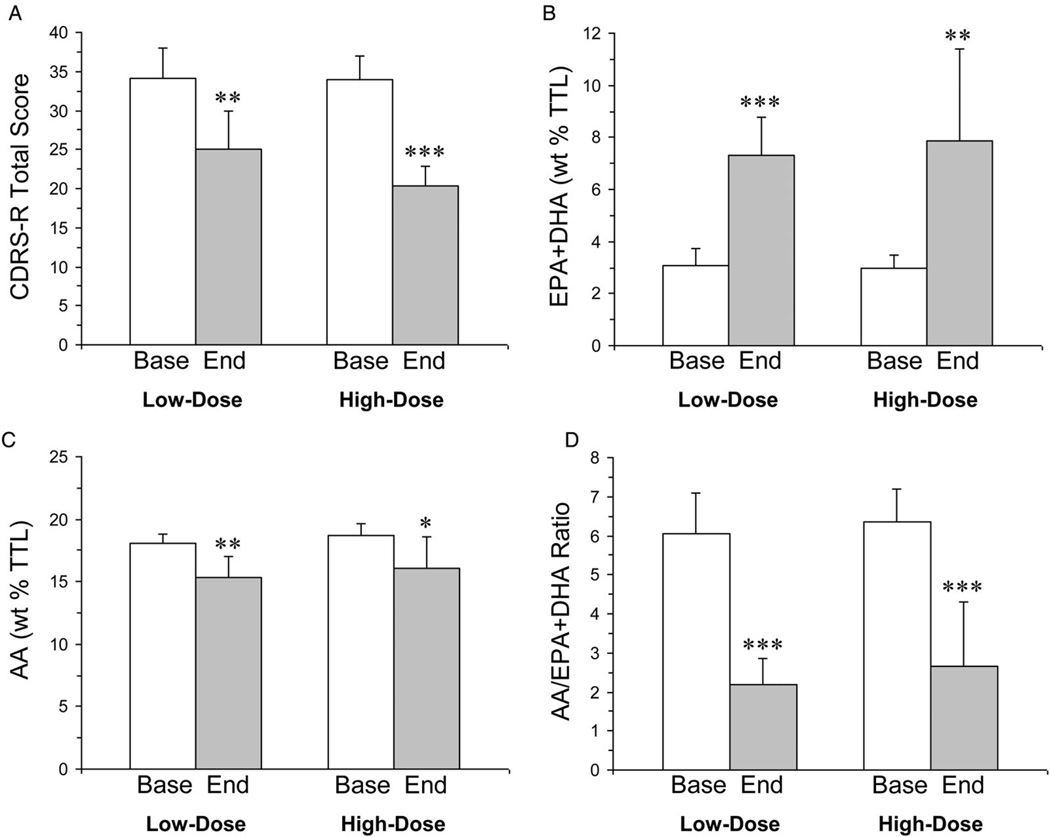
Results: Baseline erythrocyte eicosapentaenoic acid (EPA) composition was positively correlated, and arachidonic acid (AA) and the AA/EPA ratio were inversely correlated, with choline (Cho) concentrations in the right DLPFC. Docosahexaenoic acid (DHA) composition was inversely correlated with myo-inositol (mI) concentrations in the left DLPFC. Erythrocyte EPA and DHA composition increased, and AA decreased, significantly following low-dose and high-dose FO supplementation. In the intent-to-treat sample, depressive symptom severity scores decreased significantly in the high-dose group (-40%, P < 0.0001) and there was a trend in the low-dose group (-20%, P = 0.06). There were no significant baseline-endpoint changes in metabolite levels in each voxel. In the low-dose group there were changes with large effect sizes, including a decrease in mI in the left DLPFC (-12%, P = 0.18, d = 0.8) and increases in glutamate + glutamine (Glx) (+12%, P = 0.19, d = 0.8) and Cho (+15%, P = 0.08, d = 1.2) in the right DLPFC. In the high-dose group, there was a trend for increases in Cho in the right DLPFC (+10%, P = 0.09, d = 1.2).
Discussion: These preliminary data suggest that increasing the LCn-3 fatty acid status of adolescent MDD patients is associated with subtle changes in Glx, mI, and Cho concentrations in the DLPFC that warrant further evaluation in a larger controlled trial.
Keywords: Adolescent; Anterior cingulated cortex; Docosahexaenoic acid; Dorsolateral prefrontal cortex; Major depressive disorder; Proton magnetic resonance spectroscopy.
Conflict of interest statement
R.J., T.R., P.T., W.-J.C., W.A.W., and J.A.W have no conflicts to declare.
Figures

References
-
- McNamara RK. Long-chain omega-3 fatty acid deficiency in mood disorders: rationale for treatment and prevention. Curr Drug Discov Technol. 2013;10:233–244. - PubMed
-
- Hibbeln JR. Depression, suicide and deficiencies of omega-3 essential fatty acids in modern diets. World Rev Nutr Diet. 2009;99:17–30. - PubMed
-
- Su K-P, Balanza-Martinez V. Role of omega-3 fatty acids in mood disorders. In: McNamara RK, editor. The omega-3 fatty acid deficiency syndrome. USA: Nova Science Publishers, Inc.; pp. 315–336.
-
- Edwards R, Peet M, Shay J, Horrobin D. Omega-3 polyunsaturated fatty acid levels in the diet and in red blood cell membranes of depressed patients. J Affect Disord. 1998;48:149–155. - PubMed
Publication types
MeSH terms
Substances
Grants and funding
LinkOut - more resources
Full Text Sources
Other Literature Sources
Medical
Research Materials
Miscellaneous
