


TRP channel cannabinoid receptors in skin sensation, homeostasis, and inflammation
- PMID: 24915599
- PMCID: PMC4240254
- DOI: 10.1021/cn5000919
TRP channel cannabinoid receptors in skin sensation, homeostasis, and inflammation
Abstract
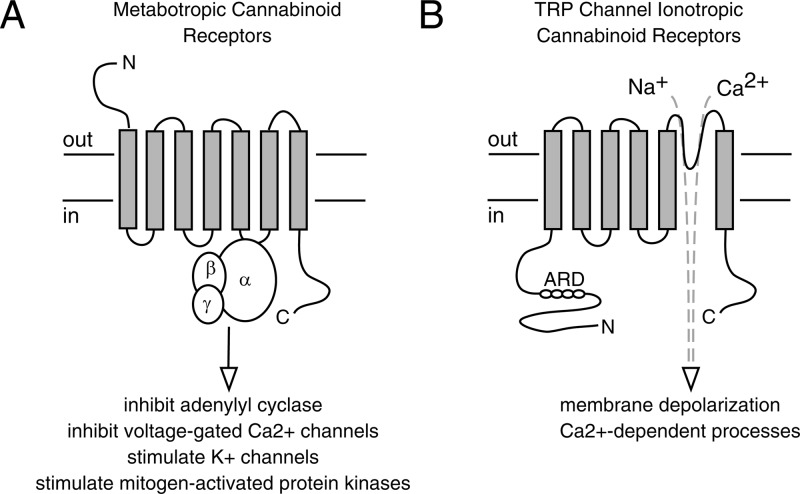
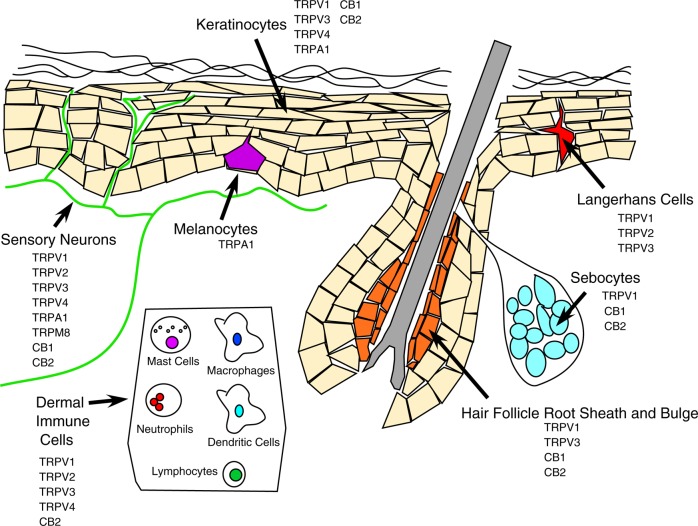
In the skin, cannabinoid lipids, whether of endogenous or exogenous origin, are capable of regulating numerous sensory, homeostatic, and inflammatory events. Although many of these effects are mediated by metabotropic cannabinoid receptors, a growing body of evidence has revealed that multiple members of the transient receptor potential (TRP) ion channel family can act as "ionotropic cannabinoid receptors". Furthermore, many of these same TRP channels are intimately involved in cutaneous processes that include the initiation of pain, temperature, and itch perception, the maintenance of epidermal homeostasis, the regulation of hair follicles and sebaceous glands, and the modulation of dermatitis. Ionotropic cannabinoid receptors therefore represent potentially attractive targets for the therapeutic use of cannabinoids to treat sensory and dermatological diseases. Furthermore, the interactions between neurons and other cell types that are mediated by cutaneous ionotropic cannabinoid receptors are likely to be recapitulated during physiological and pathophysiological processes in the central nervous system and elsewhere, making the skin an ideal setting in which to dissect general complexities of cannabinoid signaling.
Keywords: Transient receptor potential; cannabinoids; dermatitis; ion channel; nociception; pruritis.
Figures
References
-
- Pertwee R. G.; Howlett A. C.; Abood M. E.; Alexander S. P.; Di Marzo V.; Elphick M. R.; Greasley P. J.; Hansen H. S.; Kunos G.; Mackie K.; Mechoulam R.; Ross R. A. (2010) International Union of Basic and Clinical Pharmacology. LXXIX. Cannabinoid receptors and Their Ligands: Beyond CB(1) and CB(2). Pharmacol Rev. 62, 588–631. - PMC - PubMed
-
- Pucci M.; Pirazzi V.; Pasquariello N.; Maccarrone M. (2011) Endocannabinoid signaling and epidermal differentiation. Eur. J. Dermatol 21(Suppl 2), 29–34. - PubMed
Publication types
MeSH terms
Substances
Grants and funding
LinkOut - more resources
Full Text Sources
Other Literature Sources
Research Materials
