. 2014 Jun 10:14:153.
doi: 10.1186/1471-2180-14-153.

The oxygen sensor MgFnr controls magnetite biomineralization by regulation of denitrification in Magnetospirillum gryphiswaldense

Affiliations

The oxygen sensor MgFnr controls magnetite biomineralization by regulation of denitrification in Magnetospirillum gryphiswaldense

Yingjie Li et al. BMC Microbiol. .

Abstract

Background: Magnetotactic bacteria are capable of synthesizing magnetosomes only under oxygen-limited conditions. However, the mechanism of the aerobic repression on magnetite biomineralization has remained unknown. In Escherichia coli and other bacteria, Fnr (fumarate and nitrate reduction regulator) proteins are known to be involved in controlling the switch between microaerobic and aerobic metabolism. Here, we report on an Fnr-like protein (MgFnr) and its role in growth metabolism and magnetite biomineralization in the alphaproteobacterium Magnetospirillum gryphiswaldense.

Results: Deletion of Mgfnr not only resulted in decreased N2 production due to reduced N2O reductase activity, but also impaired magnetite biomineralization under microaerobic conditions in the presence of nitrate. Overexpression of MgFnr in the WT also caused the synthesis of smaller magnetite particles under anaerobic and microaerobic conditions in the presence of nitrate. These data suggest that proper expression of MgFnr is required for WT-like magnetosome synthesis, which is regulated by oxygen. Analyses of transcriptional gusA reporter fusions revealed that besides showing similar properties to Fnr proteins reported in other bacteria, MgFnr is involved in the repression of the expression of denitrification genes nor and nosZ under aerobic conditions, possibly owing to several unique amino acid residues specific to MTB-Fnr.

Conclusions: We have identified and thoroughly characterized the first regulatory protein mediating denitrification growth and magnetite biomineralization in response to different oxygen conditions in a magnetotactic bacterium. Our findings reveal that the global oxygen regulator MgFnr is a genuine O2 sensor. It is involved in controlling expression of denitrification genes and thereby plays an indirect role in maintaining proper redox conditions required for magnetite biomineralization.


Figures
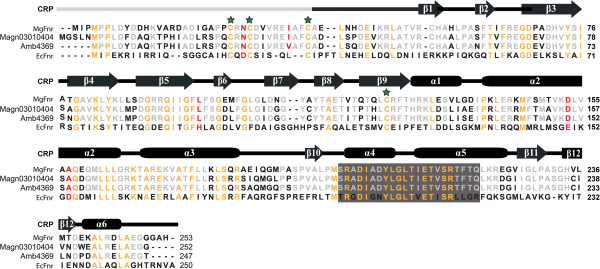
Figure 1
Figure 1
Sequence alignment of Fnr proteins from different bacteria and proposed domain structure of one subunit of Fnr based on the structure of its homolog Crp fromE. coli. Conserved residues are shown in orange while residues which are only conserved in magnetospirilla are indicated in gray. In MSR-1, the first 37 amino acids that are absent in Crp contain three of the four Cys (Cys25, Cys28, Cys37, and C125 indicated by green stars) which ligate the [4Fe-4S] cluster. Gray boxes indicate DNA-binding motif. Single residue changes which are capable to activate transcription of nitrate reductase genes under aerobic conditions in E. coli are shown in red. Amb4369 is from M. magneticum strain and Magn03010404 is from M. magnetotacticum.
Figure 2
Figure 2
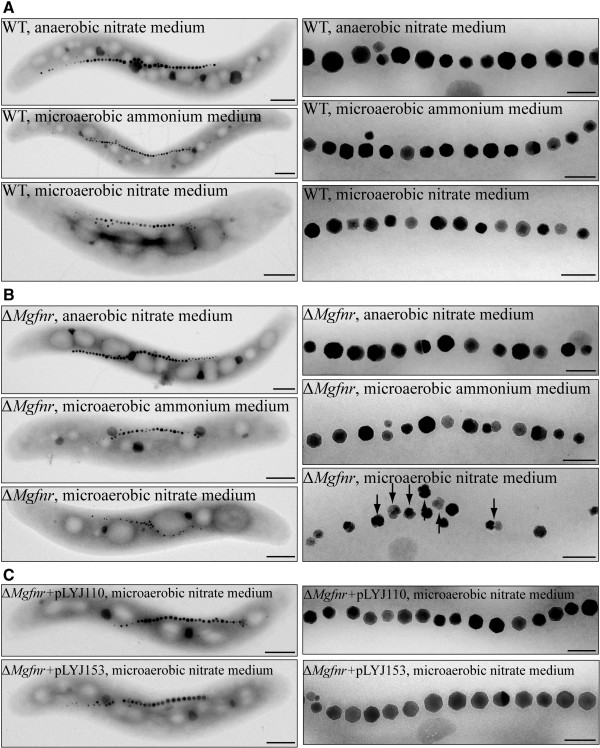
Effects ofMgfnrdeletions on magnetosome formation. (A) Left: TEM images of whole cells of WT (from top to bottom) in anaerobic nitrate medium, microaerobic ammonium medium, and microaerobic nitrate medium. Bar, 500 nm. Right: Closeup views of magnetosome crystals shown on the left. Bar, 100 nm. (B) Left: TEM images of whole cells of ΔMgfnr mutant (from top to bottom) in anaerobic nitrate medium, microaerobic ammonium medium, and microaerobic nitrate medium. Bar, 500 nm. Right: Closeup views of magnetosome crystals shown on the left. Irregular shaped particles are indicated by black arrows. Bar, 100 nm. (C) Left: TEM images of ΔMgfnr mutant complemented with plasmids pLYJ110 harboring Mgfnr gene and pLYJ153 harboring Ecfnr gene in microaerobic nitrate medium. Bar, 500 nm. Right: Closeup views of magnetosome crystals shown on the left. Bar, 100 nm.
Figure 3
Figure 3
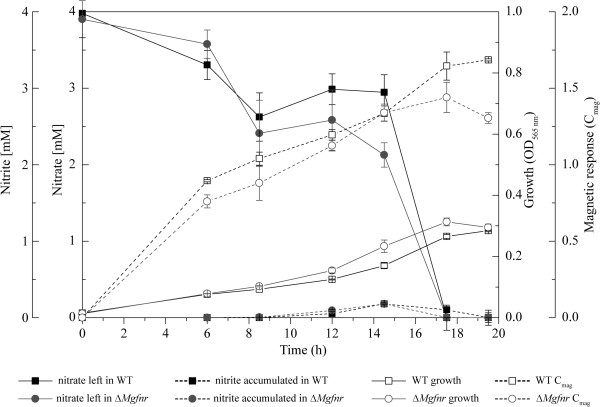
Time courses of nitrate and nitrite utilization during microaerobic growth of WT and ΔMgfnrmutant in nitrate medium. Black square with solid line, nitrate left in WT; black square with dash line, nitrite accumulated in WT; gray circle with solid line, nitrate left in ΔMgfnr; gray circle with dash line, nitrite accumulated in ΔMgfnr; white square with solid line, growth of WT; white square with dash line, WT Cmag; white circle with solid line, growth of ΔMgfnr; white circle with dash line, ΔMgfnr Cmag.
Figure 4
Figure 4
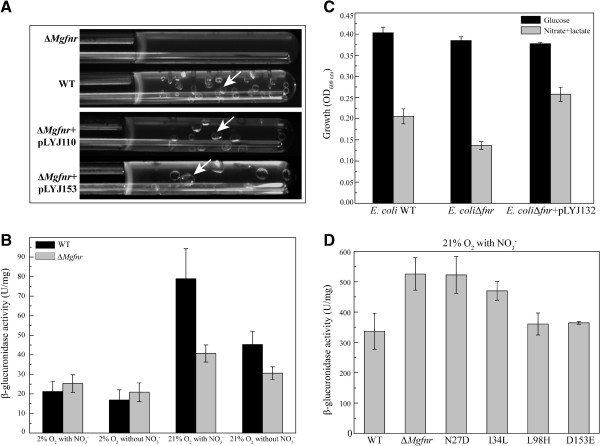
Analysis of ΔMgfnrmutant. (A) N2 production in WT, ΔMgfnr mutant, ΔMgfnr mutant plus pLYJ110, and ΔMgfnr mutant plus pLYJ153 cultures in oxygen gradient tubes with 0.3% agar. ΔMgfnr mutant plus pLYJ110, and ΔMgfnr mutant plus pLYJ153 cells contained respective fnr gene from MSR-1 and E. coli. Gas bubbles were indicated by white arrows. (B) Transcription of Mgfnr promoter fused to gusA in both WT and ΔMgfnr mutant under different conditions. Expression was measured by β-glucuronidase activity. Cultures were grown aerobically or microaerobically in nitrate and ammonium medium. (C) Heterologous transcomplementation of ΔEcfnr mutant harboring the plasmid pLYJ132 which contains Mgfnr. Cultures were anaerobically grown to stationary phase at 30°C in glucose minimal medium (black box) and lactate minimal medium (gray box). (D) Transcription of nosZ fused to gusA in Mgfnr variant strains under aerobic conditions in the presence of nitrate. Expression was measured by β-glucuronidase activity.

References

    1. Jogler C, Schüler D. Genomics, genetics, and cell biology of magnetosome formation. Annu Rev Microbiol. 2009;63:501–521. doi: 10.1146/annurev.micro.62.081307.162908. - DOI - PubMed
    1. Ullrich S, Kube M, Schübbe S, Reinhardt R, Schüler D. A hypervariable 130-kilobase genomic region of Magnetospirillum gryphiswaldense comprises a magnetosome island which undergoes frequent rearrangements during stationary growth. J Bacteriol. 2005;187:7176–7184. doi: 10.1128/JB.187.21.7176-7184.2005. - DOI - PMC - PubMed
    1. Murat D, Quinlan A, Vali H, Komeili A. Comprehensive genetic dissection of the magnetosome gene island reveals the step-wise assembly of a prokaryotic organelle. Proc Natl Acad Sci U S A. 2010;107:5593–5598. doi: 10.1073/pnas.0914439107. - DOI - PMC - PubMed
    1. Lohsse A, Ullrich S, Katzmann E, Borg S, Wanner G, Richter M, Voigt B, Schweder T, Schüler D. Functional analysis of the magnetosome island in Magnetospirillum gryphiswaldense: the mamAB operon is sufficient for magnetite biomineralization. PLoS One. 2011;6:e25561. doi: 10.1371/journal.pone.0025561. - DOI - PMC - PubMed
    1. Li YJ, Katzmann E, Borg S, Schüler D. The periplasmic nitrate reductase Nap is required for anaerobic growth and involved in redox control of magnetite biomineralization in Magnetospirillum gryphiswaldense. J Bacteriol. 2012;194:4847–4856. doi: 10.1128/JB.00903-12. - DOI - PMC - PubMed

Publication types

MeSH terms

LinkOut - more resources