


Hidden in plain sight: bias towards sick patients when sampling patients with sufficient electronic health record data for research
- PMID: 24916006
- PMCID: PMC4062889
- DOI: 10.1186/1472-6947-14-51
Hidden in plain sight: bias towards sick patients when sampling patients with sufficient electronic health record data for research
Abstract
Background: To demonstrate that subject selection based on sufficient laboratory results and medication orders in electronic health records can be biased towards sick patients.
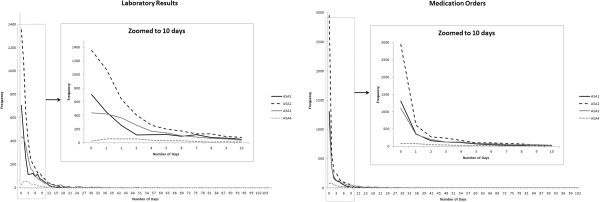
Methods: Using electronic health record data from 10,000 patients who received anesthetic services at a major metropolitan tertiary care academic medical center, an affiliated hospital for women and children, and an affiliated urban primary care hospital, the correlation between patient health status and counts of days with laboratory results or medication orders, as indicated by the American Society of Anesthesiologists Physical Status Classification (ASA Class), was assessed with a Negative Binomial Regression model.
Results: Higher ASA Class was associated with more points of data: compared to ASA Class 1 patients, ASA Class 4 patients had 5.05 times the number of days with laboratory results and 6.85 times the number of days with medication orders, controlling for age, sex, emergency status, admission type, primary diagnosis, and procedure.
Conclusions: Imposing data sufficiency requirements for subject selection allows researchers to minimize missing data when reusing electronic health records for research, but introduces a bias towards the selection of sicker patients. We demonstrated the relationship between patient health and quantity of data, which may result in a systematic bias towards the selection of sicker patients for research studies and limit the external validity of research conducted using electronic health record data. Additionally, we discovered other variables (i.e., admission status, age, emergency classification, procedure, and diagnosis) that independently affect data sufficiency.
Figures
References
-
- Blumenthal D. Stimulating the adoption of health information technology. N Engl J Med. 2009;360(15):1477–1479. - PubMed
-
- Blumenthal D, Tavenner M. The “meaningful use” regulation for electronic health records. N Engl J Med. 2010;363(6):501–504. - PubMed
-
- Charles D, King J, Patel V, Furukawa M. ONC Data Brief No. 9: Adoption of Electronic Health record Systems among U.S. Non-federal Acute Care Hospitals: 2008-20012. 2013. (The Office of the National Coordinator for Health Information Technology).
-
- Hsiao C, Hing E. NCHS Data Brief No. 111: Use and characteristics of electronic health record systems among office-based physician practice: United States, 2001-2012. 2012. (National Center for Health Statistics). - PubMed
Publication types
MeSH terms
Grants and funding
LinkOut - more resources
Full Text Sources
Other Literature Sources
