Emergence of HPV16-positive oropharyngeal cancer in Black patients over time: University of Maryland 1992-2007
- PMID: 24916537
- PMCID: PMC4429293
- DOI: 10.1158/1940-6207.CAPR-14-0089-T
Emergence of HPV16-positive oropharyngeal cancer in Black patients over time: University of Maryland 1992-2007
Abstract
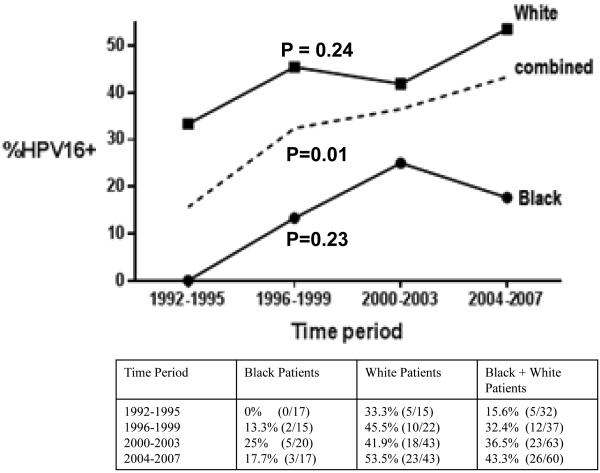
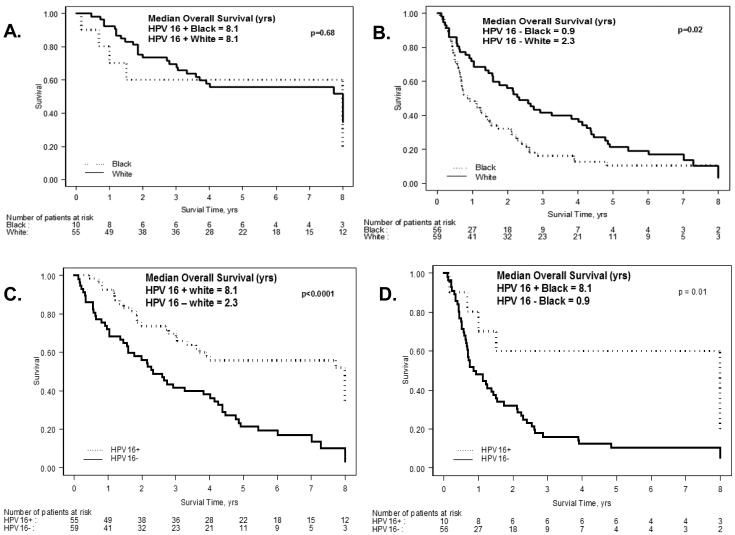
While we previously reported a striking racial difference in the prevalence of human papilloma virus (HPV)-positive squamous cell carcinoma of the oropharynx (OPSCC), less is known about differences in outcomes and trends over time in OPSCC by HPV status and race. We conducted a retrospective analysis of 467 patients with OPSCC treated at the University of Maryland Greenebaum Cancer Center (Baltimore, MD) between 1992 and 2007, of which 200 had tissue available for HPV16 testing. HPV16-positive patients were significantly more likely to be white, with 45.5% of whites and 15.5% of blacks testing positive for HPV16. There was a significant increase in HPV16-positive OPSCC for all patients over time from 15.6% in 1992 to 1995 to 43.3% in 2004 to 2007 (P = 0.01). From 1992 to 1995, 33% of white patients were HPV16-positive, with no black patients positive. From 2004 to 2007, 17.7% of black patients and 54% of white patients were HPV16-positive. White and black patients with HPV16-positive tumors had an identical and favorable overall survival (OS; median, 8.1 and 8.1 years, respectively). However, among HPV16-negative patients, whites had an improved OS compared with blacks (median, 2.3 vs. 0.9 years, respectively; P = 0.02), including when analyzed in a multivariable Cox regression model. From 1992 to 2007, the percentage of HPV16-positive OPSCC increased for white patients and was seen for the first time in black patients. While survival for HPV-positive black and white patients was similar and favorable, outcomes for HPV-negative patients were poor, with blacks having worse survival even after controlling for baseline characteristics.
©2014 American Association for Cancer Research.
Figures
Comment in
-
The rise of HPV-positive oropharyngeal cancers in the United States.Cancer Prev Res (Phila). 2015 Jan;8(1):9-11. doi: 10.1158/1940-6207.CAPR-14-0425. Epub 2014 Dec 2. Cancer Prev Res (Phila). 2015. PMID: 25468833
References
-
- Gillison ML, Koch WM, Capone RB, Spafford M, Westra WH, Wu L, et al. Evidence for a causal association between human papillomavirus and a subset of head and neck cancers. Journal of the National Cancer Institute. 2000;92(9):709–20. Epub 2000/05/04. - PubMed
-
- D'Souza G, Kreimer AR, Viscidi R, Pawlita M, Fakhry C, Koch WM, et al. Case-control study of human papillomavirus and oropharyngeal cancer. The New England journal of medicine. 2007;356(19):1944–56. Epub 2007/05/15. - PubMed
-
- Chaturvedi AK, Engels EA, Pfeiffer RM, Hernandez BY, Xiao W, Kim E, et al. Human papillomavirus and rising oropharyngeal cancer incidence in the United States. Journal of clinical oncology : official journal of the American Society of Clinical Oncology. 2011;29(32):4294–301. Epub 2011/10/05. - PMC - PubMed
-
- Begum S, Westra WH. Basaloid squamous cell carcinoma of the head and neck is a mixed variant that can be further resolved by HPV status. The American journal of surgical pathology. 2008;32(7):1044–50. Epub 2008/05/23. - PubMed
-
- Hafkamp HC, Manni JJ, Haesevoets A, Voogd AC, Schepers M, Bot FJ, et al. Marked differences in survival rate between smokers and nonsmokers with HPV 16-associated tonsillar carcinomas. International journal of cancer Journal international du cancer. 2008;122(12):2656–64. Epub 2008/03/25. - PubMed
Publication types
MeSH terms
Grants and funding
LinkOut - more resources
Full Text Sources
Other Literature Sources