


Prognostic B-cell signatures using mRNA-seq in patients with subtype-specific breast and ovarian cancer
- PMID: 24916698
- PMCID: PMC4102637
- DOI: 10.1158/1078-0432.CCR-13-3368
Prognostic B-cell signatures using mRNA-seq in patients with subtype-specific breast and ovarian cancer
Abstract
Purpose: Lymphocytic infiltration of tumors predicts improved survival in patients with breast cancer. Previous studies have suggested that this survival benefit is confined predominantly to the basal-like subtype. Immune infiltration in ovarian tumors is also associated with improved prognosis. Currently, it is unclear what aspects of the immune response mediate this improved outcome.
Experimental design: Using The Cancer Genome Atlas mRNA-seq data and a large microarray dataset, we evaluated adaptive immune gene expression by genomic subtype in breast and ovarian cancer. To investigate B-cells observed to be prognostic within specific subtypes, we developed methods to analyze B-cell population diversity and degree of somatic hypermutation (SHM) from B-cell receptor (BCR) sequences in mRNA-seq data.
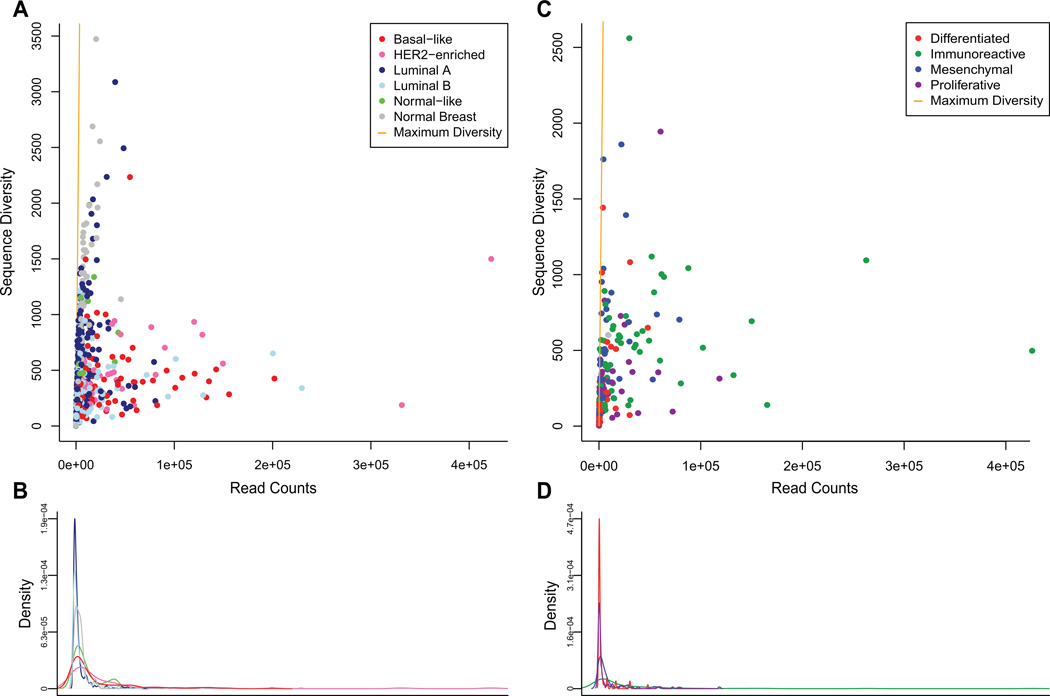
Results: Improved metastasis-free/progression-free survival was correlated with B-cell gene expression signatures, which were restricted mainly to the basal-like and HER2-enriched breast cancer subtypes and the immunoreactive ovarian cancer subtype. Consistent with a restricted epitope-driven response, a subset of basal-like and HER2-enriched breast tumors and immunoreactive ovarian tumors showed high expression of a low-diversity population of BCR gene segments. More BCR segments showed improved prognosis with increased expression in basal-like breast tumors and immunoreactive ovarian tumors compared with other subtypes. Basal-like and HER2-enriched tumors exhibited more BCR sequence variants in regions consistent with SHM.
Conclusion: Taken together, these data suggest the presence of a productive and potentially restricted antitumor B-cell response in basal-like breast and immunoreactive ovarian cancers. Immunomodulatory therapies that support B-cell responses may be a promising therapeutic approach to targeting these B-cell infiltrated tumors.
©2014 American Association for Cancer Research.
Conflict of interest statement
C.M.P is an equity stock holder, and Board of Director Member, of University Genomics/BioClassifier LLC. C.M.P and J.S.P are also listed as inventors on a patent application on the PAM50 assay.
Figures
References
-
- Lee AH, Gillett CE, Ryder K, Fentiman IS, Miles DW, Millis RR. Different patterns of inflammation and prognosis in invasive carcinoma of the breast. Histopathology. 2006;48:692–701. - PubMed
-
- Yakirevich E, Izhak OB, Rennert G, Kovacs ZG, Resnick MB. Cytotoxic phenotype of tumor infiltrating lymphocytes in medullary carcinoma of the breast. Mod Pathol. 1999;12:1050–1056. - PubMed
-
- Rakha EA, Aleskandarany M, El-Sayed ME, Blamey RW, Elston CW, Ellis IO, et al. The prognostic significance of inflammation and medullary histological type in invasive carcinoma of the breast. Eur J Cancer. 2009;45:1780–1787. - PubMed
-
- Mahmoud SM, Paish EC, Powe DG, Macmillan RD, Grainge MJ, Lee AH, et al. Tumor-infiltrating CD8+ lymphocytes predict clinical outcome in breast cancer. J Clin Oncol. 2011;29:1949–1955. - PubMed
Publication types
MeSH terms
Substances
Grants and funding
LinkOut - more resources
Full Text Sources
Other Literature Sources
Medical
Research Materials
Miscellaneous
