


Low rates of adjuvant radiation in patients with nonmetastatic prostate cancer with high-risk pathologic features
- PMID: 24917426
- PMCID: PMC4277873
- DOI: 10.1002/cncr.28856
Low rates of adjuvant radiation in patients with nonmetastatic prostate cancer with high-risk pathologic features
Abstract
Background: The 2013 American Urological Association/American Society for Radiation Oncology consensus guidelines recommend offering adjuvant radiotherapy (RT) after radical prostatectomy in patients with high-risk pathologic features for recurrence. In the current study, the authors examined practice patterns of adjuvant RT use in patients with elevated pathologic risk factors over a time period spanning the publication of supporting randomized evidence.
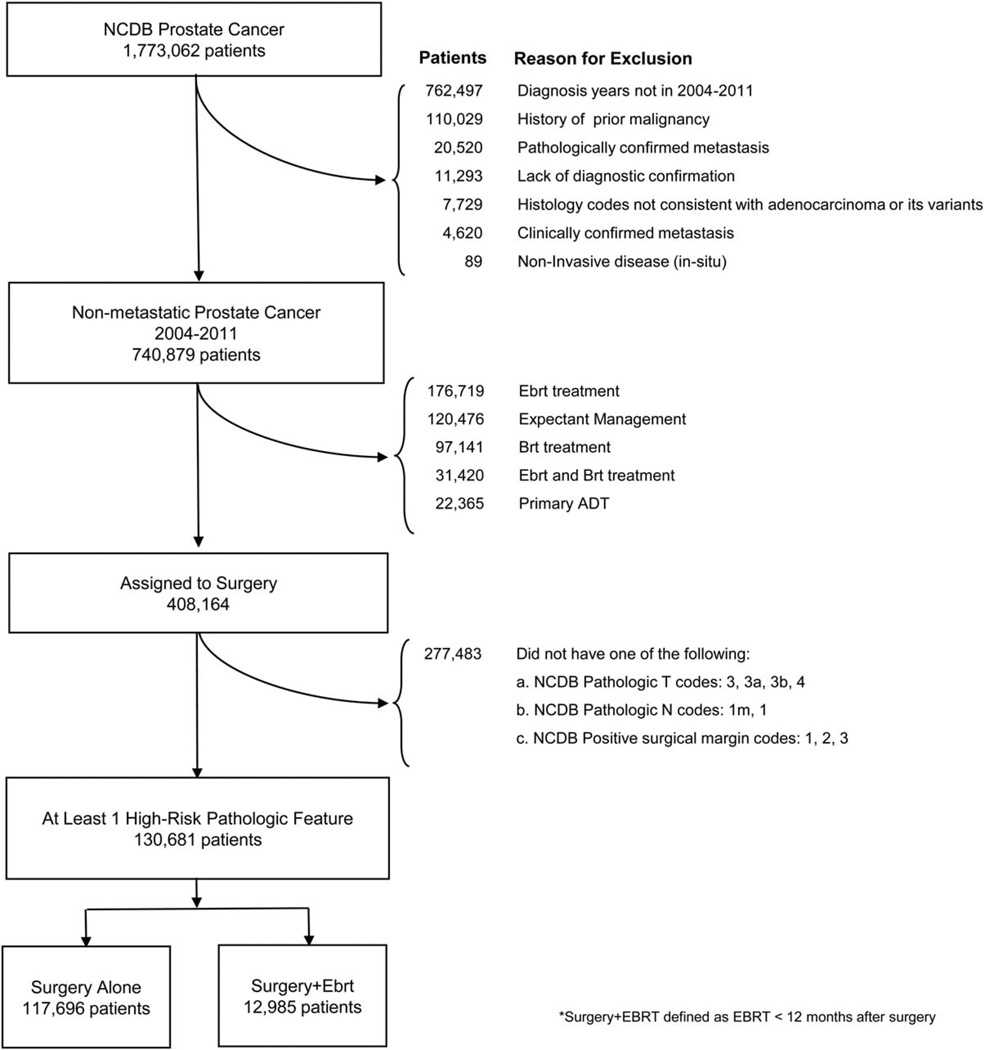
Methods: Using the National Cancer Data Base, a total of 130,681 patients were identified who underwent surgical resection for prostate cancer between 2004 and 2011 with at least 1 of the following pathologic risk factors for early biochemical failure: pT3a disease or higher, positive surgical margins and/or lymph node-positive disease. Using multivariable logistic regression, the authors examined factors associated with adjuvant RT use including patient, clinical, demographic, and temporal characteristics.
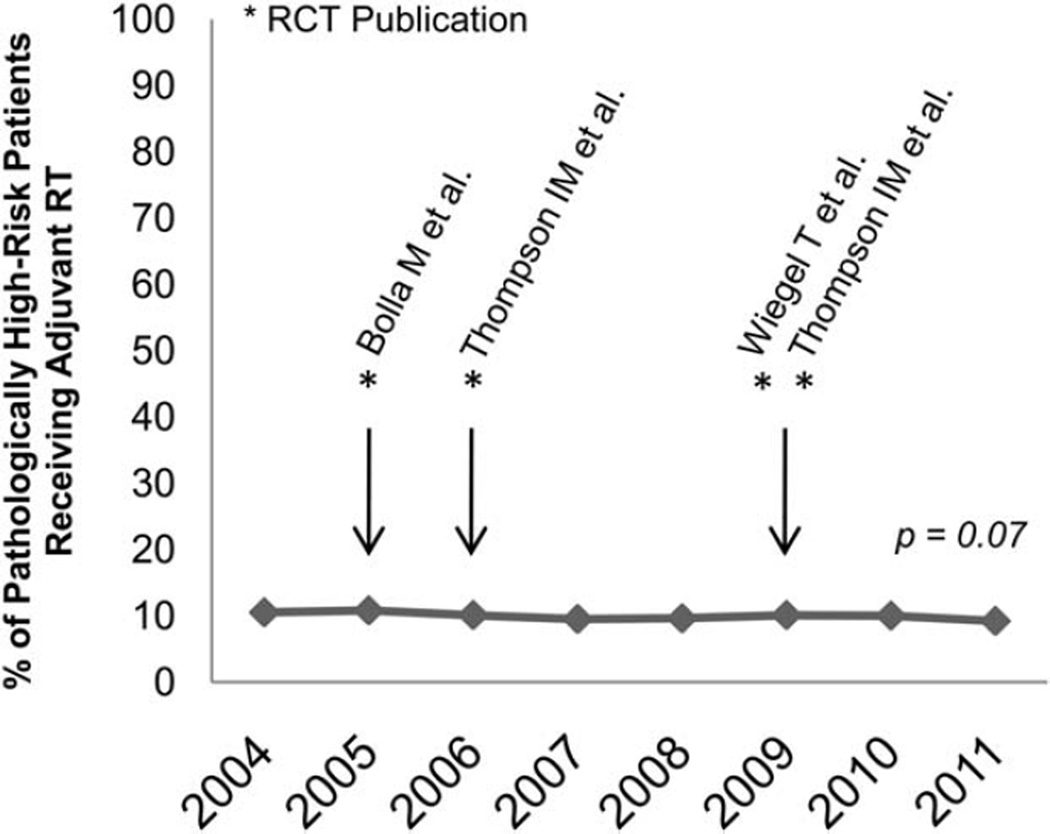
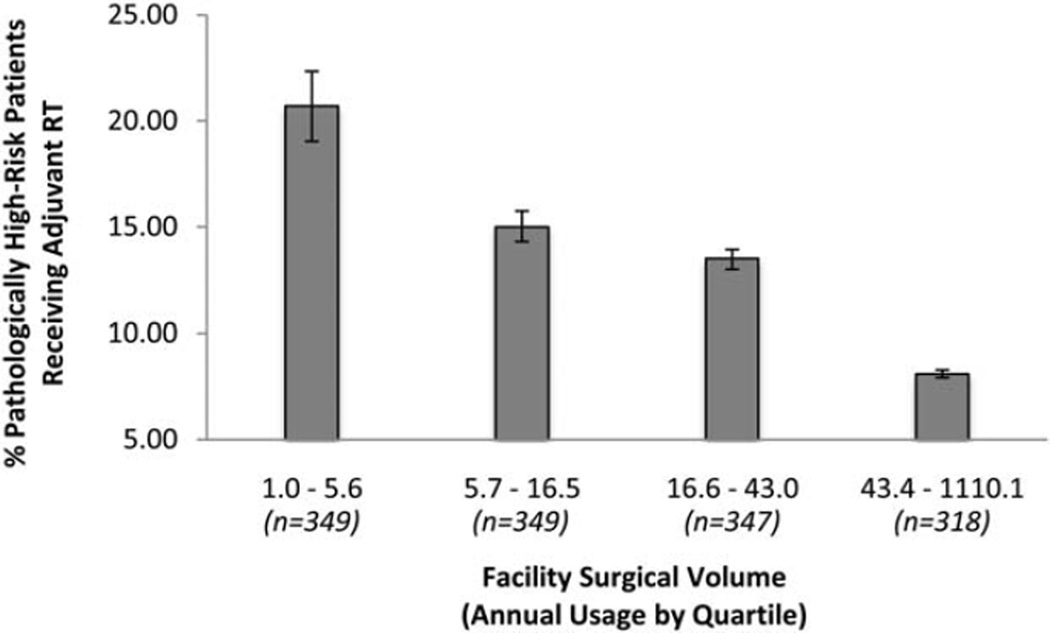
Results: Adjuvant RT was administered to 9.9% of the patients with at least 1 pathologic risk factor. Use of adjuvant RT did not change over the study period (P = .23). On multivariable analysis, we found that patients treated at high-volume surgical facilities were less likely to receive adjuvant RT (15.9% vs 7.8%; odds ratio, 0.58 [95% confidence interval, 0.50-0.65]; P < .0001). Older age, comorbidities, black race, lower income, and lower population density were also associated with lower rates of adjuvant RT.
Conclusions: Use of adjuvant RT is uncommon and remained unchanged between 2004 and 2011. Patients treated at high-volume surgical facilities are less likely to receive adjuvant RT, irrespective of margin status.
Keywords: adjuvant; patterns of care; prostate cancer; radiation; surgical volume.
© 2014 American Cancer Society.
Conflict of interest statement
CONFLICT OF INTEREST DISCLOSURES
The authors made no disclosures.
Figures
References
-
- Thompson IM, Tangen CM, Paradelo J, et al. Adjuvant radiotherapy for pathologically advanced prostate cancer. JAMA. 2006;296:2329–2335. - PubMed
-
- Wiegel T, Bottke D, Steiner U, et al. Phase III postoperative adjuvant radiotherapy after radical prostatectomy compared with radical prostatectomy alone in pT3 prostate cancer with postoperative undetectable prostate-specific antigen: ARO 96-02/AUO AP 09/95. J Clin Oncol. 2009;27:2924–2930. - PubMed
-
- Bolla M, van Poppel H, Collette L, et al. Postoperative radiotherapy after radical prostatectomy: a randomised controlled trial (EORTC trial 22911) Lancet. 2005;366:572–578. - PubMed
-
- Bolla M, van Poppel H, Tombal B, et al. Postoperative radiotherapy after radical prostatectomy for high-risk prostate cancer: long-term results of a randomised controlled trial (EORTC trial 22911) Lancet. 2012;380:2018–2027. - PubMed
Publication types
MeSH terms
Grants and funding
LinkOut - more resources
Full Text Sources
Other Literature Sources
Medical
