. 2014 Jun 11:11:110.
doi: 10.1186/1743-422X-11-110.

Inhibition of mTORC1 inhibits lytic replication of Epstein-Barr virus in a cell-type specific manner

Affiliations

Inhibition of mTORC1 inhibits lytic replication of Epstein-Barr virus in a cell-type specific manner

Amy L Adamson et al. Virol J. .

Abstract

Background: Epstein-Barr virus is a human herpesvirus that infects a majority of the human population. Primary infection of Epstein-Barr virus (EBV) causes the syndrome infectious mononucleosis. This virus is also associated with several cancers, including Burkitt's lymphoma, post-transplant lymphoproliferative disorder and nasopharyngeal carcinoma. As all herpesvirus family members, EBV initially replicates lytically to produce abundant virus particles, then enters a latent state to remain within the host indefinitely.

Methods: Through a genetic screen in Drosophila, we determined that reduction of Drosophila Tor activity altered EBV immediate-early protein function. To further investigate this finding, we inhibited mTOR in EBV-positive cells and investigated subsequent changes to lytic replication via Western blotting, flow cytometry, and quantitative PCR. The student T-test was used to evaluate significance.

Results: mTOR, the human homolog of Drosophila Tor, is an important protein at the center of a major signaling pathway that controls many aspects of cell biology. As the EBV immediate-early genes are responsible for EBV lytic replication, we examined the effect of inhibition of mTORC1 on EBV lytic replication in human EBV-positive cell lines. We determined that treatment of cells with rapamycin, which is an inhibitor of mTORC1 activity, led to a reduction in the ability of B cell lines to undergo lytic replication. In contrast, EBV-positive epithelial cell lines underwent higher levels of lytic replication when treated with rapamycin.

Conclusions: Overall, the responses of EBV-positive cell lines vary when treated with mTOR inhibitors, and this may be important when considering such inhibitors as anti-cancer therapeutic agents.


Figures
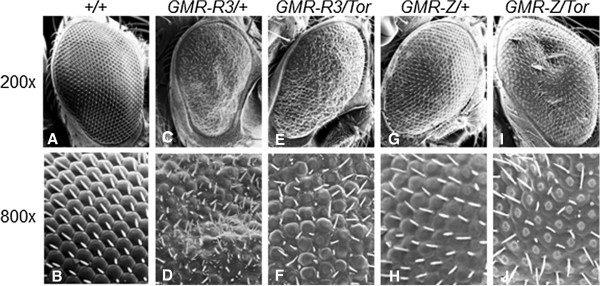
Figure 1
Figure 1
Loss of Tor alters Z and R activity in a Drosophila model system. A-B. Wild-type eye. C-D. GMR-R3 heterozygote. Note the rough eye phenotype and extra small bristles in D. E-F. GMR-R3/Tor transheterozygote. Note the more wild-type structure and reduction of extra small bristles. G-H. GMR-Z heterozygote. I-J. GMR-Z/Tor transheterozygote. Note the flattening of the ommatidia in J.
Figure 2
Figure 2
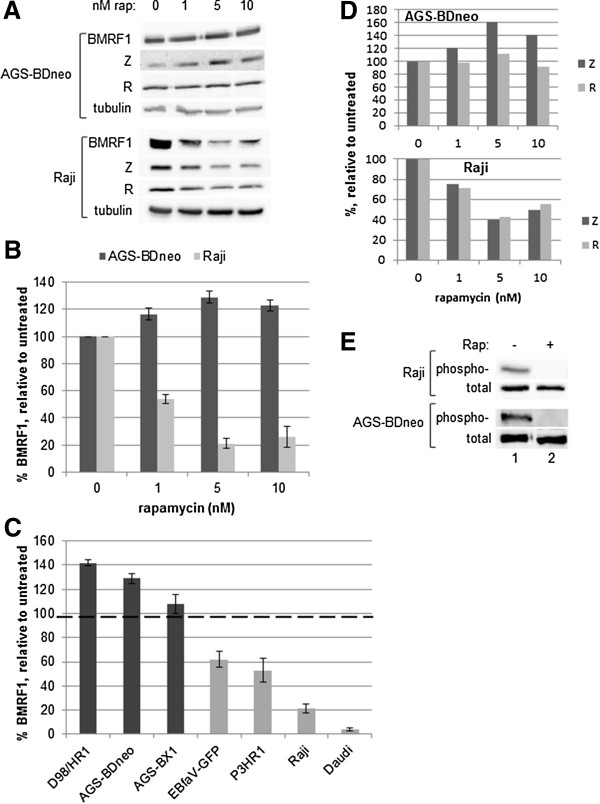
Inhibition of mTORC1 alters early lytic replication in EBV-positive cells. A. AGS-BDneo or Raji cells were treated with 0, 1, 5, or 10 nM rapamycin 24 hr prior to induction of lytic replication. Western blot analysis was performed with anti-BMRF1, anti-Z, anti-R, and anti-tubulin antibodies. Representative blots are shown. B. The BMRF1 levels from Western blots (in triplicate) were quantified and standardized to tubulin levels. The resulting BMRF1 protein levels are presented, relative to induced cells (with no rapamycin treatment). C. BMRF1 levels of a panel of EBV-positive cells treated with 5 nM rapamycin, induced, and analyzed as in parts A and B above. Dark bars are epithelial cell lines, light bars are B cell lines. D. Z and R levels from the Western blots in part A were quantified and standardized to tubulin levels. The resulting Z and R protein levels are presented, relative to induced cells (with no rapamycin treatment). E. Inhibition of mTOR with 5 nM rapamycin inhibits mTOR activity. Raji and AGS-BDneo cells were treated with 0 or 5 nM rapamycin for 2 days, then subjected to Western blot analysis with anti-phospho-p70S6K and total p70S6K antibodies.
Figure 3
Figure 3
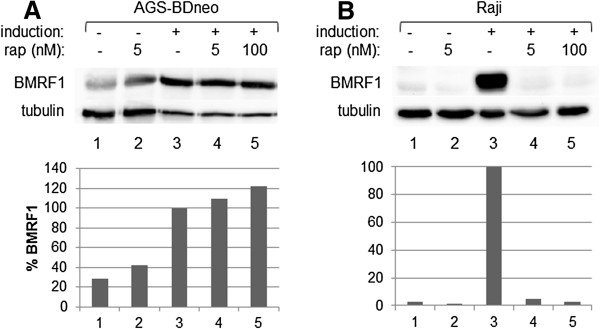
Higher doses of rapamycin are not effective in inhibiting EBV lytic replication in AGS-BDneo cells. A, AGS-BDneo cells, B, Raji cells. Cells were treated with rapamycin as indicated for 24 hr prior to the induction of lytic replication. Western blot analysis was performed with anti-BMRF1 and anti-tubulin antibodies. The BMRF1 levels were quantified and standardized to tubulin levels. The resulting BMRF1 protein levels are presented, relative to induced cells (with no rapamycin treatment).
Figure 4
Figure 4
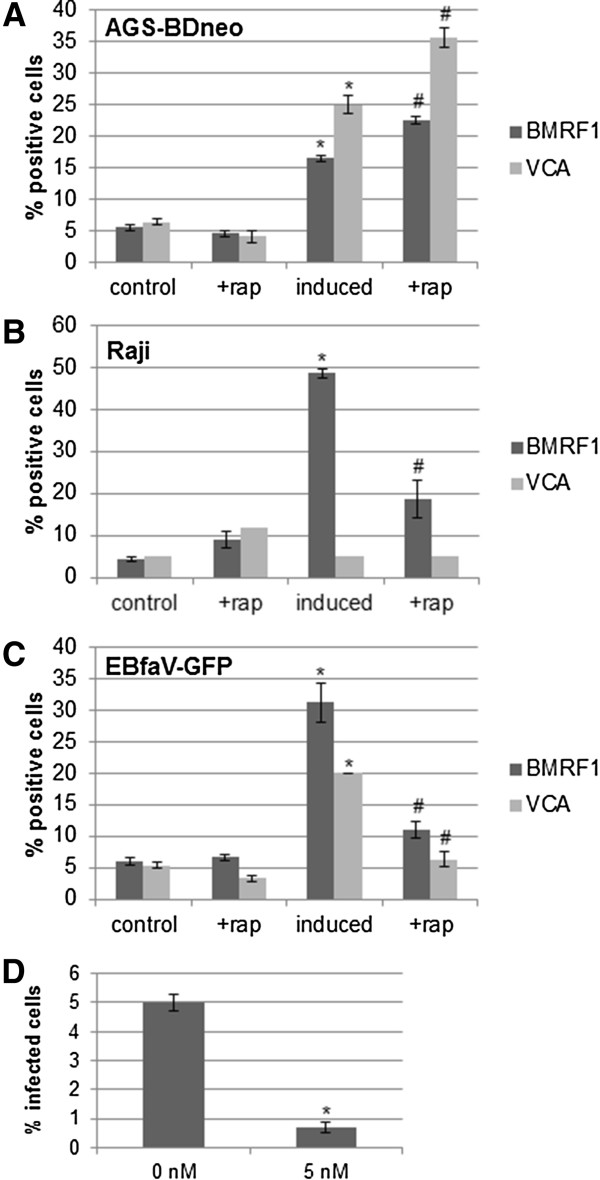
Inhibition of mTOR alters late lytic replication in EBV-positive cells. AGS-BDneo (A), Raji (B), and EBfaV-GFP (C) cells were left untreated or treated with 5 nM rapamycin for 24 hr prior to induction of lytic replication, as indicated. 48 hr post-infection cells were immunostained for BMRF1 or VCA, and the staining was analyzed by flow cytometry. The percent positive cells is presented. D. EBfaV-GFP cells were left untreated or treated with 5 nM rapamycin for 24 hr prior to induction of lytic replication, as indicated. 2 days post-induction the media from each condition was filtered and placed on Raji cells for 2 days. The number of resulting infected Raji cells was quantified, as judged by GFP, and the percent of infection presented. * = P < 0.05 relative to uninduced, untreated control cells; # = P < 0.05 relative to induced, untreated cells.
Figure 5
Figure 5
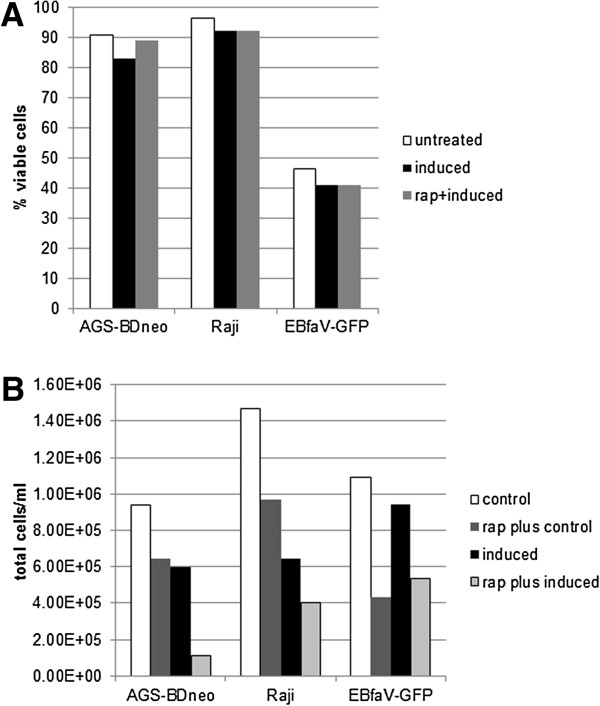
Rapamycin treatment does not alter EBV-positive cell viability, but does decrease cell proliferation. Raji, EBfaV-GFP, and AGS-BDneo cells were left untreated or treated with 5 nM rapamycin for 24 hr prior to induction of lytic replication, as indicated. 24 hr later the viability of cells and cell density were determined by flow cytometry. The percentage of viable cells is presented in A, the cell density (total cells/ml) is presented in B.
Figure 6
Figure 6
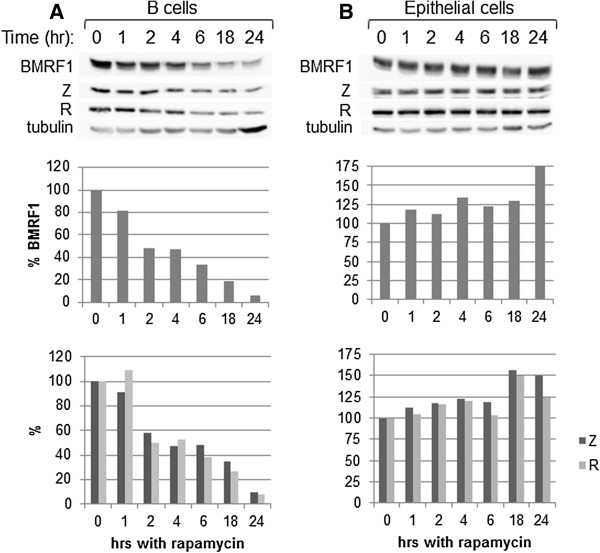
Shorter exposure times to rapamycin are not more effective at altering BMRF1 production in either B or epithelial cells. Raji (A) and D98/HR1 (B) cells were treated with 5 nM rapamycin for the times indicated prior to induction. The rapamycin-containing media was washed off the cells at time 0 (the time of induction). Two days post-induction proteins were harvested and Western blot analyses were performed with anti-BMRF1, anti-Z, anti-R, and anti-tubulin antibodies. The resulting bands were quantified and standardized to tubulin levels. Resulting BMRF1 protein levels (middle panels), and Z and R levels (lower panels) are presented, relative to 0 hr.
Figure 7
Figure 7
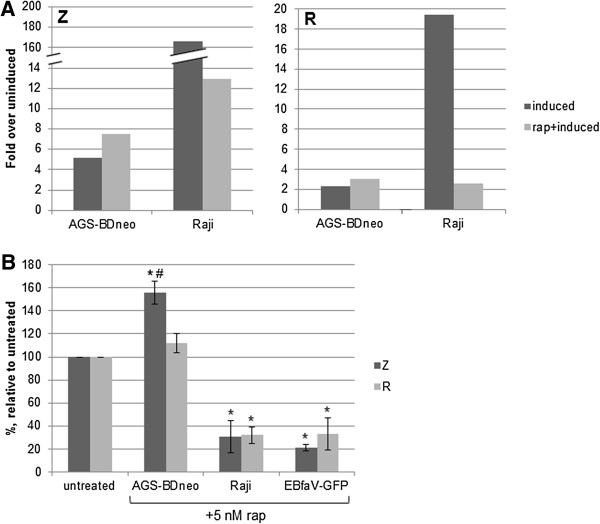
Z and R transcript and protein levels are altered by rapamycin treatment. Raji and AGS-BDneo cells were treated with 5 nM rapamycin for 24 hr prior to induction of lytic replication. A. Total RNA was isolated and qRT-PCR was performed with GAPDH (control)-, Z-, or R-specific primers, in triplicate. The mean fold expression over uninduced cells, standardized to GAPDH levels, is presented. B. Z and R protein levels from Western blots (in triplicate) were quantified and standardized to tubulin levels. The resulting Z and R protein levels from AGS-BDneo, Raji, and EBfaV-GFP cells are presented, relative to induced cells (with no rapamycin treatment). * = P < 0.05 relative to induced cells (with no rapamycin treatment); # = P < 0.05 relative to R levels within same cell type.
Figure 8
Figure 8
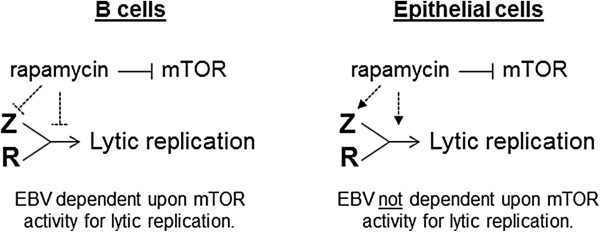
Model of rapamycin action upon EBV lytic replication.

References

    1. Kieff E, Rickinson AB. In: Field's Virology. Volume 2. 5. Knipe DM, Howley PM, editor. Philadelphia: Lippincott Williams & Wilkins; 2007. Epstein-Barr virus and its replication; pp. 2603–2654.
    1. Rickinson AB, Kieff E. In: Field's Virology. Volume 2. 5. Knipe DM, Howley PM, editor. Philadelphia: Lippincott Williams & Wilkins; 2007. Epstein-Barr virus; pp. 2655–2700.
    1. Adamson AL, Kenney S. The Epstein-Barr virus BZLF1 protein interacts physically and functionally with the histone acetylase CREB-binding protein. J Virol. 1999;73:6551–6558. - PMC - PubMed
    1. Swenson JJ, Holley-Guthrie E, Kenney SC. Epstein-Barr virus immediate-early protein BRLF1 interacts with CBP, promoting enhanced BRLF1 transactivation. J Virol. 2001;75:6228–6234. doi: 10.1128/JVI.75.13.6228-6234.2001. - DOI - PMC - PubMed
    1. Chang Y, Lee HH, Chen YT, Lu J, Wu SY, Chen CW, Takada K, Tsai CH. Induction of the early growth response 1 gene by Epstein-Barr virus lytic transactivator Zta. J Virol. 2006;80:7748–7755. doi: 10.1128/JVI.02608-05. - DOI - PMC - PubMed

MeSH terms

LinkOut - more resources