. 2014 Mar 19:4:321-7.
doi: 10.1016/j.fob.2014.03.007. eCollection 2014.

Mutation G805R in the transmembrane domain of the LDL receptor gene causes familial hypercholesterolemia by inducing ectodomain cleavage of the LDL receptor in the endoplasmic reticulum

Affiliations

Mutation G805R in the transmembrane domain of the LDL receptor gene causes familial hypercholesterolemia by inducing ectodomain cleavage of the LDL receptor in the endoplasmic reticulum

Thea Bismo Strøm et al. FEBS Open Bio. .

Abstract

More than 1700 mutations in the low density lipoprotein receptor (LDLR) gene have been found to cause familial hypercholesterolemia (FH). These are commonly divided into five classes based upon their effects on the structure and function of the LDLR. However, little is known about the mechanism by which mutations in the transmembrane domain of the LDLR gene cause FH. We have studied how the transmembrane mutation G805R affects the function of the LDLR. Based upon Western blot analyses of transfected HepG2 cells, mutation G805R reduced the amounts of the 120 kDa precursor LDLR in the endoplasmic reticulum. This led to reduced amounts of the mature 160 kDa LDLR at the cell surface. However, significant amounts of a secreted 140 kDa G805R-LDLR ectodomain fragment was observed in the culture media. Treatment of the cells with the metalloproteinase inhibitor batimastat largely restored the amounts of the 120 and 160 kDa forms in cell lysates, and prevented secretion of the 140 kDa ectodomain fragment. Together, these data indicate that a metalloproteinase cleaved the ectodomain of the 120 kDa precursor G805R-LDLR in the endoplasmic reticulum. It was the presence of the polar Arg805 and not the lack of Gly805 which led to ectodomain cleavage. Arg805 also prevented γ-secretase cleavage within the transmembrane domain. It is conceivable that introducing a charged residue within the hydrophobic membrane lipid bilayer, results in less efficient incorporation of the 120 kDa G805R-LDLR in the endoplasmic reticulum membrane and makes it a substrate for metalloproteinase cleavage.

Keywords: DAPT, N-(N-(3,5-difluorophenacetyl)-l-alanyl)-S-phenylglycine t-butyl ester; DiD, 1,1′-dioctadecyl-3,3,3′,3′-tetramethylindodicarbocyanine perchlorate; Endoplasmic reticulum; Familial hypercholesterolemia; LDL receptor; LDL, low density lipoprotein; LDLR, low density lipoprotein receptor; Metalloproteinase; Mutation; Transmembrane domain.


Figures
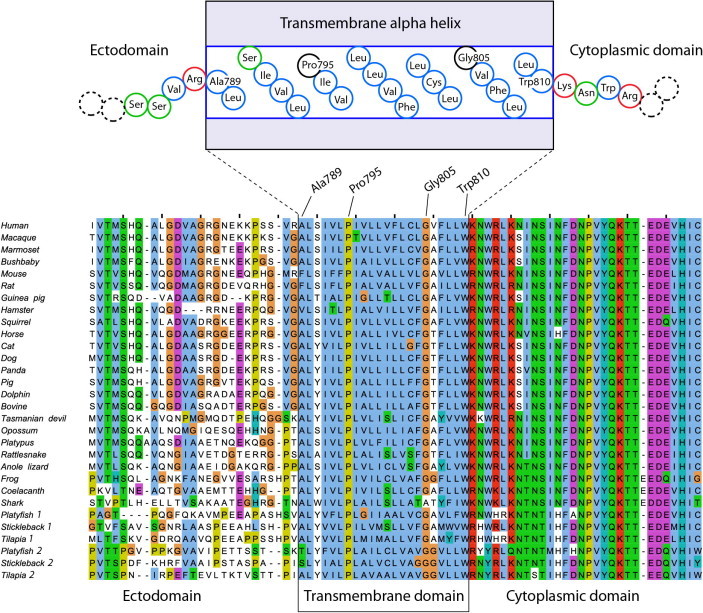
Fig. 1
Fig. 1
The LDLR transmembrane domain is devoid of residues with charged side chains. Multiple sequence alignment of the human LDLR (residues 764–839) and 29 vertebrate homologs shows a complete lack of charged residues in the transmembrane alpha helix passing through the membrane lipid bilayer. In the cartoon at the top, non-polar-aliphatic and aromatic residues are indicated by blue circles, the highly conserved Pro795 and Gly805 by black circles, basic residues by red circles, and polar, neutral residues by green circles. (For interpretation of the references to color in this figure legend, the reader is referred to the web version of this article.)
Fig. 2
Fig. 2
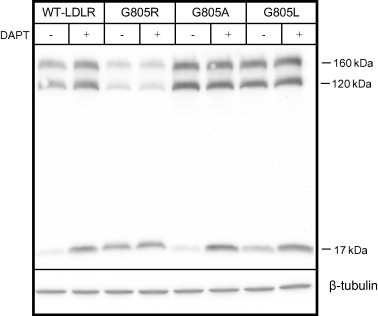
Effect of mutation G805R on the amount of precursor and mature G805R-LDLR. HepG2 cells were transiently transfected with the WT-LDLR plasmid or LDLR plasmids containing mutations G805R, G805A or G805L. The cells were cultured in the presence or absence of the γ-secretase inhibitor DAPT (10 μM). Cell lysates were subjected to Western blot analysis using an antibody against the C-terminal HA tag. The 160 kDa mature LDLR, the 120 kDa precursor LDLR and a C-terminal 17 kDa cleavage fragment are indicated. Beta-tubulin was used as a loading control. One representative of three separate experiments is shown.
Fig. 3
Fig. 3
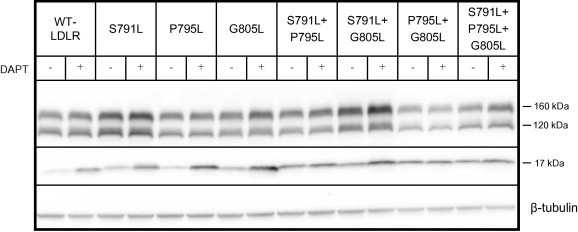
Effect of mutating the alpha helix-destabilizing residues Ser791, Pro795 and Gly805 on γ-secretase cleavage. HepG2 cells were transiently transfected with the WT-LDLR plasmid or plasmids containing one or more of the mutations S791L, P795L and G805R, as indicated. The cells were cultured in the presence or absence of the γ-secretase inhibitor DAPT (10 μM). Cell lysates were subjected to Western blot analysis using an antibody against the C-terminal HA tag. The 160 kDa mature LDLR, the 120 kDa precursor LDLR and a C-terminal 17 kDa cleavage fragment are indicated. Beta-tubulin was used as a loading control. One representative of three separate experiments is shown.
Fig. 4
Fig. 4
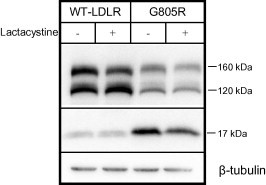
Effect of lactacystine on the amount of G805R-LDLR. HepG2 cells were transiently transfected with the WT-LDLR or the G805R-LDLR plasmids and the cells were cultured in the presence or absence of proteasome inhibitor lactacystine (10 μM). Cell lysates were subjected to Western blot analysis using an antibody against the C-terminal HA tag. The 160 kDa mature LDLR, the 120 kDa precursor LDLR and a C-terminal 17 kDa cleavage fragment are indicated. Beta-tubulin was used as a loading control. One representative of three separate experiments is shown.
Fig. 5
Fig. 5
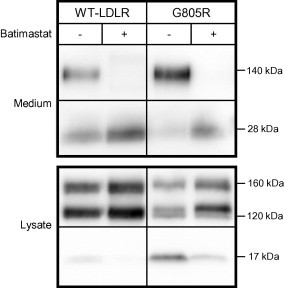
Effect of batimastat on the amount of G805R-LDLR. HepG2 cells were transiently transfected with the WT-LDLR or G805R-LDLR plasmids and the cells were cultured in the presence or absence of the metalloproteinase inhibitor batimastat (10 μM). Lysates and culture media were subjected to Western blot analysis. An antibody against the C-terminal HA tag was used to probe the lysates and an antibody against the ligand-binding domain was used to probe the media. In the media a 140 kDa ectdomain fragment and a 28 kDa fragment containing ligand-binding repeats 1–4 are shown. In the lysates the 160 kDa mature LDLR, the 120 kDa precursor LDLR and a C-terminal 17 kDa cleavage fragment are indicated. One representative of three separate experiments is shown.
Fig. 6
Fig. 6
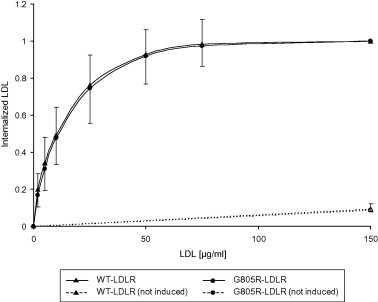
Internalization of DiD–LDL by the cell-surface G805R-LDLR. CHO T-REx cells stably transfected with the WT-LDLR plasmid or the G805R-LDLR plasmid were incubated with tetracycline (1 μg/ml) to induce the expression of the transgenes, and incubated with increasing concentrations of DiD–LDL for 2 h at 37 °C. The amount of internalized DiD–LDL was determined by flow cytometry. The amount of fluorescence detected after incubation with 150 μg/ml of DiD–LDL was given an arbitrary value of 1.0 for cells transfected with each of the plasmids. Mean (±SD) values from three separate experiments are shown. SD for the WT-LDLR is shown as upward symbols and SD for the G805R-LDLR is shown as downward symbols.
Fig. 7
Fig. 7
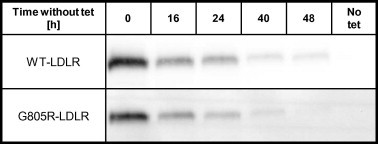
Stability of G805R-LDLR. CHO T-REx cells stably transfected with the WT-LDLR plasmid or the G805R-LDLR plasmid were incubated with tetracycline (tet) (1 μg/ml) to induce the expression of the transgenes. The media were removed and replaced with media without tetracycline and cultured for the indicated time intervals (h: hours), before Western blot analysis of cell lysates was performed using an antibody against the ligand-binding domain of the LDLR. Western blot of cells cultured in the absence of tetracycline to induce gene expression (No tet) was used as a control. One representative of three separate experiments is shown.

References

    1. Goldstein J.L., Hobbs H.H., Brown M.S. Familial hypercholesterolemia. In: Scriver C., Beaudet A.L., Sly W.S., Valle D., editors. The metabolic & molecular basis of inherited disease. McGraw-Hill; New York: 2001. pp. 2863–2914.
    1. Tolleshaug H., Goldstein J.L., Schneider W.J., Brown M.S. Posttranslational processing of the LDL receptor and its genetic disruption in familial hypercholesterolemia. Cell. 1982;30:715–724. - PubMed
    1. Brown M.S., Goldstein J.L. A receptor-mediated pathway for cholesterol homeostasis. Science. 1986;232:34–47. - PubMed
    1. Südhof T.C., Goldstein J.L., Brown M.S., Russell D.W. The LDL receptor gene: a mosaic of exons shared with different proteins. Science. 1985;228:815–822. - PMC - PubMed
    1. Hobbs H.H., Russell D.W., Brown M.S., Goldstein J.L. The LDL receptor locus in familial hypercholesterolemia: mutational analysis of a membrane protein. Annu. Rev. Genet. 1990;24:133–170. - PubMed