CPAP versus oxygen in obstructive sleep apnea
- PMID: 24918372
- PMCID: PMC4172401
- DOI: 10.1056/NEJMoa1306766
CPAP versus oxygen in obstructive sleep apnea
Abstract
Background: Obstructive sleep apnea is associated with hypertension, inflammation, and increased cardiovascular risk. Continuous positive airway pressure (CPAP) reduces blood pressure, but adherence is often suboptimal, and the benefit beyond management of conventional risk factors is uncertain. Since intermittent hypoxemia may underlie cardiovascular sequelae of sleep apnea, we evaluated the effects of nocturnal supplemental oxygen and CPAP on markers of cardiovascular risk.
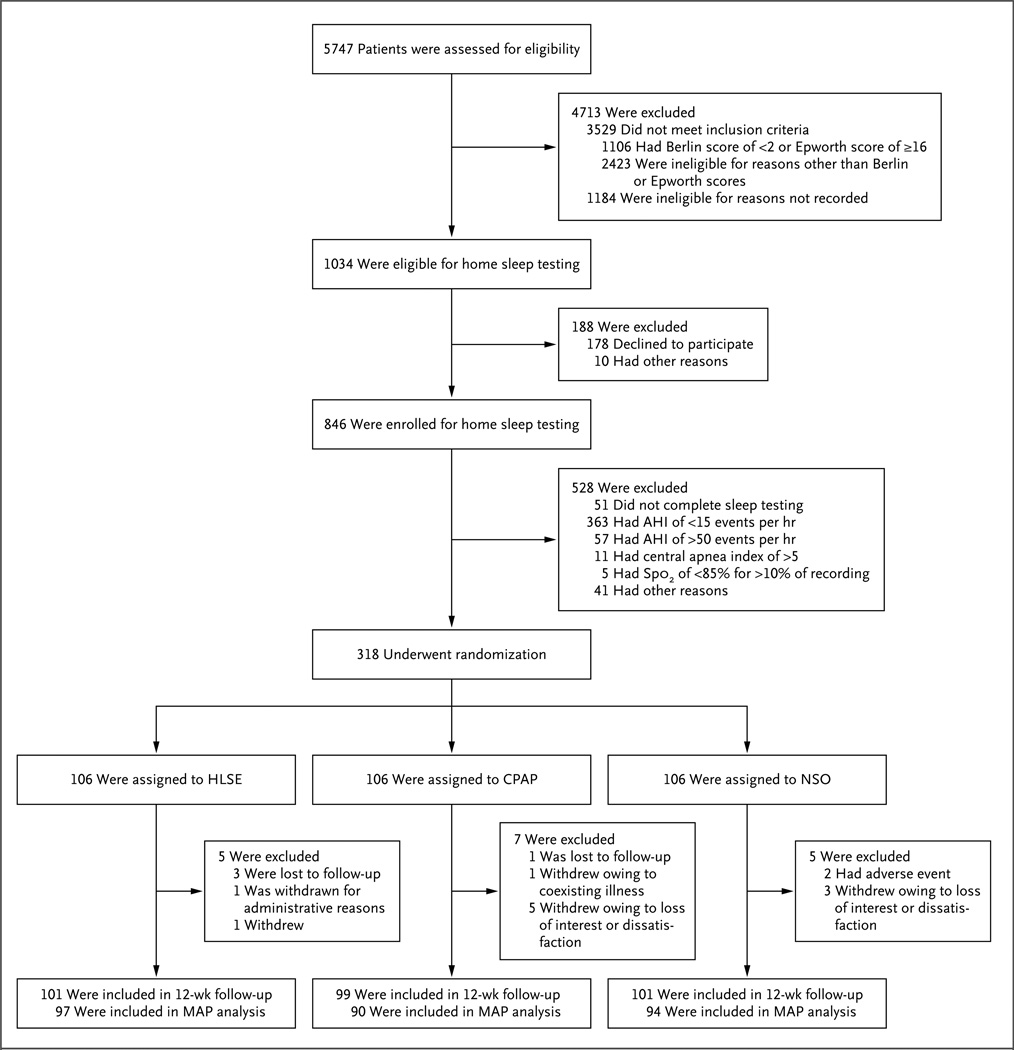
Methods: We conducted a randomized, controlled trial in which patients with cardiovascular disease or multiple cardiovascular risk factors were recruited from cardiology practices. Patients were screened for obstructive sleep apnea with the use of the Berlin questionnaire, and home sleep testing was used to establish the diagnosis. Participants with an apnea-hypopnea index of 15 to 50 events per hour were randomly assigned to receive education on sleep hygiene and healthy lifestyle alone (the control group) or, in addition to education, either CPAP or nocturnal supplemental oxygen. Cardiovascular risk was assessed at baseline and after 12 weeks of the study treatment. The primary outcome was 24-hour mean arterial pressure.
Results: Of 318 patients who underwent randomization, 281 (88%) could be evaluated for ambulatory blood pressure at both baseline and follow-up. On average, the 24-hour mean arterial pressure at 12 weeks was lower in the group receiving CPAP than in the control group (-2.4 mm Hg; 95% confidence interval [CI], -4.7 to -0.1; P=0.04) or the group receiving supplemental oxygen (-2.8 mm Hg; 95% CI, -5.1 to -0.5; P=0.02). There was no significant difference in the 24-hour mean arterial pressure between the control group and the group receiving oxygen. A sensitivity analysis performed with the use of multiple imputation approaches to assess the effect of missing data did not change the results of the primary analysis.
Conclusions: In patients with cardiovascular disease or multiple cardiovascular risk factors, the treatment of obstructive sleep apnea with CPAP, but not nocturnal supplemental oxygen, resulted in a significant reduction in blood pressure. (Funded by the National Heart, Lung, and Blood Institute and others; HeartBEAT ClinicalTrials.gov number, NCT01086800 .).
Figures
Comment in
-
Cardiovascular morbidity and obstructive sleep apnea.N Engl J Med. 2014 Jun 12;370(24):2339-41. doi: 10.1056/NEJMe1404501. N Engl J Med. 2014. PMID: 24918377 No abstract available.
-
Obesity: CPAP effects in sleep apnoea-what should be expected?Nat Rev Endocrinol. 2014 Sep;10(9):517-9. doi: 10.1038/nrendo.2014.131. Epub 2014 Aug 5. Nat Rev Endocrinol. 2014. PMID: 25091728
-
Commentary on CPAP vs. oxygen for treatment of OSA.J Clin Sleep Med. 2014 Nov 15;10(11):1257-9. doi: 10.5664/jcsm.4224. J Clin Sleep Med. 2014. PMID: 25325589 Free PMC article. No abstract available.
-
[Obstructive sleep apnea: CPAP versus oxygen: Heart Biomarker Evaluation in Apnea Treatment (HeartBEAT)].Internist (Berl). 2015 Feb;56(2):203-4. doi: 10.1007/s00108-014-3649-9. Internist (Berl). 2015. PMID: 25617001 German. No abstract available.
References
-
- Young T, Palta M, Dempsey J, Skatrud J, Weber S, Badr S. The occurrence of sleep-disordered breathing among middle-aged adults. N Engl J Med. 1993;328:1230–1235. - PubMed
-
- Nieto FJ, Young TB, Lind BK, et al. Association of sleep-disordered breathing, sleep apnea, and hypertension in a large community-based study: Sleep Heart Health Study. JAMA. 2000;283:1829–1836. [Erratum, JAMA 2002;288:1985.] - PubMed
-
- Peppard PE, Young T, Palta M, Skatrud J. Prospective study of the association between sleep-disordered breathing and hypertension. N Engl J Med. 2000;342:1378–1384. - PubMed
-
- Yaggi HK, Concato J, Kernan WN, Lichtman JH, Brass LM, Mohsenin V. Obstructive sleep apnea as a risk factor for stroke and death. N Engl J Med. 2005;353:2034–2041. - PubMed
Publication types
MeSH terms
Associated data
Grants and funding
LinkOut - more resources
Full Text Sources
Other Literature Sources
Medical